
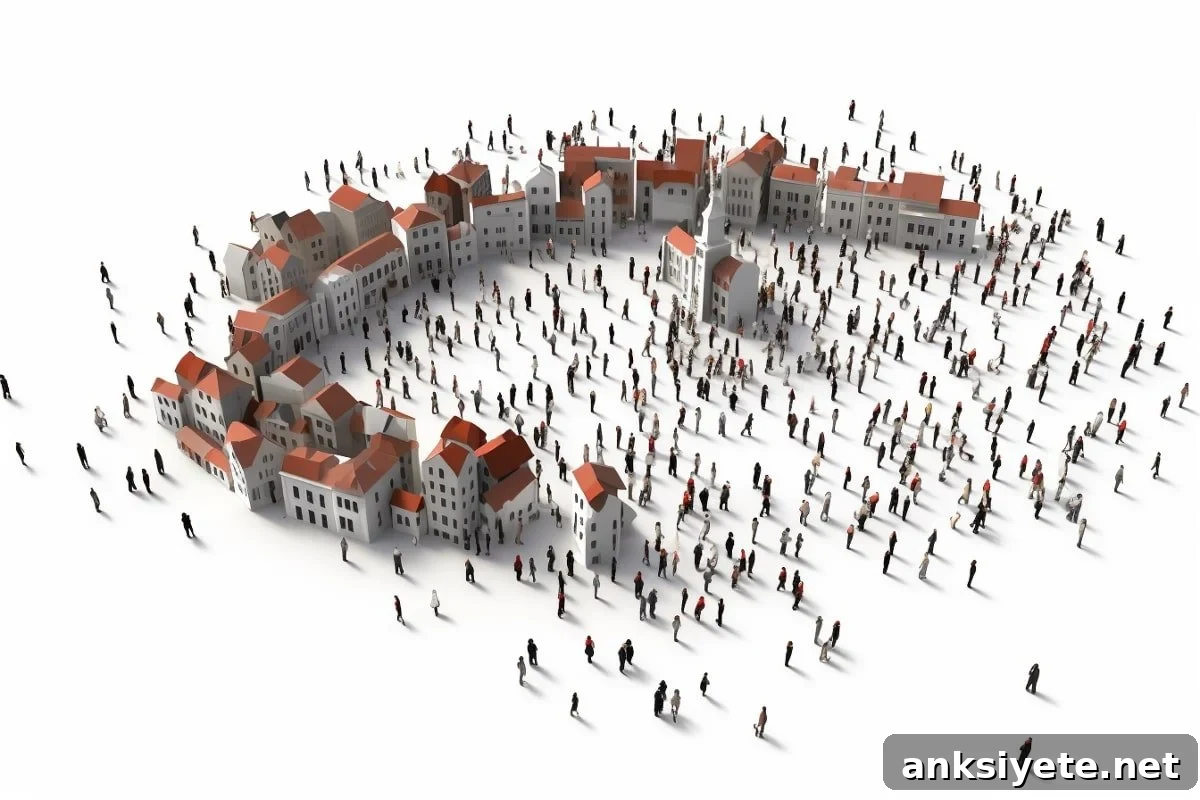
Summary: A new study finds that human crowd movement is most accurately predicted by a visual neighborhood model, which bases each person’s responses on what they actually see in their visual field.
Researchers tested human responses in both real and virtual crowd settings and report that a model grounded in visual information outperformed other common mathematical descriptions of local social interaction. This visual approach offers a more realistic account of how individual perception shapes collective motion.
These results have important implications for crowd management, public safety, and the development of simulation tools designed to prevent dangerous situations such as jams, crushing incidents, or stampedes. A visual neighborhood model can improve prediction accuracy and produce more lifelike crowd simulations.
Key facts:
- The study compared competing theories for how people influence one another in crowds—metric, topological, and visual neighborhoods—and found the visual model gave the best fit to experimental data.
- In dense gatherings, closer individuals can block the view of more distant people, which reduces or eliminates the influence of those distant neighbors on a person’s motion.
- Adopting a visual neighborhood framework can improve safety planning and make crowd simulations more faithful to real human perception and behavior.
Source: PNAS Nexus
Human crowd dynamics are best predicted by a visual neighborhood model based on each person’s visual field. Collective motion appears across many species—birds flock, fish school, and human crowds move together in coordinated patterns. Understanding the perceptual rules that govern human crowds can help prevent hazardous outcomes such as congestion and mass panic.
Traditionally, mathematical models of collective motion describe local interactions between individuals. One common framework, known as a metric model, assumes that a person responds to all neighbors within a fixed physical radius, using forces of attraction, repulsion, and velocity alignment to capture interactions.
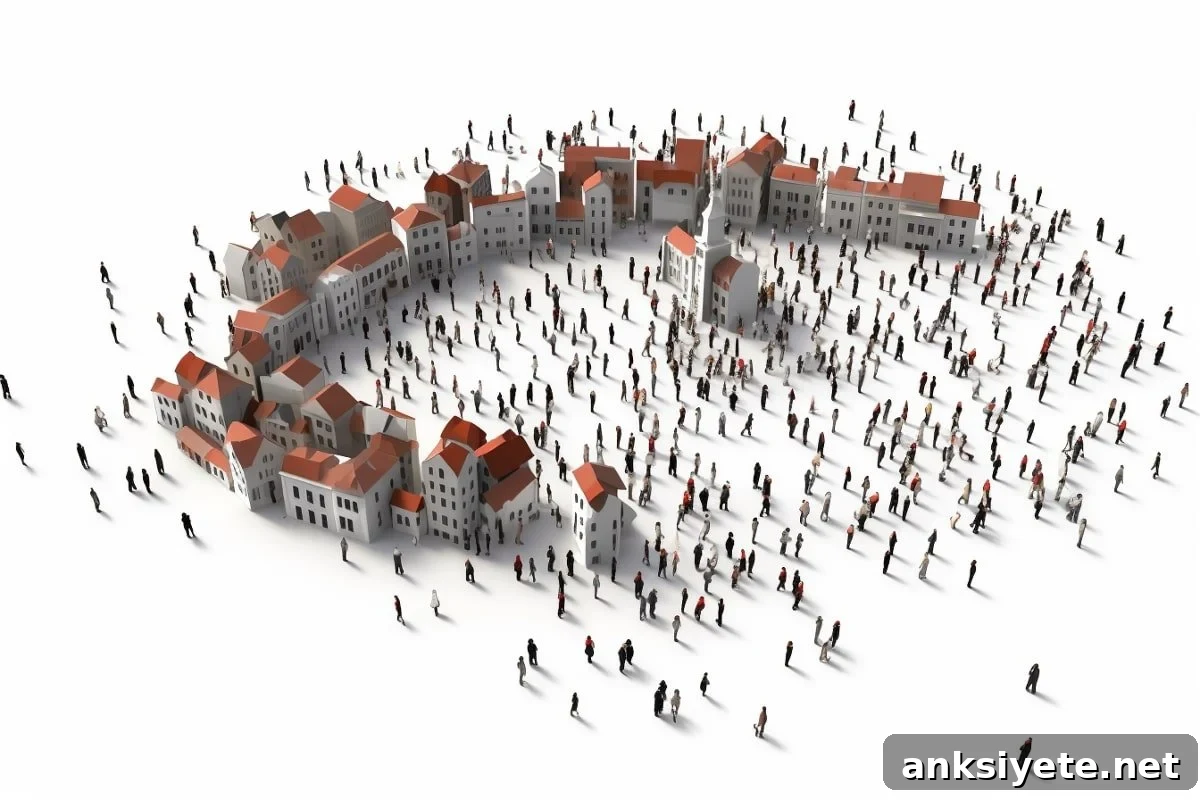
An alternative, the topological model, proposes that a person is influenced by a fixed number of nearest neighbors regardless of distance. Both metric and topological descriptions have been used to explain group coordination in animals and humans, but they rely on different assumptions about which neighbors matter.
To test these competing ideas, Trenton Wirth and colleagues ran controlled experiments in which participants walked amid real and virtual crowds with varying densities. The researchers altered the walking directions of selected neighbors and recorded how participants adjusted their heading in response.
The experimental results showed that a pure topological neighborhood does not account for the observed behavior. Data were better matched by a metric model than by a strictly topological one, but the most accurate predictions came from a visual neighborhood model. In that model, each individual’s responses are governed by the optical motions of the neighbors that are visible to them.
One important feature the visual model captures is occlusion: in dense crowds, people close to a focal individual can partially or completely block the line of sight to others, effectively removing those distant neighbors from the focal person’s set of perceptual inputs. This dynamic, arising naturally from the geometry of vision, influences how local interactions scale up to group-level motion.
By grounding interaction neighborhoods in perceptual information, the visual model combines elements of both metric and topological approaches while offering a principled explanation for when and why each type of behavior might appear. The authors emphasize that what has been observed previously as “metric” or “topological” behavior could emerge from the underlying visual constraints on perception.
Moving forward, applying a visual-neighborhood perspective promises more realistic simulations of pedestrian flow and better tools for crowd safety planning. Models that incorporate vision-based inputs can improve predictions of congestion points and the emergence of hazardous crowd conditions, helping planners design safer public spaces and more effective emergency responses.
About this neuroscience research news
Author: Trenton D. Wirth
Source: PNAS Nexus
Contact: Trenton D. Wirth – PNAS Nexus
Image: The image is credited to Neuroscience News
Original Research: Open access. “Is the neighborhood of interaction in human crowds topological, metric, or visual?” by Trenton D. Wirth et al., PNAS Nexus
Abstract
Is the neighborhood of interaction in human crowds topological, metric, or visual?
Global patterns of collective motion in bird flocks, fish schools, and human crowds are understood to arise from local interactions within a neighborhood of interaction—the zone in which an individual responds to neighbors. Both metric and topological neighborhoods have been reported in animal groups, but the structure of the neighborhood in human crowds had not been definitively settled.
Resolving this question matters for modeling crowd behavior and for predicting dangerous outcomes such as jams, crushes, and stampedes. In a metric neighborhood, an individual is influenced by all neighbors within a fixed radius. In a topological neighborhood, an individual responds to a fixed number of nearest neighbors regardless of distance. A third option, a visual neighborhood, posits that individuals are influenced by the optical motions of all visible neighbors.
To evaluate these hypotheses, participants walked in both real and virtual crowds while the experimenters manipulated crowd density and neighbor motions. The results rule out a pure topological neighborhood, show that a metric neighborhood approximates the data, but demonstrate that a visual neighborhood best explains the observed behavior. The study concludes that human interaction neighborhoods naturally follow from the laws of optics and suggests that previously reported metric and topological effects may be consequences of visual constraints.