
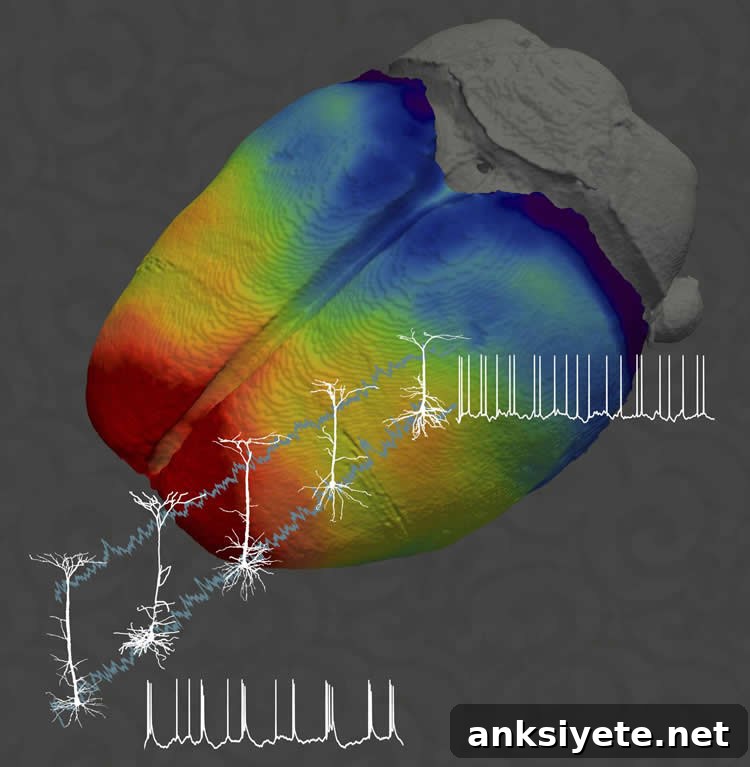
Summary: New research from the University of Queensland shows that variations in neocortical thickness change how individual neurons integrate and process information.
Source: University of Queensland
Researchers find cortical thickness shapes how neurons compute
Scientists at the Queensland Brain Institute (QBI), University of Queensland, report that the physical thickness of the neocortex influences both the anatomy and the electrical behavior of individual neurons. This discovery challenges long-standing assumptions that local cortical microcircuits operate in a uniform way across the brain and highlights a previously unrecognized diversity in neuronal computation tied to cortical topology.
The neocortex — the brain’s outer layer responsible for perception, action, and higher cognitive functions — is organized in repeating microcircuits. Each microcircuit contains thousands of neurons packed into a tiny area. A common assumption in neuroscience has been that these microcircuits follow similar rules everywhere: a given neuronal class would perform the same computations regardless of its cortical location. The new study tested that assumption by examining how neocortical thickness varies across the cortex and how that variation affects neuron structure and function.
Anatomical gradient in cortical thickness and neuron size
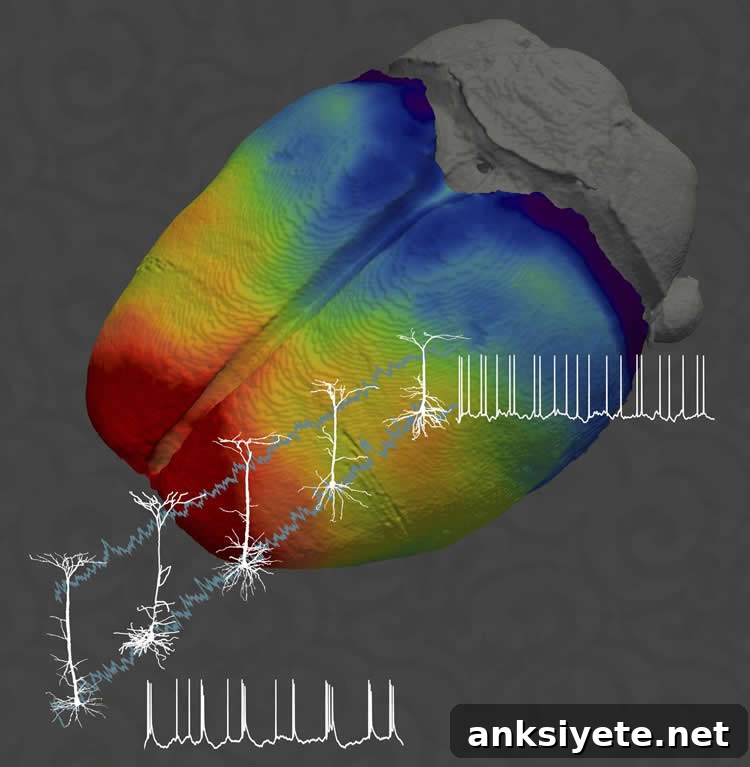
Using high-resolution MRI and detailed anatomical analyses in rodents, the researchers found a gradual, rostro-caudal gradient in cortical thickness: the cortex can be up to three times thicker in some frontal regions than in posterior regions. Even within a single functional area — for example the primary visual cortex — there are measurable differences in thickness across its extent. These variations in cortical thickness are accompanied by systematic changes in the size and shape of principal excitatory neurons (layer 5 pyramidal neurons): neurons located in thicker cortical regions tend to be longer and more extended than those in thinner regions.
An important functional distinction: one versus two integration zones
Neurons need to combine multiple streams of information to perform comparisons that support perception and action. The research highlights an essential cellular mechanism for such comparisons: many pyramidal neurons have distinct dendritic integration zones that separately receive inputs representing sensory signals and inputs representing internally generated predictions or models of the world. When these two integration zones interact, a single neuron can effectively compare sensory evidence against internal expectations.
Williams and Fletcher found that longer pyramidal neurons in thicker cortical regions retain this two-zone organization and thus can perform comparative integration of sensory and predictive inputs. In contrast, the shorter neurons found in thinner cortical regions lack this clear separation: they behave electrically as a single integration unit, combining inputs without the same capacity for local comparison. In other words, neurons in thin cortex integrate inputs differently and are less capable of performing the internal-versus-sensory comparisons that longer neurons can.
“One can perform comparative integration, the other can’t,” says the lead researcher, summarizing how the anatomical gradient maps onto distinct computational modes. The findings show that neocortical thickness governs not only neuronal morphology but also intrinsic electrical properties and computational capacity.
Functional implications and possible behavioral relevance
These differences in neuronal computation may reflect adaptive specializations across cortical space. The authors suggest a functional trade-off: computational flexibility versus processing speed. For example, parts of the visual cortex that monitor overhead visual space — the area most relevant for detecting predators in rodents — are thinner and populated by shorter, fast-operating neurons. These neurons may act as high-speed detectors that convert input into immediate action potentials with minimal internal comparison, enabling rapid, instinctive reactions to looming threats. By contrast, thicker cortical areas housing longer neurons could support more sophisticated comparisons between sensory data and internal models, useful for nuanced perception and decision-making.
Overall, the study proposes that the neocortex is not a uniform array of identical microcircuits but rather a patchwork of computationally diverse modules shaped by cortical topology. This perspective has implications for theories of cortical computation and for understanding how network-level processes arise from cellular differences across the cortical mantle.
Next steps
Future research will need to link these cellular and anatomical differences to behavior and cognition directly: how do the distinct neural computations contributed by thin versus thick cortical regions affect perception, learning, and action? Understanding how networks composed of these diverse circuit elements coordinate may reveal new principles of brain function and evolution.
Institution: Queensland Brain Institute, University of Queensland
Reporting: University of Queensland
Image credit: Fletcher / Queensland Brain Institute
Original research: “Neocortical Topology Governs the Dendritic Integrative Capacity of Layer 5 Pyramidal Neurons” by Lee N. Fletcher and Stephen R. Williams, published in Neuron (2018). This study documents how gradients in cortical thickness across primary visual cortex correlate with changes in neuronal anatomy, intracellular resistivity, and the emergence of active dendritic computations.
Abstract (summary)
The structure of the neocortex varies across the cortical mantle and governs the physical size of principal neurons. This study demonstrates that neocortical thickness determines anatomical, electrophysiological, and computational properties of layer 5 pyramidal neurons within a functionally defined cortical area. Across the rostro-caudal axis of rat primary visual cortex, thickness and pyramidal neuron size change as a gradient. Combined somato-dendritic recordings and computational modeling show that electrical architecture is not preserved uniformly: site-dependent differences in intracellular resistivity amplify an electrical gradient in layer 5B neurons that influences the emergence of active dendritic computations. These results reveal a close relationship between neocortical structure and neuronal computation.