
Caltech researchers identify neural circuit that drives stress-induced anxiety
More than 18 percent of American adults experience anxiety disorders, according to the National Institute of Mental Health. These disorders involve excessive worry or tension and often produce physical symptoms. While much anxiety research has focused on the amygdala, a Caltech research team has turned attention to the lateral septum (LS), a different brain region that appears to play a direct role in generating anxiety after stress. Using mouse models, the investigators mapped a circuit connecting the LS with hypothalamic structures and showed how that circuit increases anxiety and stress hormones.
New perspective on the lateral septum and anxiety
David Anderson, the Seymour Benzer Professor of Biology at Caltech and corresponding author, summarizes the work: the study identifies a neural pathway that causally promotes anxiety states. Understanding the specific circuits that generate anxiety is essential for developing targeted therapies, Anderson says, because current treatments are limited by an incomplete map of how anxiety is produced and sustained in the brain.
The team, led by senior research fellow Todd Anthony, focused on the septohippocampal axis because previous studies had shown activity in the lateral septum during stress-induced anxious behavior. The key question was whether LS activation reflects a mechanism that suppresses anxiety (a brake) or one that promotes it. Contrary to the prevailing view that LS outputs dampen anxiety, the Caltech experiments revealed that activation of a genetically defined subset of LS neurons actually increases anxiety.
Optogenetic activation produces persistent anxiety
Using optogenetics to selectively stimulate LS neurons in mice, researchers found that activation produced immediate anxiety-like behavior. Remarkably, even brief, transient activation induced a prolonged anxious state that persisted for at least 30 minutes after stimulation ended. This suggests these LS neurons not only trigger anxiety but can set off a sustained state that outlasts their direct activation.
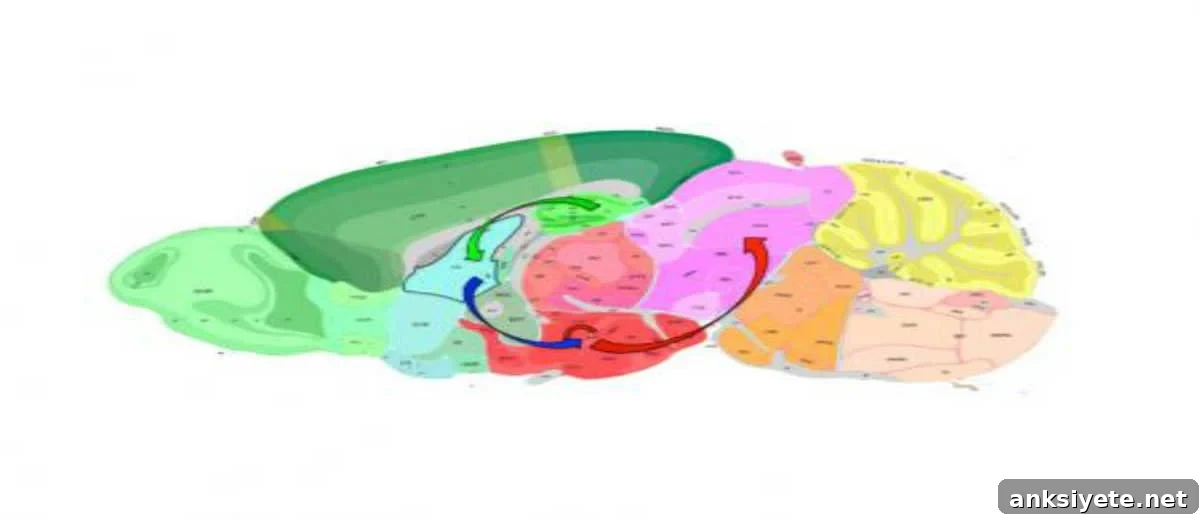
Intriguingly, the neurons in question are inhibitory cells. Normally, activating inhibitory neurons would be expected to reduce activity elsewhere in the brain, so the team sought to explain how inhibition could lead to increased anxiety. Their anatomical and functional mapping uncovered a double-inhibitory, or disinhibitory, pathway: inhibitory LS neurons suppress inhibitory neurons in the nearby hypothalamus. Those hypothalamic inhibitory neurons normally inhibit the paraventricular nucleus (PVN), a region known to orchestrate stress hormone release. In effect, inhibiting an inhibitor releases the PVN from suppression, increasing stress-system output.
Hormonal evidence supports the disinhibition model
To test whether LS activation engages the stress hormone system, the researchers measured circulating stress hormones following optogenetic stimulation. LS activation raised stress hormone levels, consistent with disinhibition of the PVN. Conversely, blocking LS projections to the hypothalamus reduced the cortisol response to stress. Together, these results support the model that LS outputs can elevate physiological stress responses by disinhibiting hypothalamic circuits that drive the PVN.
Implications for therapeutic strategies
These findings change the sign of how LS outputs are understood: rather than acting as a brake on anxiety, the identified LS pathway promotes anxiety. That distinction matters for drug discovery. If LS outputs had suppressed anxiety, therapeutic approaches might aim to activate them; instead, reducing activity in this LS circuit may be the appropriate strategy to lower stress-induced anxiety.
Anderson cautions that translating these basic neuroscience insights into human therapies will take time. The work provides a clearer circuit-level target for future research, but practical treatments remain years away. Still, mapping how defined populations of neurons contribute to anxiety gives researchers direction for rational drug or neuromodulation strategies aimed at psychiatric disorders.
Next steps and broader significance
The Caltech team plans to further map this brain region and dissect the circuit with greater cellular and molecular detail to understand how stress-induced anxiety is initiated and maintained. The study opens many new questions about how different cell types, projections, and neuromodulators interact to produce persistent anxious states.
“It may seem like we’ve examined just a small piece of circuitry,” Anderson said, “but that piece is a foothold on a much larger problem. Detailed circuit maps are the starting point for climbing that mountain.”
Study details and credits
The results appear in the journal Cell in a paper titled “Control of Stress-Induced Persistent Anxiety by an Extra-Amygdala Septohypothalamic Circuit.” Lead authors include Todd E. Anthony, with contributions from Walter Lerchner, Nick Dee, Amy Bernard, Nathaniel Heintz, and David J. Anderson. The research received support from the National Institutes of Health, the Howard Hughes Medical Institute, and the Beckman Institute at Caltech.
Author: Katie Neith
Affiliation: California Institute of Technology
Keywords: lateral septum, septohippocampal axis, anxiety, stress, optogenetics, paraventricular nucleus, PVN, cortisol, neural circuitry, Caltech
#neuroscience #anxiety #optogenetics