
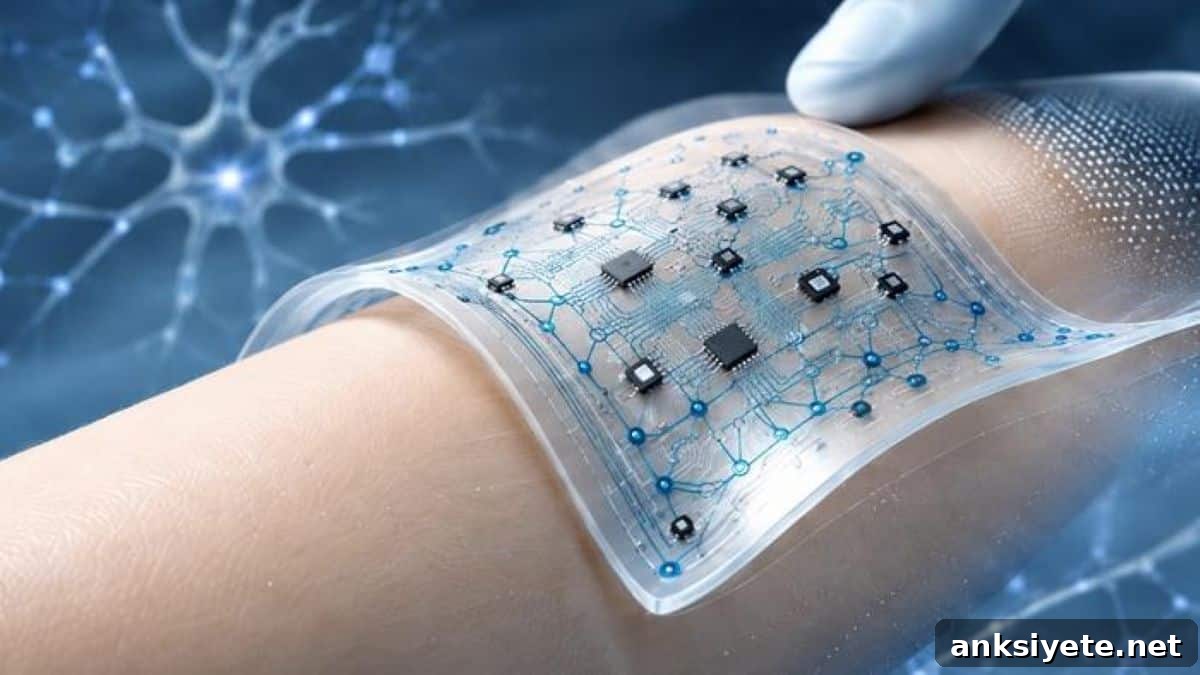
Summary: A recent review traces a major shift in bioelectronics: moving from rigid silicon microchips to intrinsically soft, brain-inspired computing networks. For decades, the mismatch between stiff silicon devices and the flexible surfaces of human organs has caused tissue damage, device delamination, and premature failure.
By developing malleable polymers and fluid ionogels that use organic mixed ionic-electronic conduction, researchers have built stretchable neuromorphic circuits that conform to biological tissues while reproducing the chemical signaling and synaptic plasticity of the human brain.
Key Facts
- The silicon–tissue mismatch: Directly integrating artificial intelligence processors with the human body—for continuous health monitoring or advanced prosthetics—has been limited by the rigidity of silicon chips. When mounted on moving organs or muscles, stiff devices can scrape tissue, delaminate, and fail mechanically.
- Organic ionic–electronic conduction: Instead of relying solely on electron flow through rigid metal traces, soft neuromorphic devices emulate brain-like chemistry. Their active layers behave like microscopic sponges that absorb and release charged ions from the surrounding environment, enabling reversible reconfiguration of circuits.
- Biological synaptic behavior: The coupled motion of ions and electrons lets a single soft transistor reproduce synaptic plasticity—the mechanism by which biological neurons strengthen or weaken connections during learning and forgetting.
- High mechanical resilience: Recent materials advances enable stretchable components to operate after elongations up to 140% of their original length. That mechanical range exceeds typical skin elasticity and allows placement over joints and other highly mobile body regions.
- Ultra-low voltage operation: Mimicking biochemical processes rather than using brute-force currents, these devices perform demanding tasks—such as heart-rhythm classification—at voltages below 0.5 V. Lower power reduces heat and improves safety for continuous contact with organs.
- Monolithic soft printing: New manufacturing approaches print networks in a single elastomeric sheet that combines sensing, memory, and processing. This eliminates complex assembly of rigid elements on flexible backings and enables responsive electronic skins and soft robotic limbs that locally interpret touch and motion.
- Island–bridge hybrid designs: Because many soft memory elements lose stored information quickly after stimulation, practical designs pair rigid, strain-protected “islands” that host durable memory elements with highly stretchable, coiled “bridges” that connect them. This hybrid strategy balances permanent storage with overall compliance.
Source: International Journal of Extreme Manufacturing
Why integration has been difficult
Traditional AI processors are typically built on rigid silicon. When affixed to beating hearts, lungs, or flexing muscles, that rigidity creates shear forces at the skin or organ interface, leading to inflammation, loss of adhesion, and device failure. Soft, deformable electronics address this fundamental mechanical mismatch.
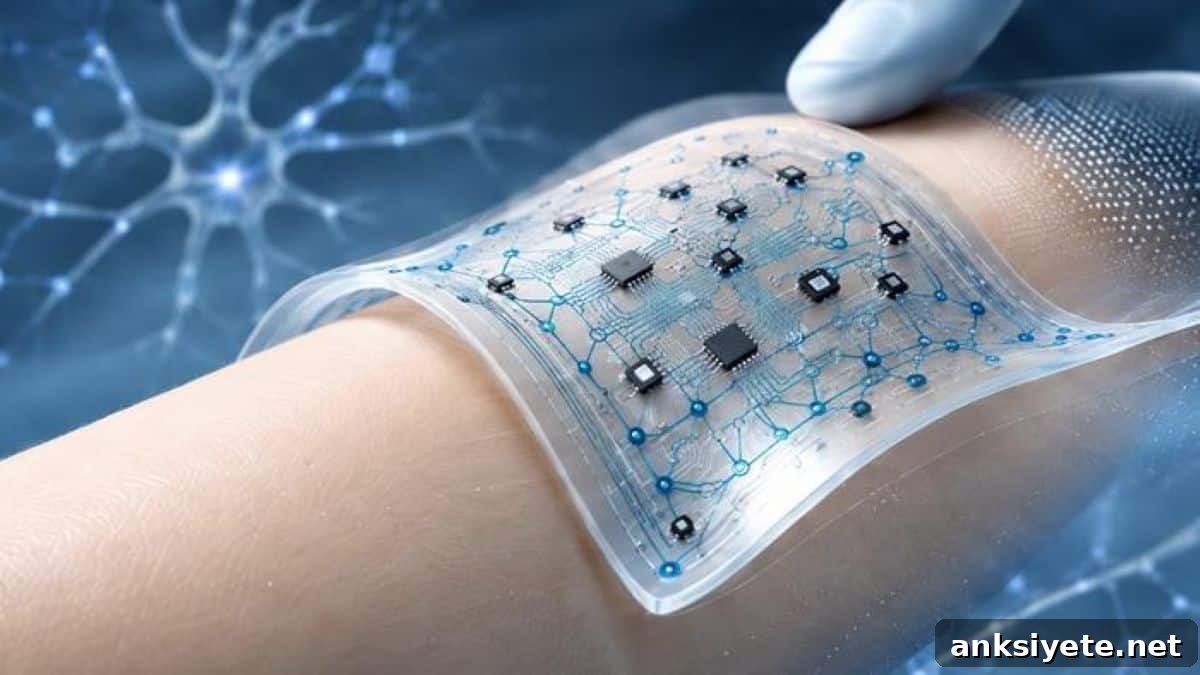
A review in the International Journal of Extreme Manufacturing summarizes how rigid architectures are giving way to soft, neuromorphic electronics that can sense, store, and process information while mechanically conforming to tissues. Using intrinsically soft materials—malleable polymers, conductive elastomers, and ion-rich gels—these systems remain functional under direct stretch and deformation.
Organic mixed ionic–electronic conduction is central to that transition. Active layers take up or release ions from adjacent media, adjusting local conductivity and effective circuit connections. This chemistry-driven mechanism enables adaptive responses and memory-like behavior without depending on stiff metallic interconnects.
Because ionic motion accomplishes much of the work, devices can compute using very low voltages, staying cooler and safer when worn or implanted. Early demonstrations show complex classification tasks, such as distinguishing cardiac rhythms, can be performed with millivolt-to-sub-volt supplies.
Manufacturing transforms as well: rather than assembling discrete rigid sensors and chips on flexible substrates, manufacturers can printed monolithic soft networks that integrate sensing, computation, and storage in a single elastomeric fabric. The result is more robust, more responsive wearable electronics and soft robots that process information locally.
Key engineering challenges remain. Many soft memory materials exhibit volatile retention, losing stored signals soon after stimulation. To overcome this, current development emphasizes island–bridge layouts that preserve nonvolatile elements on tiny, rigid islands while maintaining overall stretchability through elastic interconnects.
Combining these structural strategies with chemically stable, biocompatible materials creates a practical pathway for moving stretchable neuromorphic systems from laboratory demonstrations toward reliable human integration.
Key Questions Answered:
A: Conventional silicon chips are rigid. When affixed to dynamic organs, they can abrade tissue, cause local injury, lose adhesion, and ultimately break from repeated mechanical stress.
A: Soft transistors use organic mixed ionic–electronic conduction. They absorb and release ions from their surroundings, which modulates internal conduction paths and connection strength—functionally mirroring synaptic plasticity.
A: An island–bridge architecture protects permanent memory elements on small rigid “islands” while interconnecting them with stretchable, coiled “bridges.” This hybrid layout keeps data retention reliable without sacrificing mechanical compliance.
Editorial Notes:
- Edited by a Neuroscience News editor.
- The referenced journal paper was reviewed in full.
- Additional context was provided by editorial staff.
About this neurotech research news
Author: Yue YAO
Source: International Journal of Extreme Manufacturing
Contact: Yue YAO – International Journal of Extreme Manufacturing
Image credit: Tianda Fu, Ruizhe Yang, Max Weires, Junyi Yin, Yifan Liao and Yifan Guo
Original Research: Open access. “Stretchable neuromorphic electronics for future human-integrated intelligence” by Tianda Fu, Ruizhe Yang, Max Weires, Junyi Yin, Yifan Liao and Yifan Guo. International Journal of Extreme Manufacturing
DOI: 10.1088/2631-7990/ae5004
Abstract
Stretchable neuromorphic electronics for future human-integrated intelligence
Neuromorphic electronics replicate key computational principles of biological neural systems, offering low-power, adaptive, and parallel signal processing suited for next-generation intelligent devices. When combined with stretchable platforms, neuromorphic devices achieve the mechanical compliance required to interface with soft, dynamic biological environments, enabling new applications in wearable computing, bioelectronic skins, and implantable artificial intelligence.
This review summarizes recent progress in stretchable neuromorphic electronics, including device architectures, material strategies, underlying neuromorphic mechanisms, and emerging applications. It also addresses remaining challenges and proposes research directions to improve performance, integration, and clinical translation. The goal is to guide co-design of materials, devices, and systems toward autonomous, skin-conformal neuromorphic intelligence suitable for long-term human integration.