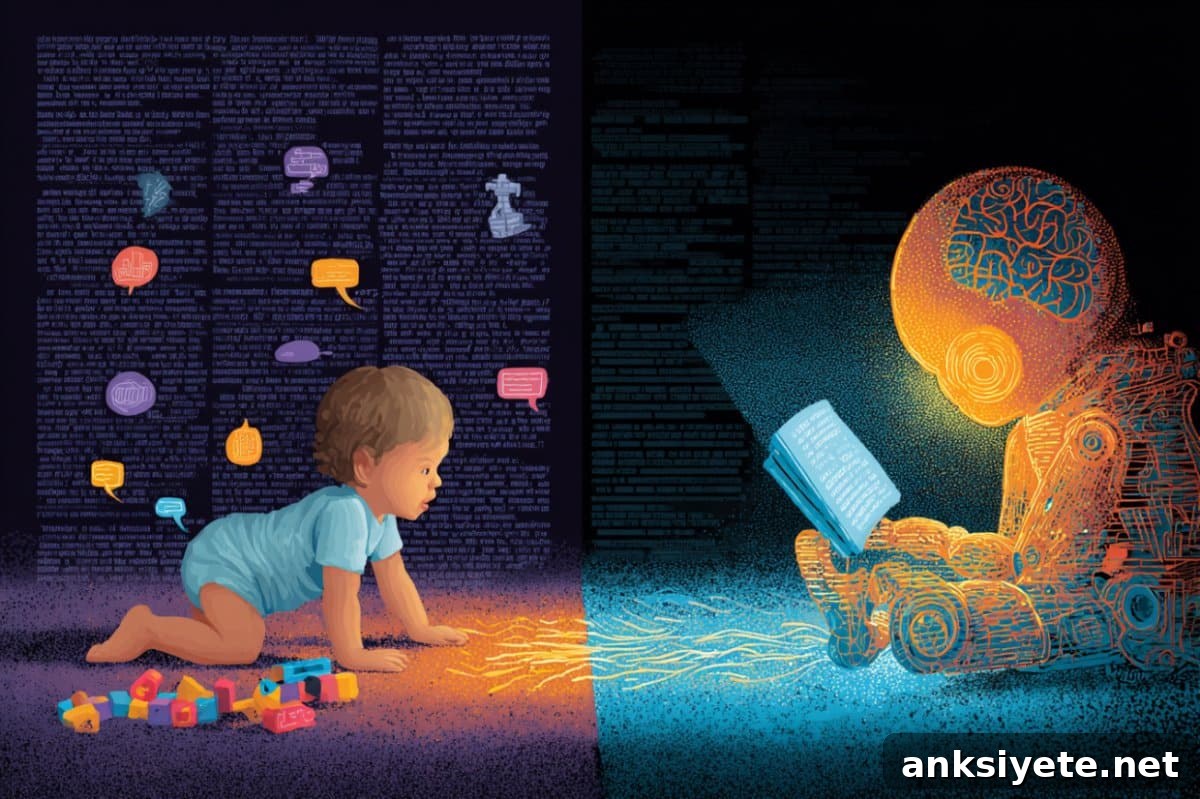
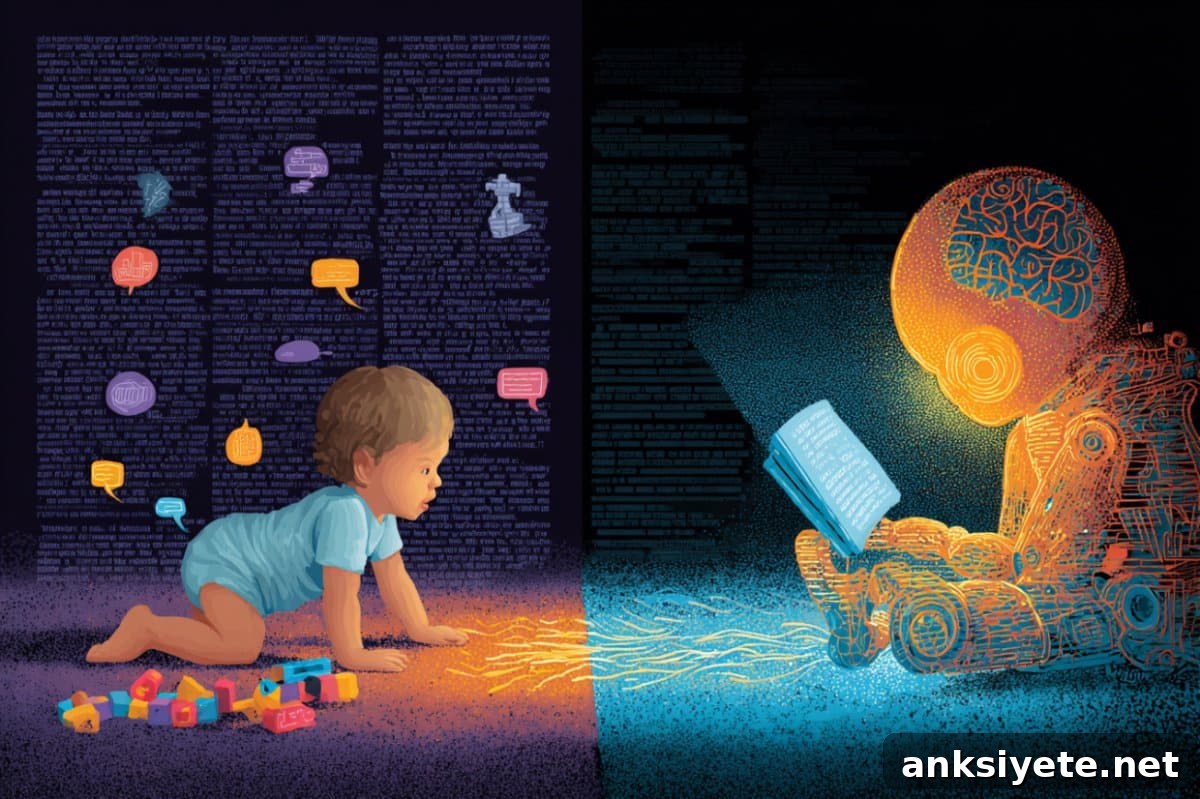
Summary: Despite the enormous processing power of modern AI, young children still outperform machines when it comes to learning language. A new constructivist framework helps explain why: unlike AI systems that learn mainly from vast amounts of passive text, children learn through multisensory exploration, social interaction, and self-driven curiosity.
Children’s language development is active, embodied, and closely tied to their motor, cognitive, and emotional growth. These insights reshape our understanding of early childhood learning and point to directions for building AI systems that learn more like humans.
Key Facts:
- Embodied learning: Children combine sight, sound, movement, and touch to construct language in a richly interactive environment.
- Active exploration: Infants and toddlers generate learning opportunities by reaching, crawling, pointing, and experimenting with objects and people.
- AI vs. human learning: Current AI models primarily process static data streams; children continuously adapt their learning in real-time social and sensory contexts.
Source: Max Planck Institute
Even the smartest machines can’t match young minds at language learning. Researchers explain how children stay ahead of AI—and why it matters.
If a human were to learn language at the same rate as a system like ChatGPT, it would take roughly 92,000 years. Machines can analyze massive datasets at high speed, but when it comes to acquiring natural language in everyday settings, children still learn far more quickly and flexibly.
A new paper in Trends in Cognitive Sciences, led by Professor Caroline Rowland of the Max Planck Institute for Psycholinguistics together with colleagues at the ESRC LuCiD Centre (UK), presents a constructivist framework that clarifies how children achieve rapid and robust language learning.
An explosion of new technology
Recent advances in research tools—such as head-mounted eye-tracking, wearable sensors, and AI-assisted speech recognition—allow scientists to observe children’s interactions with caregivers and the world at unprecedented resolution. These methods provide rich streams of multimodal data about what children see, hear, touch, and attend to in real time.
However, data collection has outpaced theory: researchers have amassed detailed observations but lacked a unified explanatory model for how sensory and social experiences translate into fluent language. The new framework seeks to fill that theoretical gap by synthesizing evidence from computational science, linguistics, neuroscience, and developmental psychology.
Children vs. ChatGPT: What’s the difference?
A core distinction lies in how learning is organized. Most large AI systems learn from static text corpora or isolated transcripts; they detect statistical patterns in symbols but lack the embodied, goal-directed, and socially situated experiences that shape human learning. Children, in contrast, learn within dynamic developmental trajectories: their motor abilities, attention, memory, and social motivation change rapidly and influence what they learn and how.
Children receive tightly coordinated, multimodal cues—visual, auditory, tactile—that converge on the same referents and events. They also create learning opportunities themselves: a child who points at a toy solicits a label from an adult; a baby who crawls toward a new object increases their exposure to relevant language. This active, exploratory behavior structures the input children receive, making it more informative than raw text alone.
“AI systems process data … but children really live it,” Rowland explains. “Their learning is embodied, interactive, and embedded in social and sensory contexts. They seek out experiences and dynamically adapt their behavior—exploring objects with hands and mouths, moving toward novel stimuli, or pointing to share attention. Those embodied actions and social dynamics are key to how quickly and effectively children master language.”
Broader implications
Understanding why children outperform AI has implications beyond early development. The constructivist perspective can inform AI research by emphasizing active, sensorimotor, and socially informed learning mechanisms. It also raises questions about adult language processing and the evolutionary pathways that made human language learning so efficient and flexible.
Rowland and colleagues suggest that if AI is to approach human-like language acquisition, designers might need to rethink architectures and training regimes—incorporating embodied interaction, multimodal grounding, and self-directed exploration rather than relying solely on massive passive datasets.
About this neurodevelopment and AI language learning research news
Author: Anniek Corporaal
Source: Max Planck Institute
Contact: Anniek Corporaal – Max Planck Institute
Image: The image is credited to Neuroscience News
Original Research: Open access.
“Brains over Bots: Why Toddlers Still Beat AI at Learning Language” by Caroline Rowland et al., Trends in Cognitive Sciences
Abstract
Brains over Bots: Why Toddlers Still Beat AI at Learning Language
Explaining how children build a language system is a central goal of research in language acquisition, with broad implications for language evolution, adult language processing, and artificial intelligence (AI). The authors propose a constructivist framework for future theory-building in language acquisition that emphasizes how children construct linguistic knowledge from embodied, social, and sensory experience.
The framework outlines four core components of constructivism and draws on cross-disciplinary evidence to show how such a perspective can explain developmental change. Adopting this approach offers plausible answers to long-standing questions—such as how children derive structured linguistic representations from variable input—and it also generates new research questions about how children adapt to different cultural and linguistic environments.