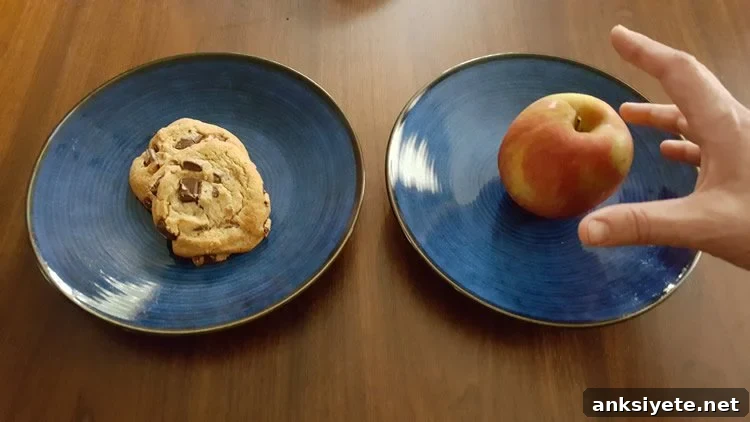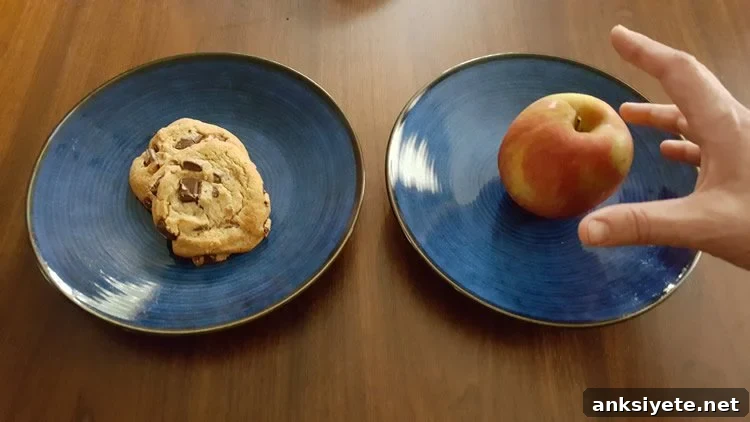
Summary: A new study suggests that subtle movements of the hand can reveal whether someone is leaning toward self-discipline or giving in to temptation even before a final decision is made. The findings offer fresh insight into how real-time cognitive processes unfold when people resist immediate rewards for longer-term goals.
Source: Ohio State University.
Study shows decision-making in real time.
Deciding between a cookie and an apple can take only a few seconds, yet those moments reveal more than a final choice. Researchers tracked the movement of participants’ hands as they made choices and found that the path a hand takes toward an option can reveal the internal tug-of-war between immediate temptation and long-term goals.
In a laboratory task, participants moved a computer cursor from a start position to select between two food images displayed at the top corners of the screen: one healthy item and one indulgent treat. Although participants were asked to choose the option that best supported their health and fitness goals, the hand trajectories often betrayed the conflict underlying that choice.
When a person’s cursor veered toward the unhealthy option before selecting the healthy food, that person was later more likely to choose a candy bar over an apple when given a free choice—an indicator of lower self-control. Conversely, participants whose cursor moved more directly toward the healthy item tended to show higher self-control in their later choices.
“Hand movements reveal the process of exercising self-control,” said Paul Stillman, co-author of the study and a postdoctoral researcher in psychology. “You can see the conflict as it happens: for some people, temptation literally draws their hand closer to the less healthy choice.”
The study was led by researchers at Ohio State University in collaboration with colleagues from Cornell University. Their work appears in the journal Psychological Science and represents a methodological shift toward using continuous behavioral measures—like mouse tracking—to study the dynamics of decision-making and self-control.
One experiment involved 81 college students who completed 100 trials, each presenting a healthy and an unhealthy food image. Participants clicked a “Start” button, which made the two food images appear simultaneously in the upper left and upper right of the screen. They were instructed to choose as quickly as possible the food that would best help them meet their health goals, creating a clear “correct” answer for each trial even if temptation favored the other option.
Participants were told they would receive one of the foods selected in the experiment, but at the end of the session they were allowed to choose freely between an apple and a candy bar. Those who ultimately selected the candy bar tended to have cursor trajectories that drifted closer to the unhealthy images during the task, signaling a stronger pull toward temptation.
Similar patterns emerged in additional experiments that used monetary choices instead of food. In those tasks, students chose between a smaller amount of money available immediately ($25 today) and a larger amount available later ($45 in 180 days). Again, participants with lower self-control showed mouse trajectories that reflected greater real-time conflict compared with participants who exhibited higher self-control.
These continuous measures of decision dynamics can serve as a powerful new tool for researchers studying impulse control, willpower, and how competing goals are resolved in the moment. Rather than relying solely on final choices or self-report, mouse-tracking reveals the unfolding competition between options as decisions are being formed.
Mapping the cursor trajectories also bears on a larger debate about how self-control operates in the brain. Some theories propose two distinct systems: an impulsive system that initially drives behavior toward tempting options and a separate system that later overrides those impulses. If that dual-systems model were correct, trajectories would often start straight toward the tempting option and then abruptly change direction when the self-control system engaged.
What the researchers observed instead were smoothly curved trajectories that suggest both the tempting and goal-directed options compete from the start. “Our results point to a more dynamic process where choices compete continuously rather than switching abruptly between separate systems,” Stillman explained. The curvature in the movement indicates simultaneous influence rather than a sudden override.
Ultimately, this approach helps illuminate how cognitive processes unfold in real time to enable—or fail to enable—resistance to temptation. Continuous behavioral measures such as mouse-tracking can reveal subtle indicators of self-control that are invisible in endpoint choices alone.
Source: Paul Stillman — Ohio State University
Image source: NeuroscienceNews.com image credited to Jeff Grabmeier.
Original research: Study published in Psychological Science.
Ohio State University. “Your Hands May Reveal the Struggle to Maintain Self Control.” Neuroscience News. 7 July 2017.