
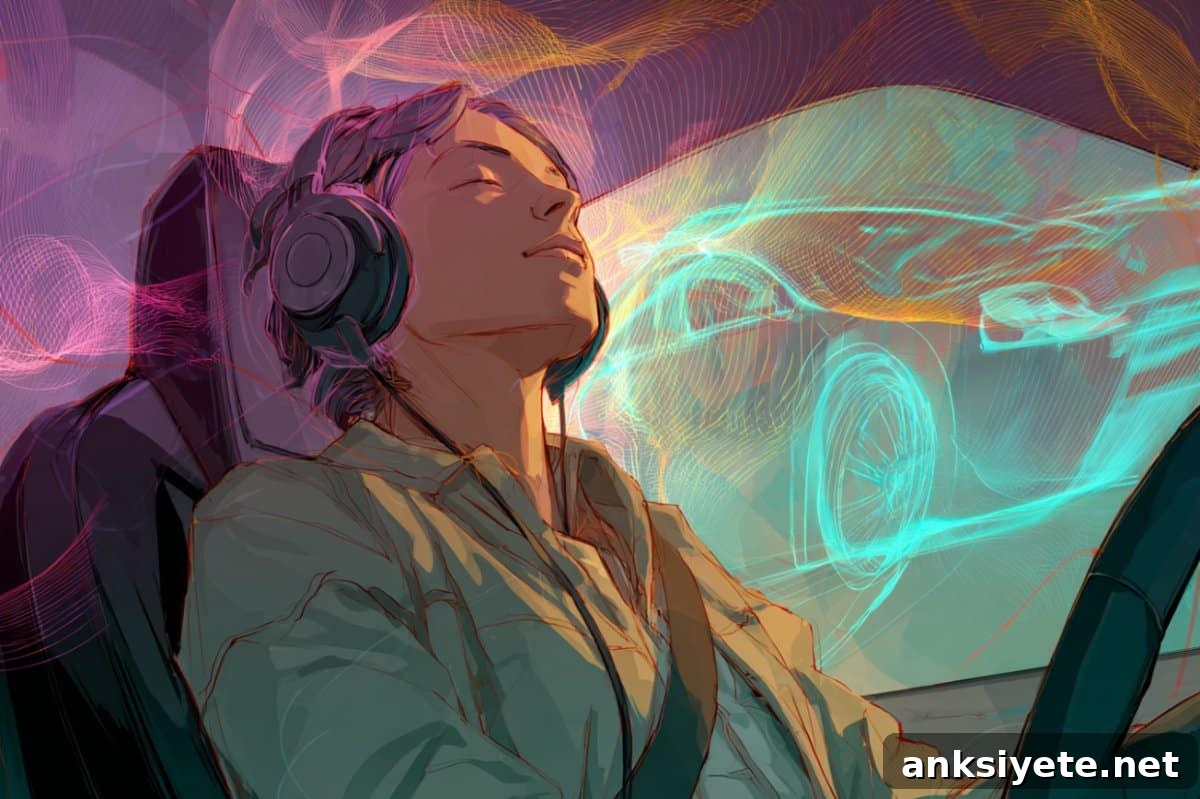
Summary: Researchers using a calibrated driving simulator found that different types of music can meaningfully influence recovery from motion sickness. Participants who listened to joyful or soft music experienced the largest reductions in symptoms, while sad music slowed recovery compared with doing nothing. Electroencephalogram (EEG) recordings revealed brain activity changes associated with symptoms, suggesting music affects both emotional state and neural processes. These findings point to music as a low-cost, non-invasive approach to ease travel-related discomfort.
EEG measures linked specific changes in occipital lobe activity with reported severity of motion sickness, and activity tended to return toward baseline as symptoms diminished. The study suggests personalized music interventions — particularly cheerful or gentle tracks — could be a practical strategy for managing motion sickness during car, air, or sea travel.
Key Facts
- Most effective relief: Joyful music reduced symptoms by 57.3% and soft music by 56.7% on average.
- Brain patterns: EEG showed lower complexity in the occipital lobe during peak carsickness, which normalized as recovery progressed.
- Unexpected result: Sad music produced less symptom relief (40%) than the no-music control group (43.3%), suggesting it may amplify negative emotions and slow recovery.
Source: Frontiers
Overview
Motion sickness commonly disrupts travel experiences and can be aggravated by anxiety and muscle tension. Because music can reduce stress and shift attention, researchers led by Dr Qizong Yue at Southwest University, China, tested whether different music types aid recovery from carsickness and whether EEG can provide objective signals that track symptom changes.
Study design and participants
The team first developed a driving-simulator route that reliably induced motion sickness. They screened volunteers for prior susceptibility and selected 30 participants who reported moderate past carsickness. Participants wore EEG caps to record brain activity while they completed a driving task designed to provoke symptoms.
Participants were assigned to six groups: four music intervention groups (joyful, sad, stirring/passionate, and soft), one no-music control group that recovered naturally, and one comparative group whose simulators were stopped before they became nauseous to provide baseline EEG contrasts. Baseline EEGs were recorded while participants sat quietly. After the driving task, each music group listened to a 60-second music clip and then reported their symptoms.
Results: symptom relief and EEG markers
Joyful and soft music delivered the strongest symptomatic relief, reducing self-reported carsickness by 57.3% and 56.7%, respectively. Passionate music produced a moderate improvement (48.3%). In contrast, sad music provided only a 40% reduction — slightly worse than the control group’s natural recovery of 43.3%.
EEG analyses showed that motion sickness correlated with decreased signal complexity in the occipital lobe. As participants recovered, occipital EEG complexity rose toward baseline levels, and the degree of signal normalization corresponded with participants’ reported symptom improvement. The researchers used time- and frequency-domain EEG features and classification algorithms to build a model that identified motion sickness states from brain signals.
Interpretation
The authors propose two plausible mechanisms: soft music may reduce muscular tension and anxiety that contribute to nausea, while joyful music may redirect attention and activate brain reward circuits that mitigate discomfort. Conversely, sad music can intensify negative feelings and slow the recovery process. The EEG results support a neural correlate of these subjective experiences, particularly in occipital brain regions involved in processing visual and sensory mismatch signals implicated in motion sickness.
Limitations and future directions
The researchers caution that the study’s modest sample size limits statistical power and generalizability. They call for larger studies to validate EEG complexity as a robust marker of motion sickness and to refine music-based interventions. Future work should also test effects in real-world travel situations — cars, planes, and boats — and examine how personal music preferences influence effectiveness.
“Music represents a non-invasive, low-cost, and personalized intervention strategy,” said Dr Qizong Yue. Based on these findings, travelers experiencing motion sickness may benefit from listening to cheerful or gentle music to speed recovery.
About this neuroscience and motion sickness research news
Author: Angharad Brewer Gillham
Source: Frontiers
Contact: Angharad Brewer Gillham – Frontiers
Image: The image is credited to Neuroscience News
Original Research: Open access.
“A study on the mitigating effect of different music types on motion sickness based on EEG analysis” by Qizong Yue et al., Frontiers in Human Neuroscience.
Abstract
A study on the mitigating effect of different music types on motion sickness based on EEG analysis
Introduction: Motion sickness commonly produces negative emotions such as tension that can trigger dizziness, nausea, and an unpleasant travel experience. Previous research indicates music can reduce negative emotions, but evidence is limited on how different music types quantitatively affect motion sickness.
Methods: EEG data were recorded from 30 participants in a simulated driving environment. The researchers constructed a motion-sickness recognition model using time- and frequency-domain EEG features (mean, variance, skewness, kurtosis, power spectral density) combined with classification algorithms. The model enabled evaluation of four music interventions (joyful, sad, stirring/passionate, and soft) against a control condition of natural recovery.
Results: Soft and joyful music produced the greatest average symptom reductions (56.7% and 57.3%, respectively), followed by passionate music (48.3%) and sad music (40%). The control group’s natural recovery averaged 43.3%. EEG Kolmogorov-Chaitin complexity in the occipital region was significantly negatively correlated with motion-sickness grade (r = −0.625, p < 0.005), indicating reduced occipital complexity during peak symptoms.
Discussion: Personalized music interventions show promise for alleviating motion sickness, improving passenger comfort and the overall travel experience. Further research with larger samples and real-world travel conditions is needed to validate EEG markers and to tailor music interventions to individual preferences.