
Summary: Researchers have identified amyloid fibrils in frontotemporal lobar degeneration (FTLD) that are composed not of the expected TDP-43 protein but of TMEM106B, a less-studied lysosomal membrane protein. This discovery shifts attention toward TMEM106B as a potential driver of FTLD pathology.
Source: UCLA
For years, scientists have associated amyloid fibrils — long, rope-like assemblies of protein molecules — with neurodegenerative diseases such as Alzheimer’s and Parkinson’s. These fibrils often correlate with disease progression and neuronal damage.
Now, researchers at UCLA report the presence of amyloid fibrils in brains affected by frontotemporal lobar degeneration (FTLD). Unexpectedly, the fibrils are composed of TMEM106B, a protein that until recently received little attention in the context of FTLD.
The study, published in Nature, focuses on FTLD-TDP, a subtype of FTLD characterized neuropathologically by dense, spherical aggregates in neurons that stain for TDP-43. Because TDP-43 has been central to the FTLD-TDP classification, the research team anticipated that any amyloid fibrils in these brains would be formed from TDP-43. Instead, high-resolution structural analysis revealed TMEM106B as the main fibril component.
UCLA molecular biology graduate student Yi Xiao (Sean) Jiang and postdoctoral fellow Qin Cao, working in the laboratory of Professor David Eisenberg, extracted fibrils from frozen brain tissue samples supplied by the Mayo Clinic. Using cryogenic electron microscopy (cryo-EM) and complementary bioinformatics analyses performed by Michael Sawaya, the team determined the fibrils’ molecular structure and identified TMEM106B — transmembrane protein 106B — as the constituent protein.
Although TMEM106B has been linked to FTLD risk through genetic studies conducted a decade ago, its direct structural involvement in disease was previously unknown, said senior author David Eisenberg, the Paul D. Boyer Professor of Molecular Biology at UCLA and a Howard Hughes Medical Institute investigator.
Structural insights: TMEM106B forms complex amyloid folds
Pathological amyloid deposits are implicated in more than 50 degenerative conditions, and structural studies over the past two decades have shown that many amyloid fibrils are built from protein strands that interlock like a zipper. TMEM106B fibrils follow this principle but exhibit a more intricate architecture.
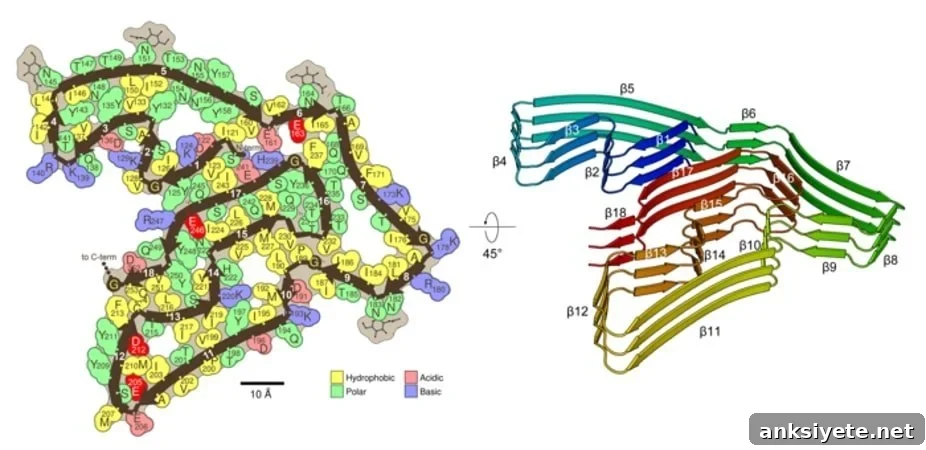
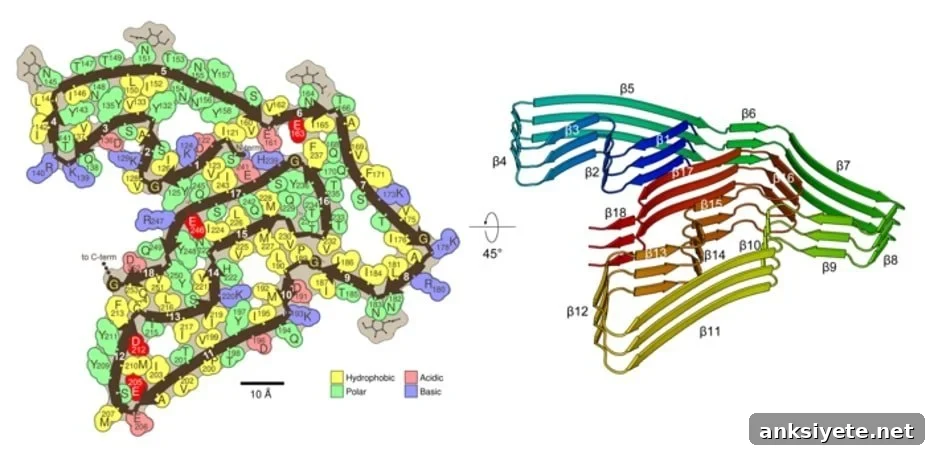
The cryo-EM structures reveal TMEM106B chains folded into a repeating unit with 18 straight segments. The researchers liken this arrangement to the 18 fairways of a golf course, where the first and the 18th are positioned near each other — hence the description “golf course–like fold.” Thousands of these folded layers stack to produce the long fibrils observed in affected brain tissue, a pattern that echoes the stacked, layered nature of amyloid fibrils in Alzheimer’s and Parkinson’s disease.
Importantly, the team also detected abundant, non-fibrillar aggregated TDP-43 in the same samples, demonstrated through immunogold labeling. This indicates that while TDP-43 pathology remains a hallmark of FTLD-TDP, the amyloid component in these cases appears to be TMEM106B rather than TDP-43 itself.
Whether TMEM106B fibrils actively drive neurodegeneration in FTLD-TDP or represent a downstream consequence of other pathological processes is not yet established. The relationship between TMEM106B fibrillization and TDP-43 aggregation remains an important open question: future research will need to determine if these protein pathologies interact mechanistically or represent parallel disease features.
“If TMEM106B proves to be a causal factor in FTLD, knowledge of its atomic structure will be invaluable for therapeutic design,” Eisenberg said. At minimum, the discovery highlights TMEM106B as a new biologically relevant target for researchers studying neurodegeneration and FTLD in particular.
Co-authors from UCLA include Romany Abskharon, Peng Ge, Janine Fu, Rachel Ogorzalek and Joseph Loo. Michael DeTure and Dennis Dickson of the Mayo Clinic in Jacksonville, Florida, provided patient tissues and performed neuropathological analyses. Lead author Qin Cao now leads an independent laboratory at Shanghai Jiao Tong University.
Funding: The research received support from the National Institute on Aging (part of the National Institutes of Health) and the Howard Hughes Medical Institute.
About this frontotemporal lobar degeneration research news
Author: Stuart Wolpert
Source: UCLA
Contact: Stuart Wolpert – UCLA
Image: Image credited to Yi Xiao Jiang, et al.
Original Research: Closed access. “Amyloid fibrils in disease FTLD-TDP are composed of TMEM106B not TDP-43” by Yi Xiao Jiang, et al. Nature.
Abstract
Amyloid fibrils in disease FTLD-TDP are composed of TMEM106B not TDP-43
Frontotemporal lobar degeneration (FTLD) is a common neurodegenerative disorder that typically presents in middle-aged adults with changes in behavior or progressive language decline. The FTLD-TDP subtype is defined clinically and pathologically by inclusions that are immunoreactive for the RNA-binding protein TDP-43.
In this study, researchers extracted amyloid fibrils from the brains of four patients covering multiple FTLD-TDP subclasses and solved their near-atomic structures using cryo-EM. Unexpectedly, the amyloid fibrils in all samples were formed from a 135-residue C-terminal fragment of TMEM106B, a lysosomal membrane protein previously implicated by genetic studies as a risk factor for FTLD-TDP.
Alongside TMEM106B fibrils, abundant non-fibrillar TDP-43 aggregates were detected by immunogold labeling. These observations indicate that FTLD-TDP involves amyloid formation, but the amyloid component is composed of TMEM106B rather than TDP-43, suggesting a revised focus for structural and mechanistic studies of FTLD-TDP.