Summary: KNT-127 reduced anxiety-like behaviors in mice, researchers report.
Source: Tokyo University of Science
Anxiety is a normal response to stress, but when it becomes excessive and persistent it can develop into an anxiety disorder—causing debilitating fear, worry, and impaired daily function for many people.
Although current treatments, including selective serotonin reuptake inhibitors, help many patients, anxiety disorders remain complex and incompletely understood. Researchers continue to investigate alternative targets and mechanisms that could yield new, effective therapies.
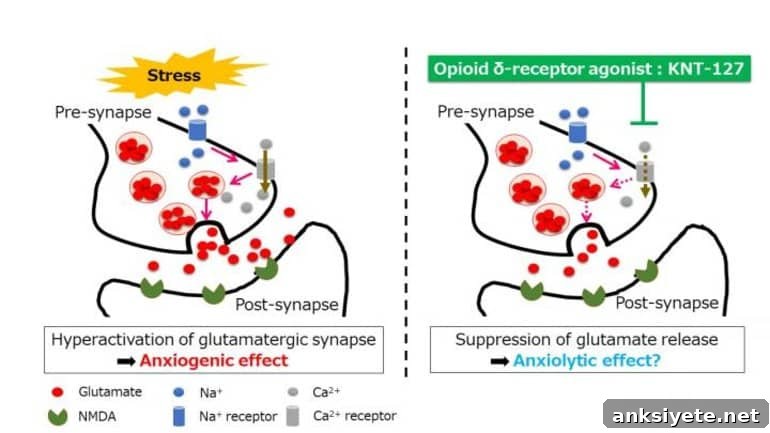
In recent work from teams at Tokyo University of Science and the University of Tsukuba, scientists explored the effects of a drug candidate called KNT-127. KNT-127 is a selective agonist of delta opioid receptors (DOP), and earlier studies showed that it reduced anxiety-like behavior in mice. The group then examined how KNT-127 affects glutamate signaling in a brain region known to regulate emotional responses.
Their focus was the prelimbic subregion of the medial prefrontal cortex (PL-PFC), which plays a central role in processing emotional events. Prior evidence indicates that enhanced glutamatergic transmission in the PL-PFC can provoke anxiety-like behavior in rodents. The new study, published in Biochemical and Biophysical Research Communications, aimed to clarify whether KNT-127 reduces glutamate release and neuronal excitability in this specific circuit, thereby producing anxiolytic effects.
Using whole-cell patch-clamp electrophysiology on individual PL-PFC principal neurons in mice, the researchers measured spontaneous and electrically evoked excitatory postsynaptic currents (EPSCs). They compared synaptic activity in brain slices treated with KNT-127 to untreated controls, and they examined both spontaneous and miniature EPSCs as well as paired-pulse responses to assess presynaptic release probability.
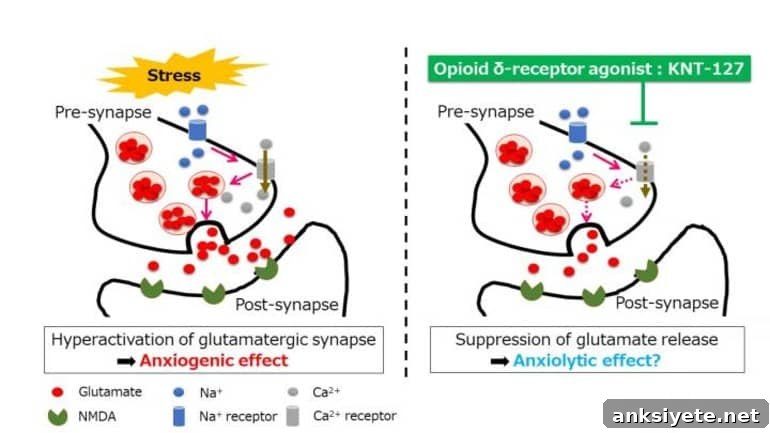
The key findings were consistent and specific: KNT-127 significantly decreased the frequency of both spontaneous and miniature EPSCs in PL-PFC neurons, without altering their amplitude, rise time, or decay time. An increase in paired-pulse ratio of electrically evoked EPSCs further supported a presynaptic effect—indicating that KNT-127 reduces the probability of glutamate release from presynaptic terminals rather than changing postsynaptic receptor responsiveness.
Beyond synaptic transmission, the investigators evaluated intrinsic neuronal excitability. KNT-127 treatment lowered the number of action potentials fired by pyramidal neurons and altered firing thresholds, indicating that the compound also makes PL-PFC neurons less excitable. Together, reduced glutamate release and diminished neuronal excitability point to a clear mechanism by which DOP activation in the PL-PFC can dampen circuit activity linked to anxiety.
These physiological effects align with prior behavioral results showing that local perfusion of KNT-127 into the PL-PFC attenuated veratrine-induced increases in extracellular glutamate and reduced anxiety-like behaviors in mice. The combined synaptic and cellular data therefore support a model in which activation of delta opioid receptors suppresses PL-PFC excitatory signaling and contributes to anxiolytic outcomes.
The authors propose that targeting DOPs in the prelimbic medial prefrontal cortex represents a promising new avenue for anxiety treatment development. As Dr. Daisuke Yamada and colleagues note, there is a clinical need for therapeutic agents with mechanisms distinct from existing medications. Drugs like KNT-127, acting through delta opioid receptors to modulate glutamatergic transmission and neuronal excitability, could expand the repertoire of evidence-based anxiolytics if further preclinical and clinical work confirms safety and efficacy.
In summary, this study identifies a clear synaptic and cellular basis for the anxiolytic-like effects of KNT-127 in mice: presynaptic suppression of glutamate release and a reduction in pyramidal neuron excitability within the PL-PFC. These findings highlight delta opioid receptor signaling as a mechanistic target for future anxiety disorder therapies.
About this anxiety research news
Source: Tokyo University of Science
Contact: Tsutomu Shimizu – Tokyo University of Science
Image: The image is credited to Akiyoshi Saitoh, Tokyo University of Science
Original Research: Closed access. “Modulation of glutamatergic synaptic transmission and neuronal excitability in the prelimbic medial prefrontal cortex via delta-opioid receptors in mice” by Akiyoshi Saitoh et al., Biochemical and Biophysical Research Communications.
Abstract
Modulation of glutamatergic synaptic transmission and neuronal excitability in the prelimbic medial prefrontal cortex via delta-opioid receptors in mice
The medial prefrontal cortex (mPFC) is critical for processing emotional events. Activation of glutamatergic transmission in the prelimbic subregion of the mPFC (PL-PFC) has been shown to evoke anxiety-like behavior in rodents. Previous work reported that local perfusion of the selective delta-opioid receptor agonist KNT-127 attenuated veratrine-induced elevation of extracellular glutamate in the PL-PFC and reduced anxiety-like behavior in mice.
To test whether KNT-127 suppresses glutamate release directly at presynaptic sites, we performed whole-cell patch-clamp recordings from PL-PFC principal neurons and examined spontaneous and electrically evoked excitatory postsynaptic currents (EPSCs). Bath application of KNT-127 significantly decreased the frequency of spontaneous and miniature EPSCs, while amplitude, rise time, and decay time were unchanged. KNT-127 also increased paired-pulse ratios of electrically evoked EPSCs, consistent with reduced presynaptic release probability.
Analysis of pyramidal neuron firing properties revealed that KNT-127 reduced the number of action potentials and altered firing thresholds, indicating decreased neuronal excitability. These results suggest that KNT-127 suppresses glutamatergic synaptic transmission by inhibiting presynaptic glutamate release and reduces neuronal excitability in the mouse PL-PFC. We propose that these suppressive effects on PL-PFC activity contribute to the anxiolytic-like actions of KNT-127.