
Summary: Passive data collected from smartphones—such as social activity, screen time, location, exercise, and sleep patterns—can predict functional connectivity between brain regions involved in emotion. Dartmouth College researchers show that models trained on phone-sensed behavior can identify patterns of brain connectivity associated with anxiety and depression with about 80% accuracy.
Source: Dartmouth College
Smartphone sensing data can predict connectivity between brain areas responsible for emotional processing, according to a Dartmouth College study.
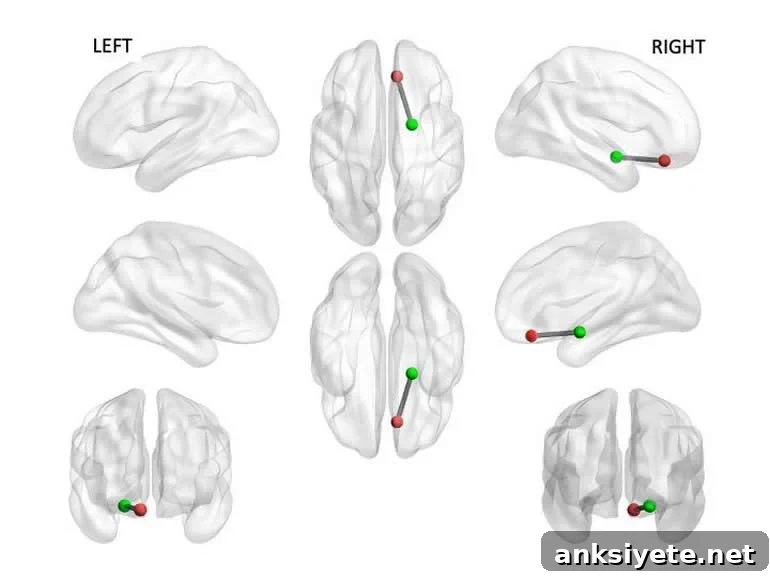
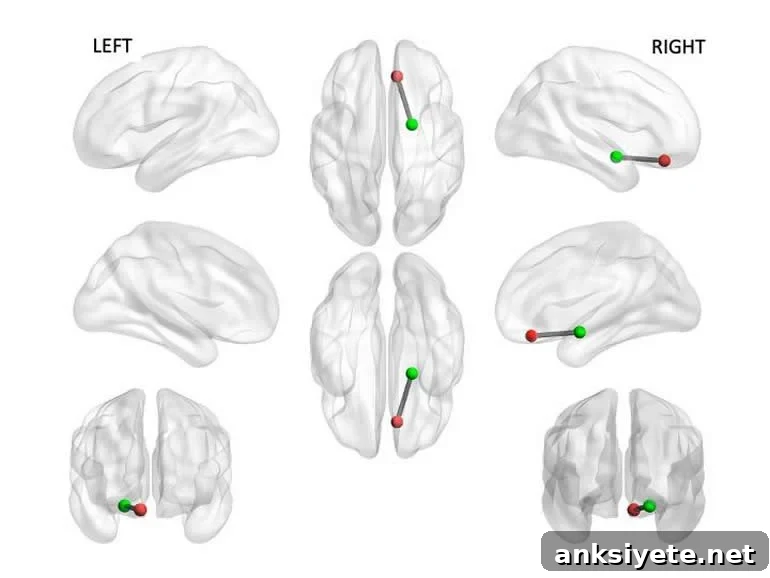
Researchers compared passive mobile sensing data with functional MRI (fMRI) scans and found that daily behavioral signals from phones reliably mirror neural activity between the ventromedial prefrontal cortex (vmPFC) and the amygdala—two regions central to emotional regulation. The study demonstrates that phone-derived measures of social engagement, screen time, movement and sleep correlate with brain connectivity patterns linked to mood and anxiety.
Using only passively collected smartphone features, the research team trained classifiers to distinguish participants with higher versus lower functional connectivity between the vmPFC and right amygdala. Predictions based solely on phone data matched the fMRI-based connectivity categories with roughly 80 percent accuracy, indicating that continuous sensing can capture meaningful proxies of brain function.
Presented at ACM UbiComp, the annual conference on pervasive and ubiquitous computing, this work is the first to predict connectivity specifically between emotion-related brain regions using only passive smartphone data. The results were published in the Proceedings of the ACM on Interactive, Mobile, Wearable and Ubiquitous Technologies and build on Dartmouth’s Student Life study, a year-long passive sensing project that monitored over 100 first-year student volunteers.
“Simple information about how someone is using their smartphone can provide a peek into the complex functioning of the human brain,” said Mikio Obuchi, a PhD student in Dartmouth’s Computer Science Department and lead author of the study. He emphasized that integrating mobile sensing with traditional neuroimaging could accelerate research into emotional functioning by offering continuous, ecological measurements of daily life.
The vmPFC contributes to self-control, decision making and evaluating risk, while the amygdala initiates rapid emotional responses and helps assess others’ emotions. Stronger functional connectivity between these regions has been associated in clinical studies with lower levels of anxiety and depression; weaker connectivity corresponds to more negative emotional states. In this study, phone-derived signals that correlated with higher vmPFC–amygdala connectivity included greater social interaction, specific location patterns, increased physical activity, earlier bedtimes, and overall screen-time measures.
Data were treated anonymously and divided into categories representing relatively low and high connectivity. By matching passive phone features against the fMRI-derived categories, the researchers could predict a participant’s connectivity level with a high degree of accuracy. The phone data enabled momentary assessments of emotional state without requiring intrusive measures or repeated in-person evaluations.
Co-author Jeremy Huckins, a lecturer in psychological and brain sciences at Dartmouth, noted that mobile sensing is not a replacement for neuroimaging like fMRI but a complementary tool. “Phones can help individuals and health providers learn more about behavior patterns from everyday observations,” he said, pointing to the value of objective, continuous data to reduce biases that affect self-report and interview-based assessments.
Senior researcher Andrew Campbell, the Albert Bradley 1915 Third Century Professor of Computer Science at Dartmouth, added that longitudinal mobile sensing provides rich behavioral context that single-timepoint scans cannot capture. Continuous sensing can reveal trends and situational behaviors that inform understanding of emotional well-being over time.
The authors emphasize that passive smartphone sensing can reduce subjectivity in mental health research by capturing behaviors continuously and unobtrusively. Such sensing can support both short-term monitoring of emotional state and long-term predictions of trait-like emotional patterns, offering potential applications in personalized mental health tracking and early intervention.
This research is part of Dartmouth’s ongoing Student Life study that collects passive phone data from student volunteers to better understand mental well-being. More than 100 first-year students took part in the year-long investigation into how everyday phone behavior relates to brain function. The study results will be presented at ACM UbiComp 2020 and appear in the Proceedings of the ACM on Interactive, Mobile, Wearable and Ubiquitous Technologies.
About this psychology research article
Source:
Dartmouth College
Contacts:
David Hirsch – Dartmouth College
Image Source:
The image is credited to Jeremy Huckins.
Original Research: The study will be presented at ACM UbiComp 2020.