
Summary: Scientists used jellyfish and fruit flies to investigate the biological drive to eat, revealing new insights into how feeding is regulated across animal evolution.
Source: Tohoku University
For decades, researchers have known that hunger and satiety are governed by hormones and small neuronal signaling molecules called neuropeptides. These compounds appear across many animal groups, from humans and mice to insects, suggesting a shared evolutionary origin.
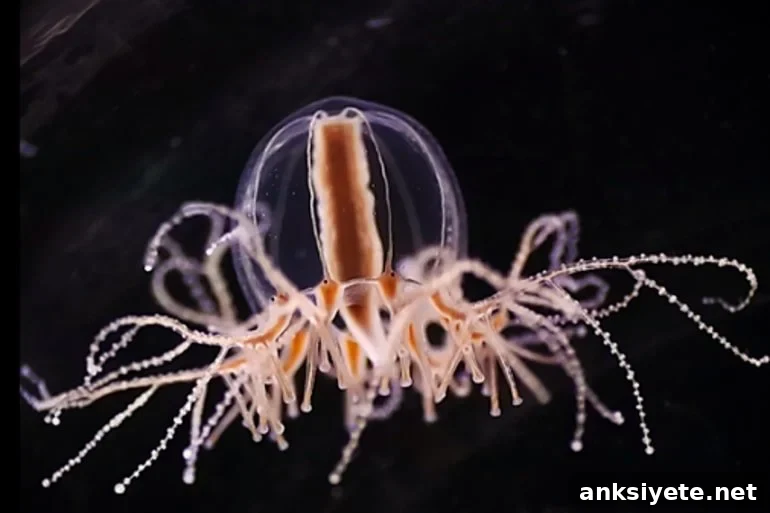
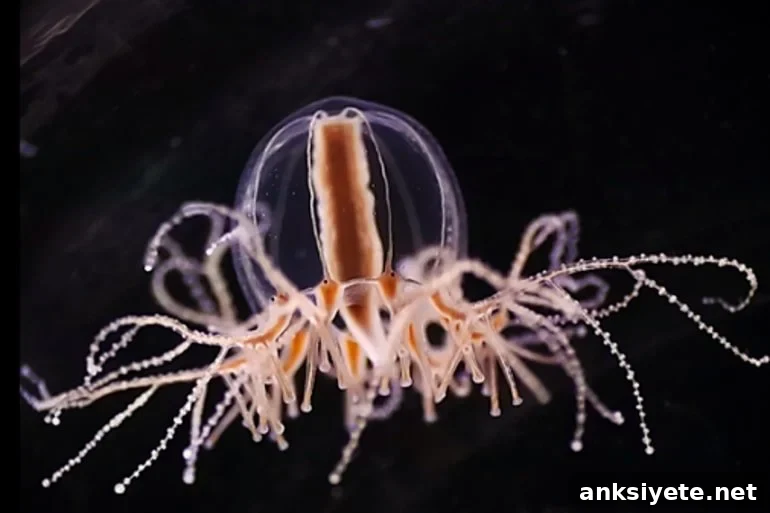
To explore how ancient this system is, a research team led by Hiromu Tanimoto and Vladimiros Thoma at Tohoku University examined feeding control in a simple marine animal, the jellyfish Cladonema, and compared it with mechanisms in the fruit fly Drosophila. Their work uncovers conserved molecular signals that suppress feeding and points to a deep evolutionary root for appetite regulation.
Jellyfish diverged from the lineage that led to mammals over 600 million years ago and have a markedly different nervous architecture: a diffuse nerve net rather than a centralized brain or ganglia. Despite that simplicity, jellyfish display complex behaviors including foraging, mating rituals, sleep-like states and learning. Yet little was known about how these animals sense and adjust feeding according to internal state.
The team focused on Cladonema pacificum, a small, laboratory-reared jellyfish with branched tentacles. Observations showed these animals change how much they eat depending on hunger, making them a suitable model to search for molecular regulators of feeding. The researchers compared gene expression patterns between hungry and fed animals to identify candidates linked to satiety and hunger.
Transcriptomic analyses revealed multiple genes whose expression changed with feeding state, including several that encode neuropeptides. The authors synthesized a selection of these peptides and tested their effects on feeding behavior. Five peptides reduced feeding in hungry jellyfish, highlighting specific neuropeptides as negative regulators of appetite in this species.
The team then focused on one peptide in particular, GLWamide, and conducted detailed behavioral and anatomical experiments. GLWamide suppressed a key feeding behavior: tentacle shortening, which is essential for transferring captured prey to the mouth. Using labeled peptide probes, the researchers located GLWamide in motor neurons at the bases of the tentacles, and observed that feeding elevated GLWamide levels. Taken together, these findings indicate that GLWamide functions as a satiety signal in Cladonema, communicating to the nervous system that feeding should be curtailed.
To test whether this mechanism is evolutionarily conserved, the authors examined parallels in insects. In fruit flies, a related neuropeptide called myoinhibitory peptide (MIP) is known to suppress feeding; flies lacking MIP overeat and become obese. Structural similarities between MIP and GLWamide suggested a possible shared ancestry.
The researchers performed cross-species experiments: they administered MIP to Cladonema and expressed GLWamide in MIP-deficient fruit flies. Remarkably, MIP reduced feeding in the jellyfish in the same way GLWamide did, and GLWamide expression in flies corrected the overeating seen in MIP-lacking animals. These reciprocal experiments demonstrate functional interchangeability between GLWamide and MIP across distantly related species.
This functional conservation implies that the molecular system signaling satiety is ancient and has been preserved across hundreds of millions of years of evolution. The findings link a specific neuropeptide family to the fundamental behavioral control of appetite in both cnidarians and insects, supporting the idea that core elements of feeding regulation were already in place in early animal ancestors.
Tanimoto and colleagues emphasize the value of a comparative approach in neuroscience. By studying diverse organisms with different nervous system architectures, researchers can uncover conserved molecules, neurons and circuits that govern behavior. Understanding these ancient signaling systems could inform broader questions about how appetite, metabolism and feeding-related neural circuits evolved and are organized.
About this neuroscience research news
Author: Press Office
Source: Tohoku University
Contact: Press Office – Tohoku University
Image: The image is credited to Hiromu Tanimoto
Original Research: Closed access. “On the origin of appetite: GLWamide in jellyfish represents an ancestral satiety neuropeptide” by Hiromu Tanimoto et al., PNAS.
Abstract
On the origin of appetite: GLWamide in jellyfish represents an ancestral satiety neuropeptide
Food intake is shaped by internal state, and this regulation depends on hormones and neuropeptides that relay hunger and satiety signals. While these molecules are well studied in common laboratory species, their evolutionary origins remain unclear. The researchers used the jellyfish Cladonema to investigate ancestral mechanisms of feeding regulation.
Combining transcriptomics, behavioral assays and anatomical mapping, the team identified GLWamide as a peptide that suppresses feeding by selectively inhibiting tentacle contraction in Cladonema. In the fruit fly Drosophila, the related myoinhibitory peptide (MIP) acts as a satiety signal. Unexpectedly, GLWamide and MIP proved fully interchangeable between these distant species for the suppression of feeding.
These results support the idea that satiety signaling systems across diverse animal groups share an ancient origin and that conserved neuropeptide chemistry underlies core aspects of appetite control.