
Summary: Linking specific changes in brain connectivity to different aspects of mental well-being is a crucial step toward identifying precise targets for future mental health treatments.
Source: University of Oxford
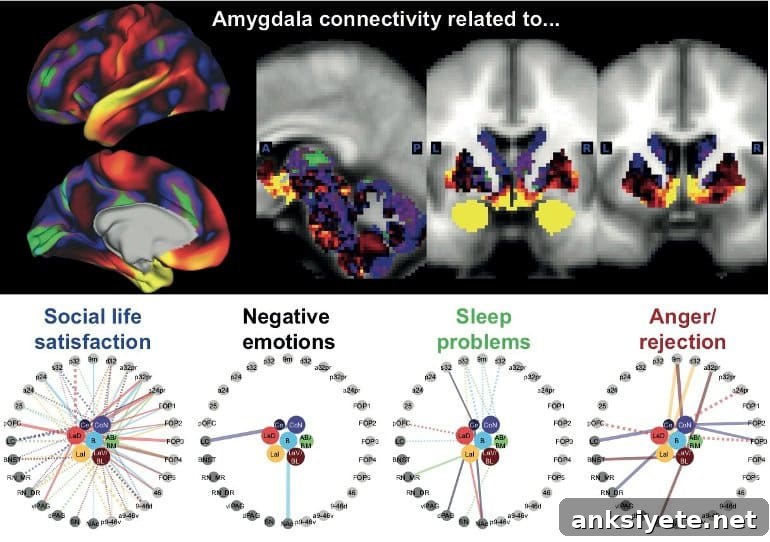
Associate Professor Miriam Klein-Flügge and her team examined brain connectivity and detailed measures of mental well-being in nearly 500 participants. Their focus was the amygdala, a small but central brain structure involved in emotion and reward processing.
Using resting-state functional magnetic resonance imaging (fMRI), the researchers divided the amygdala into seven smaller nuclei and analyzed the connectivity patterns of each subdivision, rather than treating the amygdala as a single homogeneous structure as many previous studies have done. This subdivision approach allowed a more anatomically precise investigation of how specific amygdala circuits relate to different aspects of mental health.
Alongside the neuroimaging data, the team collected detailed behavioral measures of well-being from a large sample of healthy individuals. Instead of relying on broad clinical diagnoses such as “depression” or “anxiety,” they used questionnaires that captured distinct dimensions of mental well-being, including social functioning, emotional state, sleep quality, and tendencies toward anger. This finer-grained behavioral information provided greater specificity for linking brain networks to particular psychological traits.
Published in Nature Human Behaviour, the study demonstrates that combining precise brain parcellation with carefully measured well-being dimensions makes it possible to identify which exact neural circuits relate to which aspects of mental health. The connectivity patterns that best predicted sleep difficulties were different from those that carried information about social well-being, illustrating that separate amygdala networks underlie distinct types of mental challenges.
Associate Professor Miriam Klein-Flügge, of the Department of Experimental Psychology at the Wellcome Centre for Integrative Neuroimaging (WIN), commented, “Understanding how changes in the brain relate to changes in well-being is an important step in the journey towards more targeted mental health treatments.” She added that examining the brain at a finer anatomical scale better reflects how brain systems are organized and suggests the possibility of developing precise, non-invasive interventions that could one day be tailored to an individual’s specific symptoms.
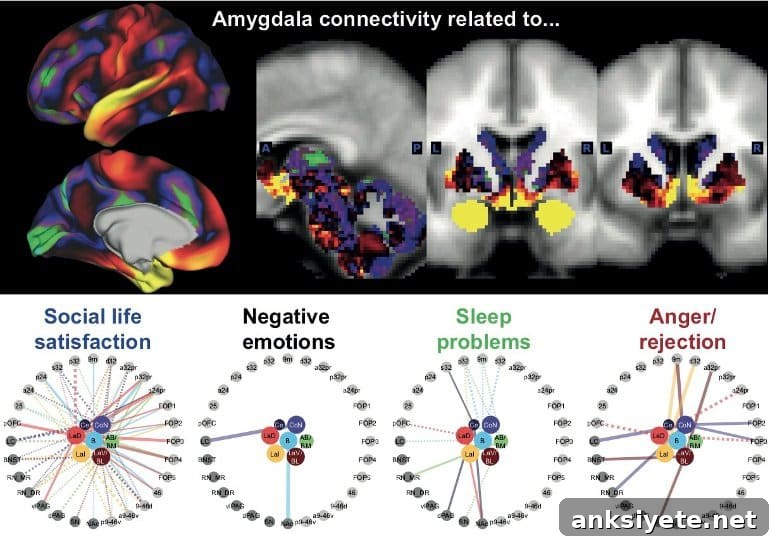
Beyond differentiating which networks relate to which behavioral dimensions, the researchers also identified qualitative differences in the types of circuits involved. Connectivity within evolutionarily older subcortical networks was most strongly associated with the tendency to experience negative emotions, whereas links between the amygdala and both newer cortical regions and older subcortical areas were important for social well-being. These observations point to a division of labor across brain circuits, where particular combinations of connections support different facets of psychological functioning.
The findings support the idea that studying mental well-being—and the brain networks that underpin it—at a scale closer to the brain’s functional architecture offers clearer and more actionable insights than using broad categorical diagnoses. With better anatomical and behavioral specificity, it becomes more feasible to imagine interventions that target the circuits most relevant to an individual’s key symptoms.
Although further research is needed to translate these insights into clinical practice, the work highlights emerging possibilities. Non-invasive deep brain stimulation techniques, including focused ultrasound approaches, are advancing and may eventually allow precise modulation of the circuits identified as most relevant for particular symptoms.
About this mental health and neuroscience research news
Author: Press Office
Source: University of Oxford
Contact: Press Office – University of Oxford
Image: Image credited to University of Oxford
Original Research: Closed access. “Relationship between nuclei-specific amygdala connectivity and mental health dimensions in humans” by Miriam C. Klein-Flügge et al., published in Nature Human Behaviour.
Abstract
Relationship between nuclei-specific amygdala connectivity and mental health dimensions in humans
There has been growing interest in using neuroimaging to predict psychiatric symptoms, but many prior approaches depend on broad, distributed brain networks and heterogeneous diagnostic categories, limiting anatomical and behavioral specificity and hindering the development of targeted interventions.
To address these challenges, the researchers parcellated the amygdala into seven nuclei using resting-state fMRI. A factor analysis of questionnaire data identified subclinical mental health dimensions often altered in anxious-depressive individuals, such as negative emotions and sleep disturbances.
For each behavioral dimension, the study identified specific resting-state functional connectivity links between individual amygdala nuclei and narrowly defined regions of interest—examples include the dorsal raphe nucleus in the brainstem and medial frontal cortical areas. These circumscribed amygdala networks successfully predicted behavioral scores in an independent dataset, revealing precise relationships between subcortical connectivity patterns and distinct aspects of mental health.