
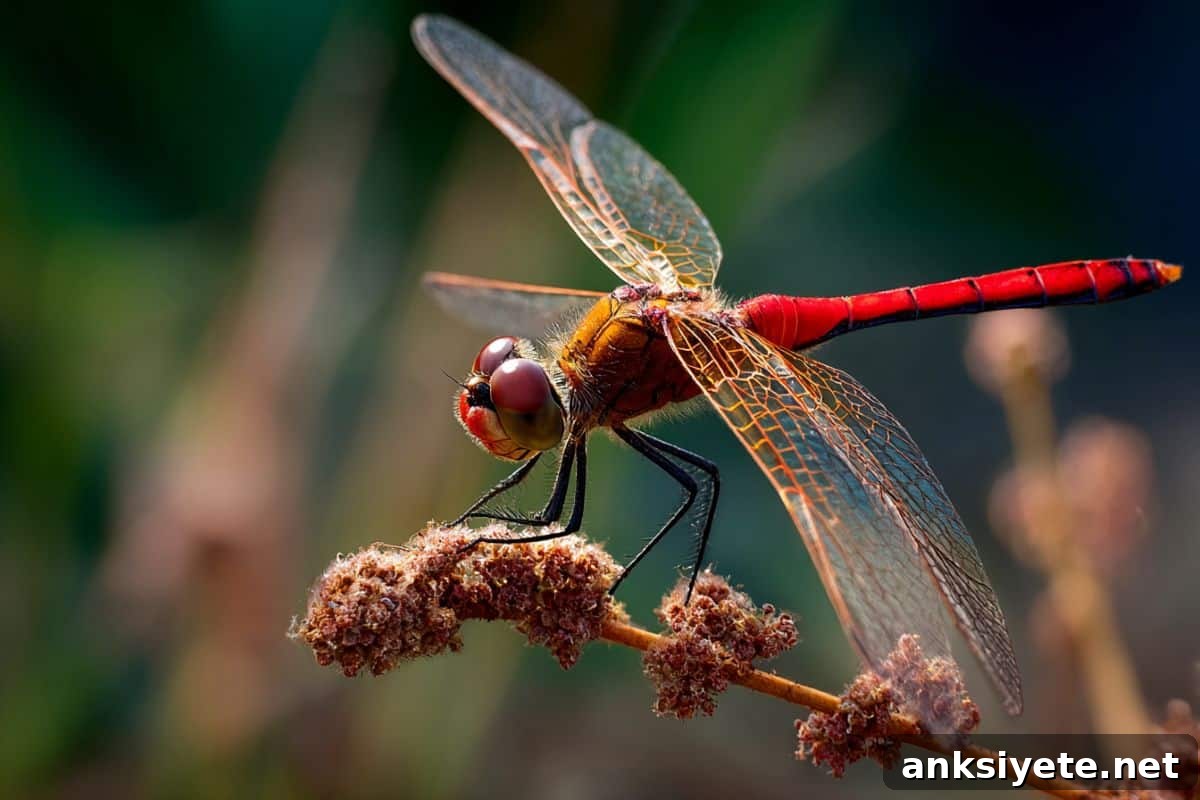
Summary: Dragonflies and humans appear very different, but new research shows they share an almost identical molecular solution for sensing red light. Scientists discovered that dragonflies evolved a red-sensitive opsin using the same chemical mechanism that underlies red vision in mammals. This rare example of parallel evolution reveals a protein sensitive up to about 720 nm—well into the near-infrared—and can be further tuned by a single amino acid change. That tweak already allowed researchers to create a variant that responds to even longer wavelengths, opening possibilities for deeper, less invasive optogenetic control in medicine.
Researchers from Osaka Metropolitan University (OMU) identified a dragonfly visual pigment with extraordinary long-wavelength sensitivity and traced how its spectral tuning works. Their work connects basic visual neuroscience, evolutionary biology, and practical biomedical engineering by demonstrating both how dragonflies use near-infrared sensitivity in nature and how that property can be harnessed in the lab.
Key Facts
- Record near-infrared sensitivity: The identified dragonfly opsin responds to wavelengths around 720 nm, one of the most red-sensitive pigments recorded among animals.
- Parallel evolution: The same chemical mechanism that shifts mammalian opsins toward red sensitivity is used independently by dragonflies, despite hundreds of millions of years of separate evolution.
- Behavioral advantage: Male dragonflies can exploit subtle differences in red and near-infrared reflectance between sexes to rapidly identify females during fast aerial chases.
- Optogenetic potential: Near-infrared light penetrates deeper into tissue than shorter wavelengths. A naturally near-infrared–tuned opsin could enable less invasive activation of cells inside the body.
- Simple molecular control: The team pinpointed a single amino acid position that governs the pigment’s spectral sensitivity; altering that position can shift peak absorption further into the infrared and produce functional cellular responses in culture.
Source: Osaka Metropolitan University
Parallel evolution can lead unrelated species to the same biochemical solution.
Color vision in vertebrates depends on opsin proteins in the eye. Humans use three opsins tuned to short (blue), medium (green), and long (red) wavelengths. Insects usually have different tuning patterns, but dragonflies stand out with unusually strong sensitivity to long wavelengths. The OMU team, led by Professors Mitsumasa Koyanagi and Akihisa Terakita, isolated a dragonfly opsin that detects much longer wavelengths—around 720 nm—beyond the deepest red most insects can perceive.
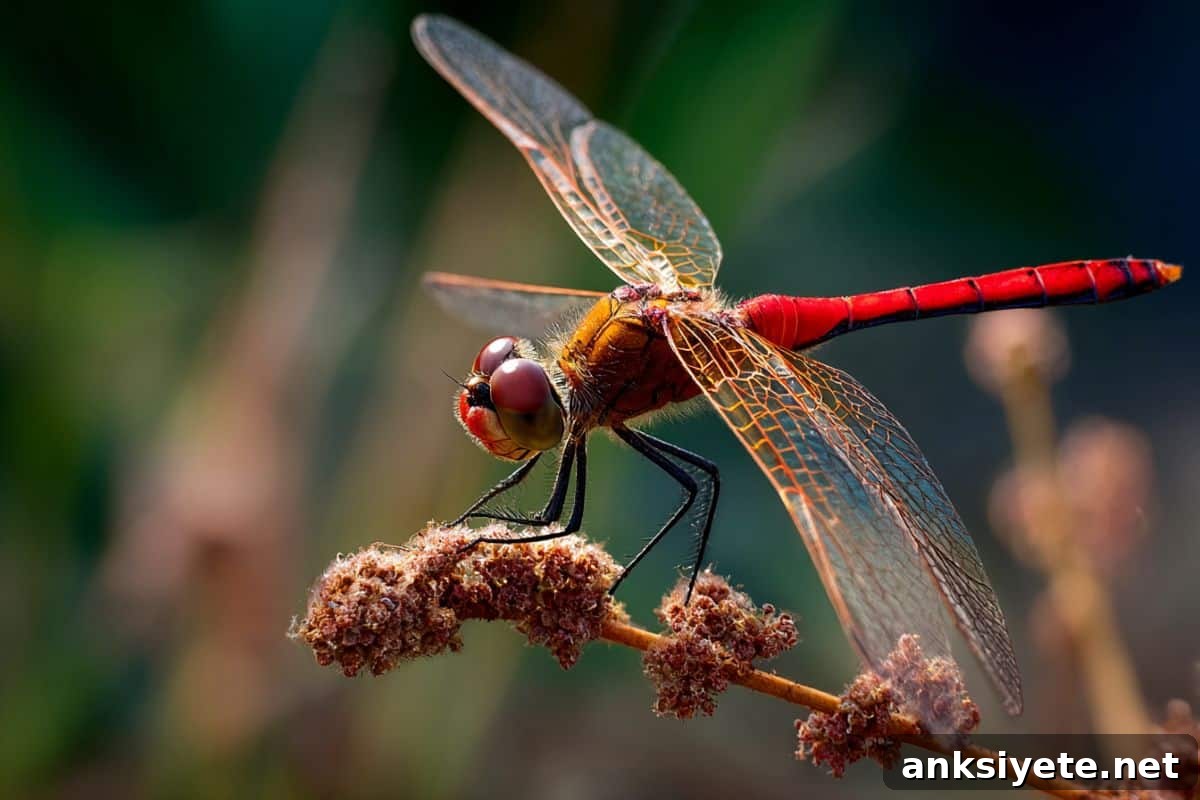
To understand the ecological reasons for such sensitivity, the researchers measured reflectance patterns from dragonfly bodies. They found consistent differences between males and females in red and near-infrared reflectance, indicating that enhanced long-wavelength vision helps males locate females quickly among vegetation and during high-speed flight.
At the molecular level, the team identified a key residue—position 292 in the protein—that controls the pigment’s red shift. Remarkably, the same position and mechanism that tune mammalian red opsins also operate in these dragonfly opsins. This is a clear instance of parallel evolution: two distant lineages converged on the same molecular change to achieve red sensitivity.
The researchers went further and engineered mutations that shift the dragonfly pigment’s peak sensitivity even more to the red and near-infrared. Introducing a second substitution produced a variant with a peak near 590 nm in spectroscopy and, crucially, cells expressing the engineered opsin showed robust responses to light at 738 nm. That cellular activation demonstrates the feasibility of using these pigments as optogenetic tools to control G-protein–coupled receptor signaling with long-wavelength light.
Because near-infrared light penetrates deeper into tissues than blue or green light, an opsin naturally tuned to these wavelengths could allow optical stimulation or therapy at greater depths without surgical access. The OMU team emphasizes the translational potential of their findings, while also highlighting the basic evolutionary insight: nature independently arrived at the same biochemical strategy for detecting red light in both insects and mammals.
Key Questions Answered:
A: Dragonflies operate at high speed and in visually complex environments. The study shows males and females reflect long-wavelength light differently; sensitivity to these wavelengths helps males spot females quickly against backgrounds that reflect less near-infrared, improving mate recognition during flight.
A: Parallel evolution here means that two distant groups—dragonflies and mammals—independently evolved the same chemical adjustment in their opsin proteins that shifts sensitivity toward red light. They did not inherit this change from a common ancestor but arrived at the same solution separately.
A: In optogenetics, light-sensitive proteins are used to control cells with light. Blue-light tools are common but penetrate poorly. An opsin sensitive to red and near-infrared light could enable activation of cells deeper in tissue, improving therapeutic or research applications without invasive procedures.
Editorial Notes:
- This article was edited by a Neuroscience News editor.
- The original journal paper was read in full by the editorial team.
- Additional context and clarification were added by staff to aid reader understanding.
About this visual neuroscience research news
Author: Matthew Coslett
Source: Osaka Metropolitan University
Contact: Matthew Coslett – Osaka Metropolitan University
Image: Image credit: Neuroscience News
Original Research: Open access.
Title: “Dragonfly red opsins share a common tuning mechanism with mammalian red opsins and further enhancement of near-infrared sensitivity” by Ryu Sato, Akihisa Terakita & Mitsumasa Koyanagi. Cellular and Molecular Life Sciences
DOI: 10.1007/s00018-025-06017-9
Abstract
Dragonfly red opsins share a common tuning mechanism with mammalian red opsins and further enhancement of near-infrared sensitivity
Many animals, including primates and insects, achieve color vision with opsin proteins tuned to different spectral regions. Red vision depends on opsins sensitive to long wavelengths, and such pigments have evolved independently across lineages. Dragonflies are notable for sensing longer wavelengths than humans, but until now the specific opsins and tuning mechanisms responsible were not well understood.
The study identified RhLWA2 opsins as the longest-wavelength–sensitive pigments in dragonflies. Spectroscopic analysis of the RhLWA2 pigment from Asiagomphus melaenops showed an absorption maximum near 580 nm and bistable behavior, making it the longest-wavelength–sensitive bistable opsin described to date. Mutational work pinpointed residue 292 as the critical spectral tuning site; the same position underlies the red shift in mammalian red opsins, demonstrating parallel molecular evolution.
A further substitution (A292V) in a dragonfly lineage pushed sensitivity toward the near-infrared. The team engineered an additional V211C mutation to produce a red-shifted Am_RhLWA2 mutant with an absorption maximum around 590 nm. Cells expressing this engineered opsin showed marked Ca2+ responses to 738 nm light, highlighting its potential as a near-infrared optogenetic tool to control GPCR signaling. Combined with evidence that body coloration differs between sexes, the findings suggest longer-wavelength sensitivity provides an advantage for sex recognition in the wild.