
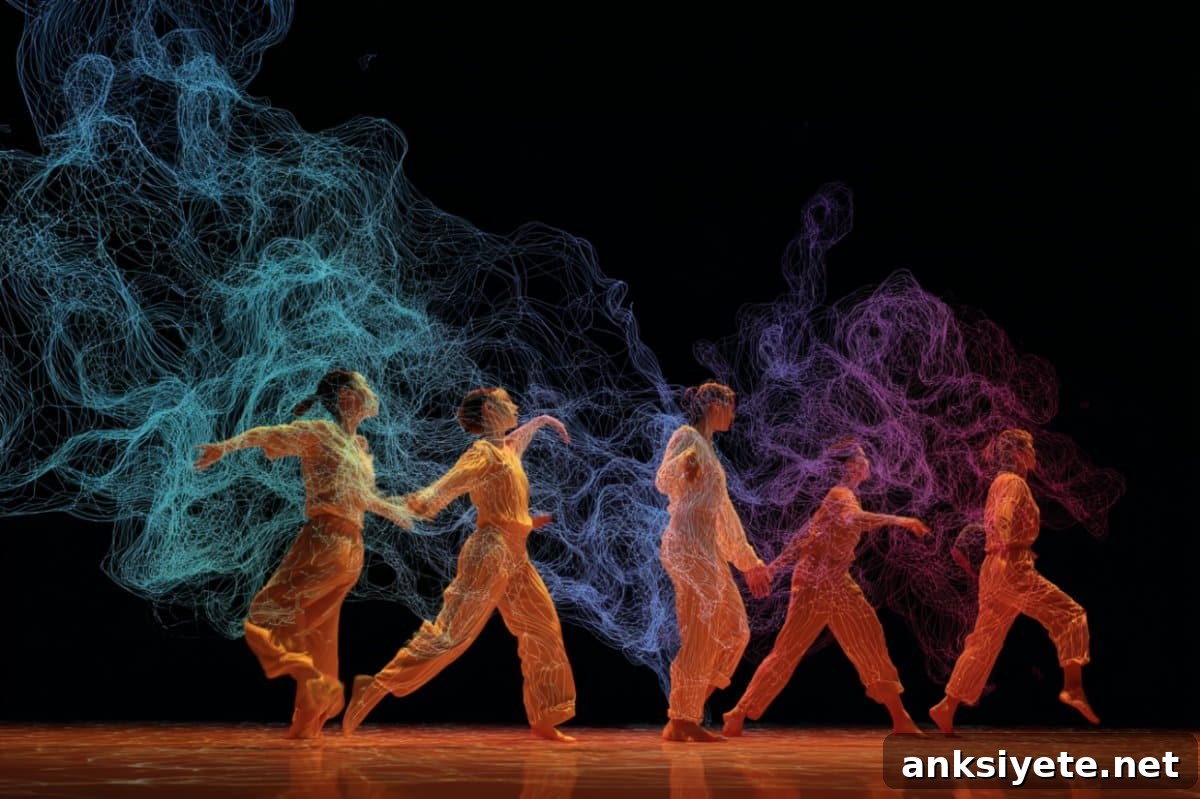
Summary: New research shows that watching a live dance performance causes audience members’ brainwaves to synchronize, reflecting shared attention and social connection. Using portable EEG headsets, scientists recorded stronger neural synchrony during live performances than when the same piece was watched alone on video, with the effect most pronounced when dancers made eye contact with the crowd.
Viewing a recorded performance together in a group also produced some synchrony, but the effect was markedly weaker when people watched alone. These results suggest that live performance creates a measurable, collective form of engagement that recordings cannot fully reproduce.
Key facts:
- Brain synchrony: Audience members’ brain activity aligned during live dance, most prominently in the delta frequency band (1–4 Hz).
- Social liveness: Being in a shared setting—being together—boosted synchrony, even when the same performance was shown as a recording.
- Predictable peaks: Moments that choreographers identified as likely to engage audiences corresponded to peaks in brain synchrony.
Source: Cell Press
A study published July 9 in the journal iScience suggests that the distinct quality of live performance is mirrored in the brain.
When people attended a live contemporary dance piece, their neural activity became aligned, indicating shared focus and attention. That same alignment did not appear when individuals watched the same choreography alone on video.
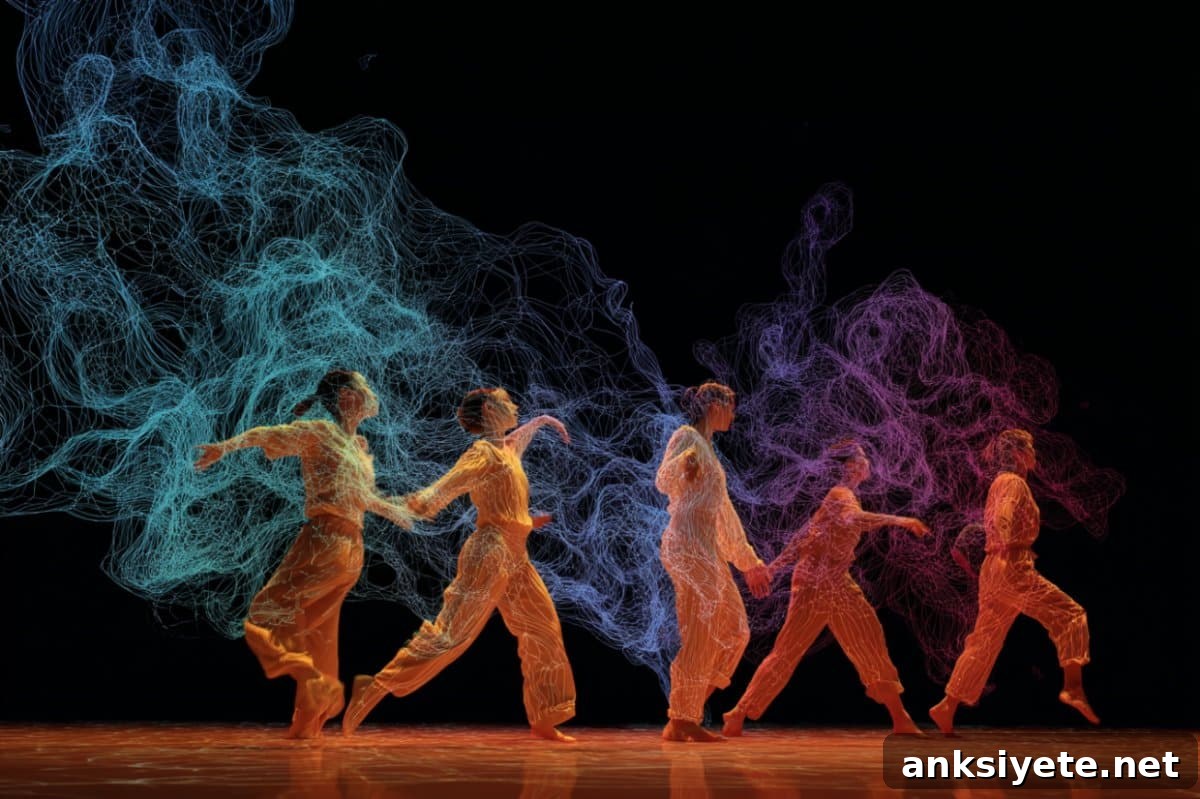
“We wanted to understand what makes live performance feel so different from watching a recording,” says senior author Guido Orgs, a dancer and neuroscientist at University College London. Dance was chosen for the study because it is frequently experienced live and in shared spaces, making it well suited to examine how presence and social context shape engagement.
As part of the NEUROLIVE project—a collaboration among researchers and artists at UCL, Goldsmiths, the Max Planck Institute for Empirical Aesthetics, and Siobhan Davies Studios—the team brought mobile neuroscience tools into the theater to study “liveness,” the unique quality of experiencing a performance in real time with others.
Fifty-nine audience members were fitted with EEG headsets during three live performances of Detective Work, a contemporary dance piece choreographed by Seke Chimutengwende with Stephanie McMann. Additional participants watched a recording of the same piece either in a cinema with others or alone in a laboratory, enabling direct comparisons across viewing conditions.
During the live performances, the strongest alignment across audience members’ brain activity appeared in the delta band, a slow-frequency range often linked to social processing and shifts in attention. Synchrony rose noticeably at moments when performers established eye contact with the audience, effectively breaking the fourth wall and creating direct social interaction.
“Previous studies typically associate attention with faster alpha rhythms,” explains first author Laura Rai, a cognitive neuroscientist at UCL. “In contrast, our data show that delta-band activity captured shared engagement during live dance.”
Even without a physical stage, watching the recorded performance alongside others in a cinema produced measurable synchrony, though to a lesser degree than the live shows. When viewers watched alone in the lab, synchrony decreased substantially. The researchers interpret these results as indicating that social presence—the feeling of sharing the moment with others—contributes meaningfully to how audiences engage.
To test whether engagement could be anticipated, the team asked choreographer Seke Chimutengwende to highlight moments he expected would be most compelling. Audience neural synchrony peaked at nearly all the moments the choreographer predicted, suggesting that artists can reliably shape collective attention.
“Art is often described as subjective and open to interpretation, which remains true for meaning and feeling. But our findings show that aspects of attention and engagement during live performance can be consistent and measurable,” says Orgs. “Artists know how to guide audiences’ focus.”
The researchers hope to expand the study to additional venues and audiences worldwide and anticipate that advances in EEG technology will make large-scale, real-world measurements easier. Current systems are relatively bulky, sensitive to motion, and time-consuming to fit to many participants.
“Live performance contains a wealth of knowledge about collective experience,” says co-author Matthias Sperling, artistic director and NEUROLIVE researcher. “Artists and audiences are both experts in liveness. Science offers a new lens to explore these shared moments and to tell richer stories about what unfolds in that space.”
Funding:
This research received support from the European Research Council under the European Union’s Horizon 2020 research and innovation program.
About this neuroscience research news
Author: Julia Grimmett
Source: Cell Press
Contact: Julia Grimmett – Cell Press
Image: The image is credited to Neuroscience News
Original Research: Open access. “Delta-band audience brain synchrony tracks engagement with live and recorded dance” by Guido Orgs et al., published in iScience.
Abstract
Delta-band audience brain synchrony tracks engagement with live and recorded dance
Evolutionary accounts propose that dance and music evolved as collective rituals for social bonding and signaling. However, many neuroscientific studies of the performing arts rely on people viewing recorded material alone in laboratories, removing the social context that is intrinsic to live events.
Across three live performances of the choreography, researchers recorded real-time neural dynamics from up to 23 audience members simultaneously using mobile wet-electrode EEG. Interpersonal neural synchrony in the delta band (1–4 Hz) was highest when performers directly engaged the audience and varied systematically with dancers’ movements and with moments the artists predicted would be most engaging.
Follow-up experiments with video recordings showed that audience synchrony and engagement are strongest when dance is experienced live and together. The study supports the view that the performing arts preserve ancient social functions by fostering shared attention and collective experience in contemporary contexts.