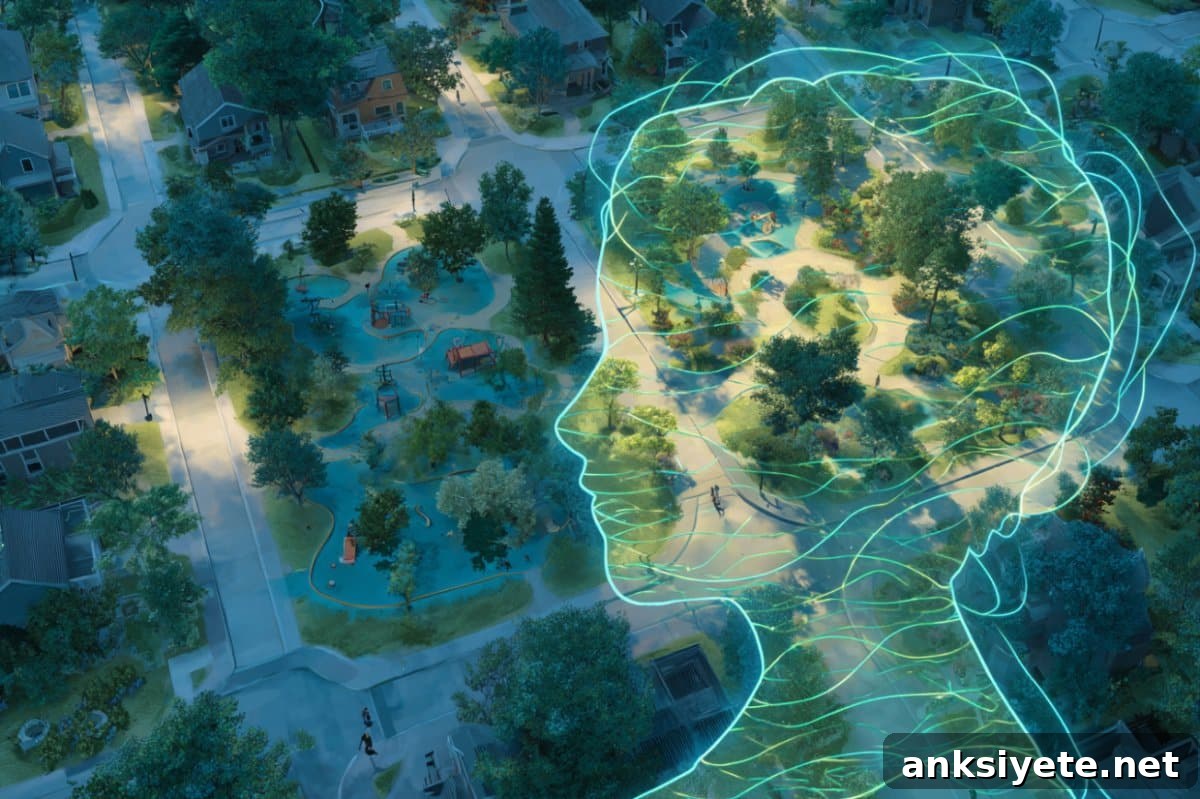
Summary: A large national study found that greater exposure to green space before birth and during early childhood is associated with lower risks of neurodevelopmental disorders. Analysis of more than 1.8 million mother–child pairs enrolled in Medicaid showed reduced rates of ADHD, autism spectrum disorder (ASD), intellectual disability and learning difficulties in areas with higher vegetation.
The protective associations were most pronounced in urban settings and among Black and Hispanic children, suggesting that expanding access to parks, trees and other green environments may be a practical way to support healthy brain development and reduce health disparities.
Key facts:
- Protective effect: Higher residential greenness was linked to lower risks of multiple neurodevelopmental conditions, including ADHD, ASD and learning delays.
- Critical windows: Benefits were observed with exposure during preconception, pregnancy and early childhood, indicating timing matters.
- Equity implications: Stronger benefits appeared for children in urban areas and for Black and Hispanic children, pointing to potential public-health and urban-planning opportunities.
Source: Rutgers University
Overview
Researchers at Rutgers School of Public Health examined whether living near green space before and during pregnancy, and in early childhood, is associated with lower risk of neurodevelopmental disorders. Published in Environment International, the study analyzed a nationwide Medicaid cohort to evaluate how residential vegetation levels relate to diagnoses such as attention-deficit/hyperactivity disorder (ADHD), autism spectrum disorder (ASD), intellectual disability and learning difficulties.
The investigators measured green space using satellite-derived Normalized Difference Vegetation Index (NDVI) values for maternal residential ZIP codes and linked these measures to diagnostic records from the Medicaid Analytic Extract. The cohort included 1,841,915 racially and socioeconomically diverse mother–child pairs, followed for up to 14 years (2001–2014).
“Enhancing access to green space in urban neighborhoods could support early childhood neurodevelopment and help reduce the burden of developmental delays,” said Stefania Papatheodorou, an associate professor at the Rutgers School of Public Health and senior author of the study. The research team notes that the potential of natural environments to improve neurodevelopment, particularly among socioeconomically disadvantaged populations, has been understudied.
Researchers evaluated exposure during three key windows—preconception, prenatal and early childhood—both separately and together. Neurodevelopmental outcomes were identified using validated algorithms and covered ASD, ADHD, learning disabilities, speech and language disorders, coordination disorders, intellectual disabilities and behavioral disorders. Analyses adjusted for individual and area-level confounders and tested whether associations differed by urbanicity, child race/ethnicity and sex.
Results showed consistent protective associations across several outcomes. Notable findings per interquartile range (IQR = 0.12) increase in NDVI included:
- Preconception exposure and intellectual disability: HR 0.66 (95% CI: 0.48–0.95)
- Pregnancy exposure and autism spectrum disorder: HR 0.83 (95% CI: 0.73–0.95)
- Postnatal exposure and learning difficulties: HR 0.81 (95% CI: 0.68–0.97)
The associations remained after multiple sensitivity checks, and the strongest benefits were observed among children living in urban environments and among Black and Hispanic children. This pattern suggests that green space may offer relatively greater advantages where natural environments are limited and where developmental risks are higher.
The authors highlight the policy relevance of these findings: improving access to green spaces—through urban planning, park investments and greening initiatives—could be a modifiable environmental strategy to support healthy neurodevelopment, particularly in low-income and underserved communities.
Abstract
Preconception, prenatal and early childhood exposure to green space and risk of neurodevelopmental delays: a national cohort study among Medicaid enrollees
Background
Existing evidence links green space to better mental health in children, but its relationship with neurodevelopmental disorders—especially in socioeconomically disadvantaged populations—remains understudied. This study assessed whether residential greenness before conception, during pregnancy, and in early childhood is associated with reduced risk of neurodevelopmental delays among Medicaid enrollees.
Methods
This cohort included 1,841,915 mother–child pairs from the Medicaid Analytic Extract (2001–2014), with follow-up up to 14 years. Greenness was measured using NDVI at the maternal ZIP code level. Exposures were examined during preconception, prenatal and postnatal periods. Neurodevelopmental outcomes were identified by validated algorithms. A stratified Cox model adjusted for individual and area-level confounders, and effect modification by urbanicity, race/ethnicity and sex was evaluated.
Findings
Higher residential greenness was associated with lower risks of several neurodevelopmental disorders. Strongest associations included preconception exposure with lower intellectual disability risk, prenatal exposure with lower ASD risk, and early childhood exposure with fewer learning difficulties. Benefits were more pronounced among Black and Hispanic children and in urban areas.
Interpretation
Residential green space exposure during key developmental windows may support children’s neurodevelopment and could help reduce disparities affecting vulnerable populations.
Funding
National Institute of Environmental Health Sciences R01-ES034038.
Author: Andrew Smith
Source: Rutgers University
Contact: Andrew Smith – Rutgers University
Image: The image is credited to Neuroscience News
Original research: Open access. “Preconception, prenatal and early childhood exposure to green space and risk of neurodevelopmental delays: a national cohort study among Medicaid enrollees” by Stefania Papatheodorou et al., Environment International. DOI: 10.1016/j.envint.2025.109666