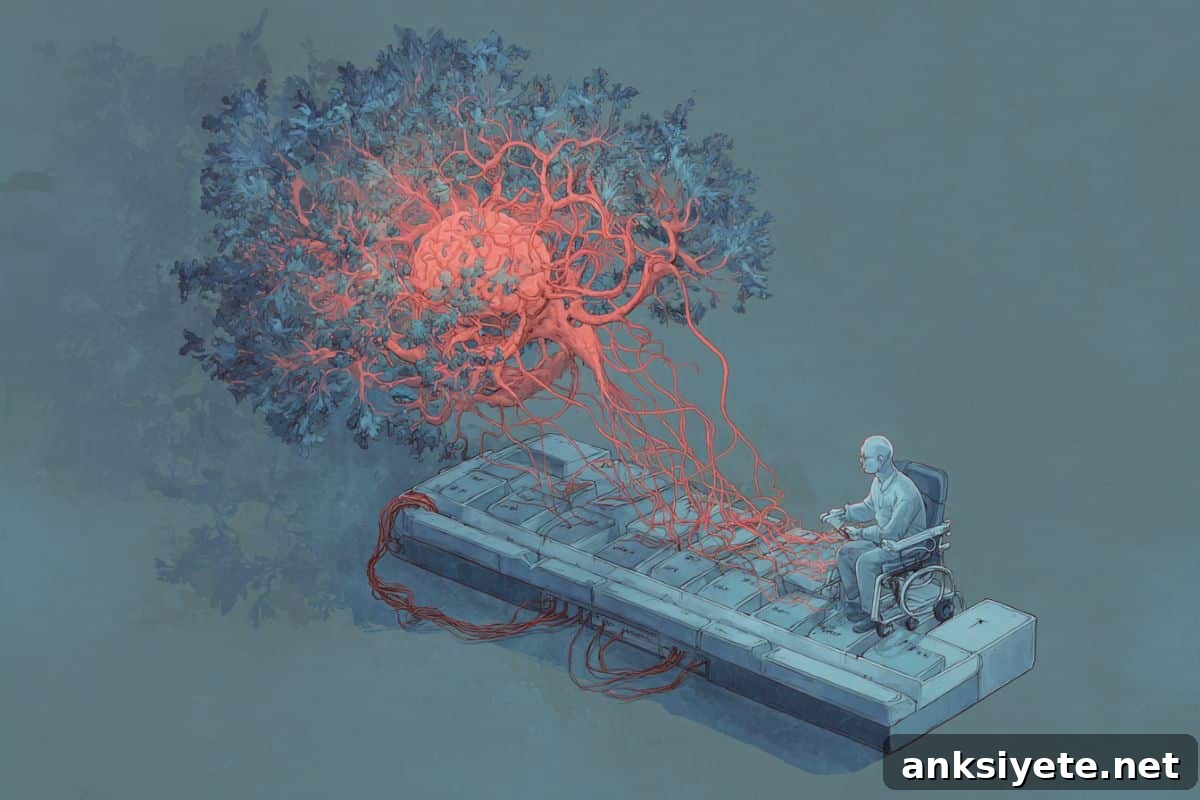
Summary: For people with severe paralysis who cannot speak or move their hands, loss of communication is a profound loss of independence. A new investigational brain-computer interface (iBCI) translates the brain’s intent to move fingers into typed words, restoring fast and accurate text communication.
Researchers report an implantable neuroprosthesis that maps attempted finger movements onto a virtual QWERTY keyboard. Microelectrodes in the motor cortex record the neural signals produced when a user tries to move a finger; those signals are decoded and displayed as keystrokes, then refined by a predictive language model to produce coherent text. The system achieved speeds and accuracy comparable to able-bodied typing in early clinical tests.
Key Facts
- The QWERTY mapping: Each letter on the on-screen keyboard is associated with a specific finger and a simple finger position (up, down, or curled). Users type by attempting those finger movements.
- High speed and accuracy: One participant reached a top speed of 110 characters (22 words) per minute with a 1.6% word error rate.
- Fast calibration: The system can be tuned with as few as 30 calibration sentences, far shorter than many previous approaches.
- At-home use: Trial participants used the device successfully from their own homes, demonstrating practical robustness for daily life beyond a laboratory setting.
- AI-assisted decoding: A predictive language model acts like intelligent autocorrect, improving sentence-level accuracy and fluency.
Source: Mass General
Background: Communication loss is often one of the most devastating consequences of paralysis. Many current assistive systems—such as eye-gaze devices—require selecting individual letters and can be slow, fatiguing, or error-prone, leading some users to abandon them. The BrainGate research consortium aims to close that gap by developing implantable neurotechnology that restores communication and mobility for people with neurologic injury or disease.
The new study, conducted by teams at Mass General Brigham Neuroscience Institute and Brown University and published in Nature Neuroscience, tested an iBCI typing neuroprosthesis with two clinical trial participants: one person with advanced amyotrophic lateral sclerosis (ALS) and another with a cervical spinal cord injury. Both individuals used the system to type quickly and accurately by attempting finger movements rather than moving their hands physically.
Microelectrode arrays were implanted in the participants’ motor cortex—the region responsible for planning and executing movements. When a participant attempted a finger motion, the implant detected characteristic electrical activity. Decoding software translated those patterns into the corresponding letters on the virtual QWERTY keyboard. A subsequent predictive language model smoothed and corrected the output to improve readability and grammatical accuracy.
Because the brain’s motor signals for attempted movement remain present even when muscles are paralyzed, the system can leverage learned “muscle memory” for typing. This approach makes typing more intuitive and faster than many existing assistive communication methods that rely on gaze or single-letter selection.
One participant calibrated the device with about 30 sentences and reached the study’s peak performance—110 characters per minute with a 1.6% word error rate—comparable to typical accuracy for able-bodied typing. Both participants operated the system from their own homes during the trial, an important milestone toward practical, everyday use.
Beyond restoring fast text communication, decoding attempted finger movements also opens the door to restoring complex reach-and-grasp functions for people with upper-limb paralysis. The investigators note further improvements are possible, including personalized keyboard layouts or stenography-style mappings to increase throughput for individual users.
Authorship: The study’s authors include Justin J. Jude, Hadar Levi-Aharoni, Alexander J. Acosta, Shane B. Allcroft, Claire Nicolas, Bayardo E. Lacayo, Nicholas S. Card, Maitreyee Wairagkar, Alisa D. Levin, David M. Brandman, Sergey D. Stavisky, Francis R. Willett, Ziv M. Williams, John D. Simeral, Leigh R. Hochberg, and Daniel B. Rubin.
Disclosures: CAUTION: Investigational Device. Limited by Federal Law to Investigational Use. The content reflects the authors’ views and does not necessarily represent the official views of the National Institutes of Health, the Department of Veterans Affairs, or the United States government.
Key Questions Answered:
A: The motor cortex still generates the electrical patterns associated with intended finger movements even when muscles cannot move. The implant detects those neural signals and decodes which letter the person intended to select.
A: For many users, yes. Eye-gaze systems require focusing on each letter and can be slow and tiring. This BCI taps into familiar typing intentions—essentially the brain’s muscle memory for typing—making it more intuitive and often faster.
A: The device is currently investigational and undergoing clinical trials. Successful at-home performance by trial participants is an important step toward wider availability, but additional testing and regulatory review are required before general clinical use.
Editorial Notes:
- This article was edited by a Neuroscience News editor.
- The full journal paper was reviewed in detail by the editorial team.
- Additional context was added by staff to clarify clinical and technical aspects.
About this neurotech research news
Author: Noah Brown
Source: Mass General
Contact: Noah Brown – Mass General
Image: The image is credited to Neuroscience News
Original Research: Open access. “Restoring rapid natural bimanual typing with a neuroprosthesis after paralysis” by Justin J. Jude et al., published in Nature Neuroscience. DOI: 10.1038/s41593-026-02218-y
Abstract
Restoring rapid natural bimanual typing with a neuroprosthesis after paralysis
Recognizing keyboard typing as a familiar, high-throughput communication paradigm, the investigators developed an intracortical brain–computer interface (iBCI) that provides bimanual QWERTY keyboard functionality for people with paralysis. Typing relies solely on attempted finger movements, which can be decoded accurately with as few as 30 calibration sentences. Sentence-level decoding benefits from a 5-gram language model. The system performed well for two clinical trial participants with tetraplegia—one with ALS and one with spinal cord injury—allowing user-regulated typing speeds up to 110 characters per minute (about 22 words per minute) with a word error rate of 1.6%. These results approach able-bodied typing accuracy and offer higher throughput than prior hand-motor iBCI systems, providing an intuitive and rapidly learned communication option for individuals with impaired speech or motor control due to paralysis.