
Summary: New research clarifies early mechanisms of brain injury caused by microgravity exposure.
Source: Science China Press
Background: Prolonged exposure to microgravity produces upward fluid shifts that trigger adaptive and maladaptive changes in brain tissue, cerebrospinal fluid (CSF), and cerebral blood vessels. Although investigators have studied these effects for more than a decade, the precise mechanisms that drive microgravity-induced neurological changes are not fully understood.
The brain extracellular space (ECS) — the network of narrow channels that surround neurons and glia — contains interstitial fluid (ISF) and accounts for roughly 15%–20% of brain volume in living tissue. Because the ECS is the primary route for material exchange between capillaries, neural cells, and CSF, early microgravity-driven alterations in ECS structure and ISF transport could help explain functional and structural brain changes observed in astronauts.
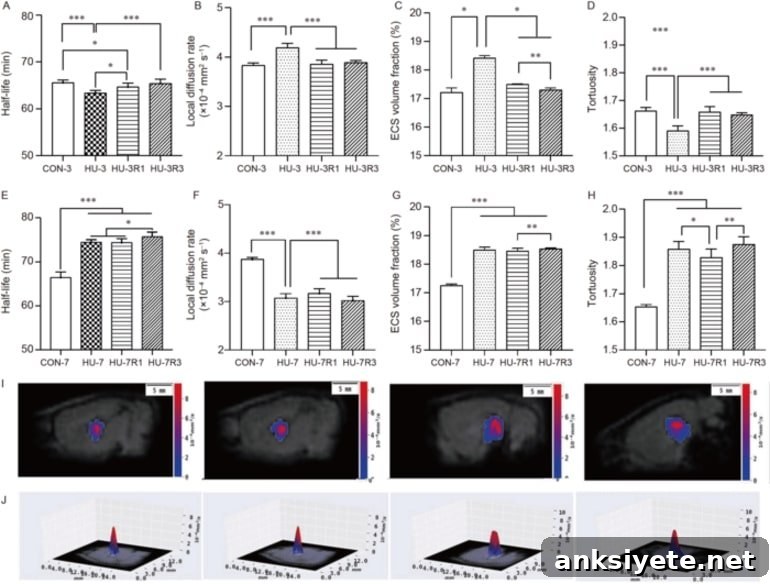
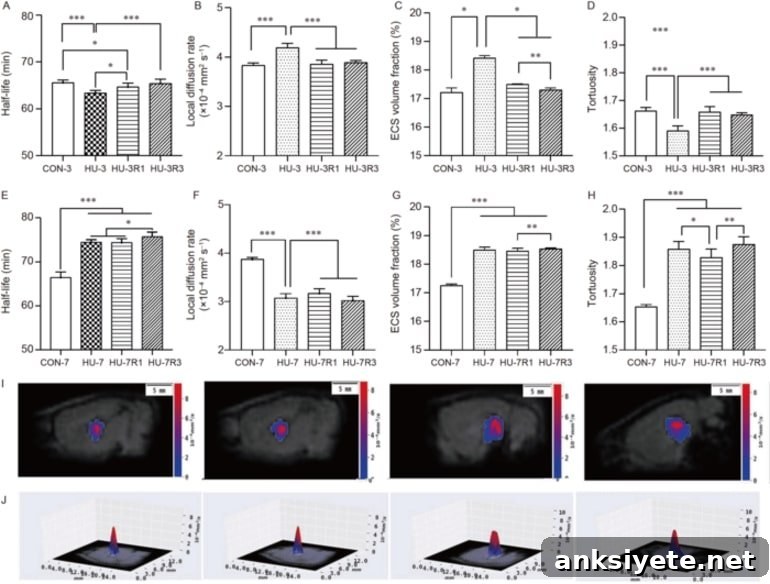
Study overview: This study used a tail-suspended hindlimb-unloading rat model to simulate microgravity and applied tracer-based magnetic resonance imaging (MRI) together with a custom D_ECS-mapping measurement system to track ISF drainage and ECS properties in the hippocampus at two early time points: day 3 (HU-3) and day 7 (HU-7). The approach allowed in vivo visualization of substance transport and quantitative assessment of ECS parameters such as volume fraction, tortuosity, and diffusion rate.
Key findings: At three days of simulated microgravity, the drainage of ISF from the hippocampal ECS was accelerated, the ECS tortuosity decreased, and the diffusion rate within the ECS increased. By contrast, after seven days of exposure the drainage of ISF slowed substantially, ECS tortuosity increased, and diffusion rates declined. Notably, the ECS volume fraction increased at both time points, indicating an early expansion of extracellular space despite divergent effects on transport dynamics.
Histology and cell viability: Histological examination with hematoxylin–eosin (HE) staining and TUNEL assays showed no abnormal neuronal morphology or elevated apoptosis in the HU-3 group compared with controls. However, in the HU-7 group the hippocampal CA1 region displayed persistent structural abnormalities and increased neuronal apoptosis, suggesting that the longer exposure produced irreversible cellular damage in this region.
Recovery after reloading: When animals were returned to normal loading conditions, the accelerated drainage seen at day 3 returned to baseline, indicating reversibility of early changes. In contrast, the slowed ISF drainage and associated ECS alterations observed at day 7 did not recover after reloading, pointing to lasting impairment of interstitial fluid dynamics following prolonged simulated microgravity.
Physiological implications: Brain ISF flow through the ECS is essential to maintaining the chemical environment required for neuronal signaling and metabolic clearance. ISF drainage depends on both the microscopic geometry of the ECS and the functional integrity of drainage pathways. Changes in ECS tortuosity, volume fraction, and diffusion rates directly affect how quickly metabolites and signaling molecules can be removed or distributed, with potential consequences for neuronal health and cognition.
Regulatory factors: Both ISF drainage and ECS diffusion are influenced by neuronal activity and neurotransmitter release, implying that altered neural network activity during microgravity may feed back to modify ECS structure and transport. The study highlights the need to explore interactions among neural networks, the ECS, and the cerebrovascular system to better understand how microgravity perturbs brain homeostasis.
Implications for spaceflight and astronaut health: Detecting early nanoscale structural changes in the hippocampal ECS and associated disruptions in ISF drainage may offer a novel route for monitoring and mitigating microgravity-induced brain injury. These findings emphasize the importance of studying ECS and ISF dynamics over longer durations to develop targeted neuroprotective strategies for long-term manned missions, including extended orbital flights and lunar surface operations.
About this neuroscience research news
Author: Bei Yan
Source: Science China Press
Contact: Bei Yan – Science China Press
Image: Image credited to Science China Press
Original Research: Closed access. “Early changes to the extracellular space in the hippocampus under simulated microgravity conditions” by Gao, Y., Han, H., Du, J., et al. Published in Science China Press Sciences.
Abstract
Early changes to the extracellular space in the hippocampus under simulated microgravity conditions
Smooth transport of molecules through the brain extracellular space (ECS) is critical for preserving neuronal function, but how these processes respond to simulated microgravity has been unclear. Using tracer-based MRI and D_ECS-mapping, this study measured ISF drainage and ECS parameters in the hippocampus of hindlimb-unloaded rats at day 3 (HU-3) and day 7 (HU-7). Results showed accelerated ISF drainage, reduced tortuosity, increased diffusion rates, and ECS expansion at day 3. At day 7, ISF drainage was markedly slowed, tortuosity increased, diffusion slowed, and ECS volume fraction remained elevated. Early changes at day 3 were reversible after reloading, whereas alterations at day 7 persisted. These observations indicate that tracer-based MRI can detect early, nanoscale alterations to hippocampal ECS structure and ISF drainage under simulated microgravity, offering new avenues for studying microgravity-induced brain changes and for designing neuroprotective interventions for long-duration spaceflight.