
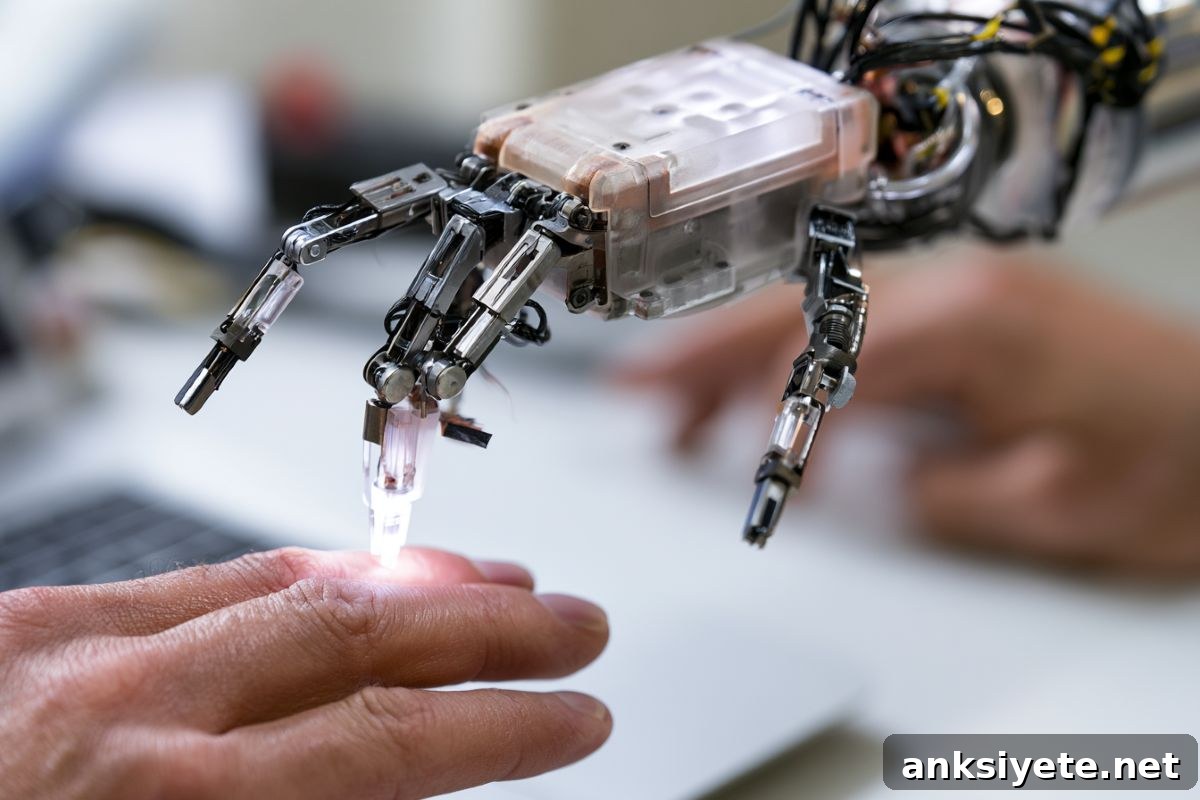
Summary: Researchers have developed a soft, mechanochromic material that converts invisible mechanical forces into immediate, high-definition structural color patterns. By embedding sensing into the material itself, a simple, low-cost USB camera can capture rich, high-resolution pressure and strain maps in real time without heavy computation or complex reconstruction algorithms.
Key Facts
- Sensing inside the substrate: Instead of arrays of fragile microelectronic sensors, the sensing mechanism is built directly into the polymer’s molecular architecture, so mechanical deformation produces an optical response at the material level.
- Fingerprint-level resolution: The system achieves exceptionally high sensor density. During tests, a standard camera captured the microscopic ridges of a human fingerprint—resolution that would demand thousands of wired microcomponents in conventional taxel-based systems.
- Direct observation of touch: Mechanical interactions are encoded as distinct, spatial color fields, eliminating the need for time-consuming reconstruction. The optical signal itself contains the tactile information, removing latency introduced by heavy processing.
- Precision robotic gripping: Mechanochromic skin wrapped around industrial grippers makes micro-scale shifts in force immediately visible, helping to protect fragile components during precision assembly.
- Prosthetics with richer touch: External prosthetic limbs can use this direct optical feedback to provide continuous, high-resolution tactile information during everyday tasks and clinical interactions.
- Color-guided surgical assistance: When applied to minimally invasive instruments, the material can reveal subtle pressure signatures that help distinguish tissue types, supporting safer automated or robot-assisted procedures.
Source: Queen Mary University of London
Overview of the innovation
Invented by Giacomo Sasso, a postdoctoral researcher in the School of Engineering and Materials Science at Queen Mary University of London, this approach translates mechanical strain and pressure directly into visible structural colors. The material is designed so that microscopic changes in its internal architecture alter how light is reflected and transmitted. Those color variations form spatial maps of contact, strain, and pressure that a basic camera can record instantly.
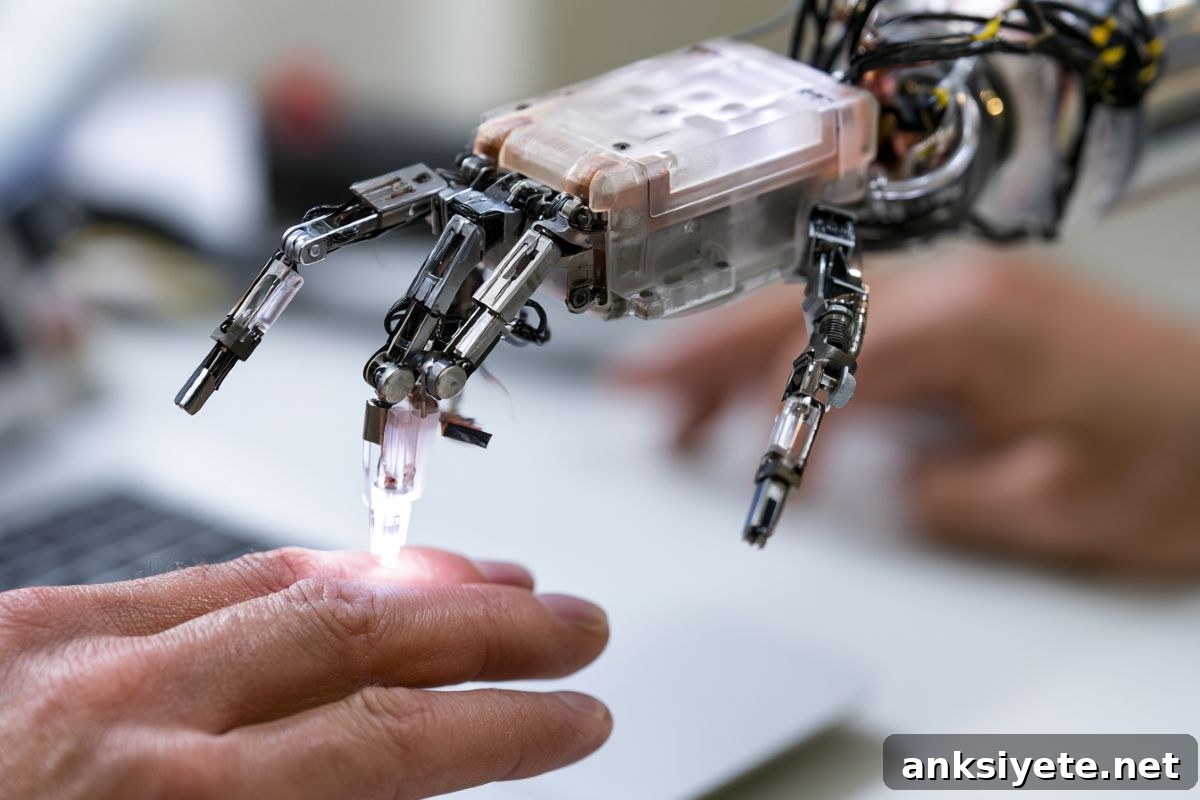
Because the optical response appears immediately at the point of contact, the system requires no dense wiring, complex sensor arrays, or deep learning enhancement to reveal contact morphology. The mechanochromic element is a Bragg-reflector-like multilayer embedded between soft silicone layers; by tailoring the stack thickness and elasticity, designers can tune the material to respond to pressure or strain distributions appropriate to the application.
This simplicity makes the technology suitable for diverse applications: robotic grippers handling delicate electronic parts benefit from instant visual feedback of force distribution; prosthetic devices can convey nuanced touch cues externally or to downstream systems; and surgical tools can present real-time pressure maps that help differentiate soft, healthy tissue from stiffer lesions or scar tissue during minimally invasive operations.
Traditional tactile sensing faces a persistent trade-off: taxel-based sensors can operate in real time but are limited by the physical size, wiring, and cross-talk of individual sensing elements, while vision-based approaches attain higher spatial detail only at the cost of computational latency. The mechanochromic strategy breaks that compromise by producing high-resolution optical maps at frame rates dictated only by the camera, not by heavy reconstruction pipelines.
How it works: concise explanations
A: The material’s internal microstructure shifts under mechanical strain. Rather than using dyes, it produces structural color: tiny periodic features change spacing or orientation when compressed or stretched, altering how specific wavelengths of light are reflected. The color change is local and instantaneous, so a camera image directly encodes the pressure pattern.
A: Direct optical encoding removes the computational middle step required by many tactile systems. Because the tactile information is already present in the light signal, a camera can capture contact geometry and pressure distribution in real time with minimal processing, enabling zero-latency sensing suitable for responsive robotic control.
A: The skin’s immediate color response reveals subtle differences in mechanical resistance. Wrapped around surgical instruments, it can highlight areas that resist pressure differently—such as harder tumors or scarred tissue—by producing distinct color patterns that guide safer instrument motion and manipulation.
Editorial notes
- This article was edited by a Neuroscience News editor.
- The original journal paper was reviewed in full.
- Additional context was provided by editorial staff.
About this research
Author: Anna Asenova Dinis
Source: Queen Mary University of London
Contact: Anna Asenova Dinis – Queen Mary University of London
Image credit: Neuroscience News
Original research: Open access. Title: “High-resolution real-time mechanochromic tactile sensors” — authors include Aaron M. Duncan, Alessandro Pagani, Federico Carpi, Giacomo Sasso, Gianni Pedrizzetti, James J. C. Busfield, Nicola Pugno. Published in Science Advances. DOI: 10.1126/sciadv.aee5236
Abstract
High-resolution real-time mechanochromic tactile sensors
High-resolution, real-time tactile sensing is critical for tasks that require accurate detection of contact shape and pressure distribution, such as grasping fragile, slippery, or irregular objects. Existing technologies face a trade-off between spatial resolution and response speed. Traditional taxel-based sensors (capacitive, resistive, piezoelectric) operate in real time but are limited by taxel size, spacing, wiring, and cross-talk; even data-driven super-resolution rarely achieves better than ~1 millimeter. Vision-based tactile sensors can reach finer detail but typically rely on computation to reconstruct three-dimensional contact maps, adding latency.
Mechanochromic tactile sensors presented here directly encode mechanical strain into spatially resolved structural colors, enabling vision-based tactile sensing with a unique combination of high spatial resolution, immediate operation, and architectural simplicity. Devices consist of a stretchable mechanochromic Bragg reflector sandwiched between soft silicone layers, with tunable thickness to map pressure or strain precisely. Example topological maps—of a fingertip, a coin, and a leaf—demonstrate approximately 100 micrometer resolution without deep learning enhancement or computational delay. This straightforward, optically encoded sensing approach has transformative potential for robotic gripping, tactile inspection, and enhanced human–robot interaction.