
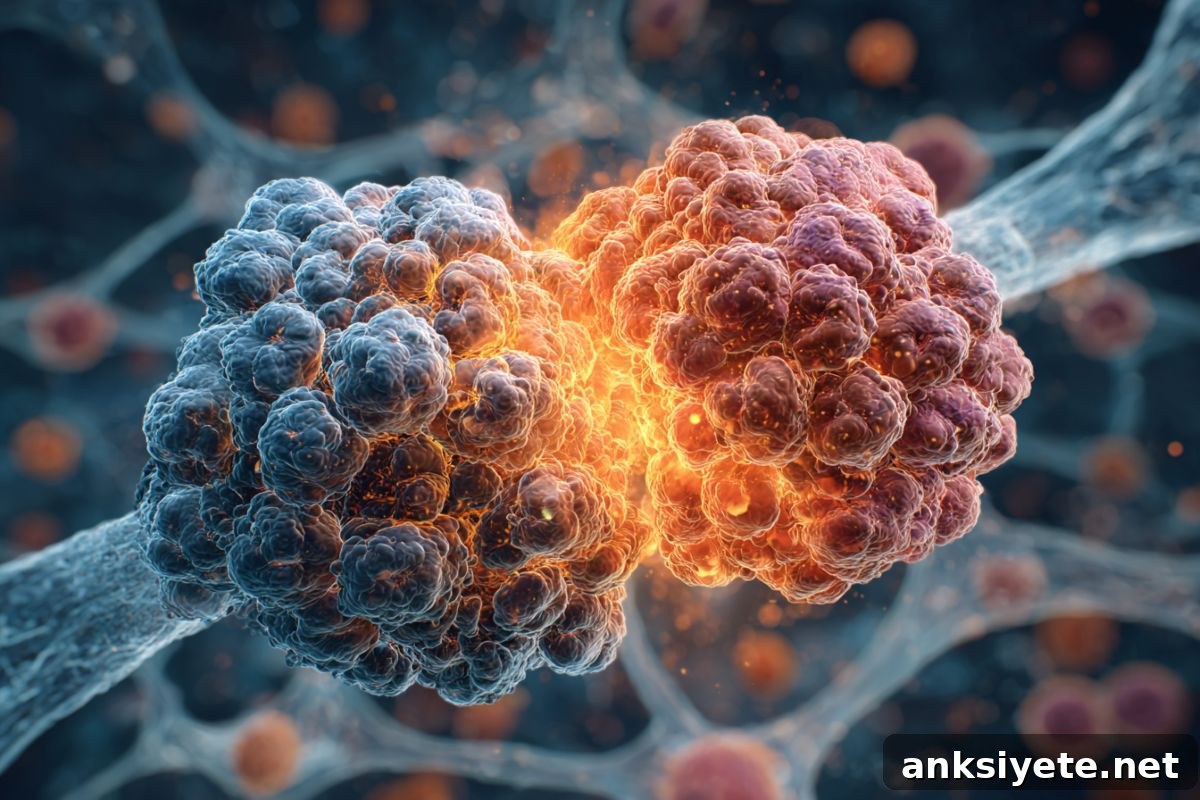
Summary: A new study reveals that glioblastoma cells behave very differently depending on whether they remain in homotypic clusters or disperse through the tumor. Cells that stay clustered tend to be less aggressive and maintain a stable identity, while dispersed cells show increased plasticity—making them more adaptable and more likely to resist therapies. This relationship between spatial arrangement and cell state may explain why glioblastoma almost always returns after treatment and appears to extend to other solid tumors, including breast cancer.
Key Facts
- Clustered vs. Dispersed: Cells in homotypic clusters retain their original state and appear less aggressive; dispersed cells adopt alternative phenotypes and are more plastic.
- Treatment Risks: Radiation or chemotherapy may unintentionally break clusters apart, increasing the proportion of dispersed, treatment-resistant cells.
- Broad Principle: Similar spatial and functional patterns were observed in breast cancer samples, suggesting a general mechanism across solid tumors.
Source: University of Miami
Researchers at the Sylvester Comprehensive Cancer Center, part of the University of Miami Miller School of Medicine, report detailed observations that change how we think about glioblastoma cell behavior. Led by Anna Lasorella, M.D., and Antonio Iavarone, M.D., the team used spatial transcriptomics to map single-cell gene expression and location within tumors. Their results, published in Cancer Cell, show that glioblastoma cells organized in homotypic clusters are biologically distinct from cells that are spatially dispersed.
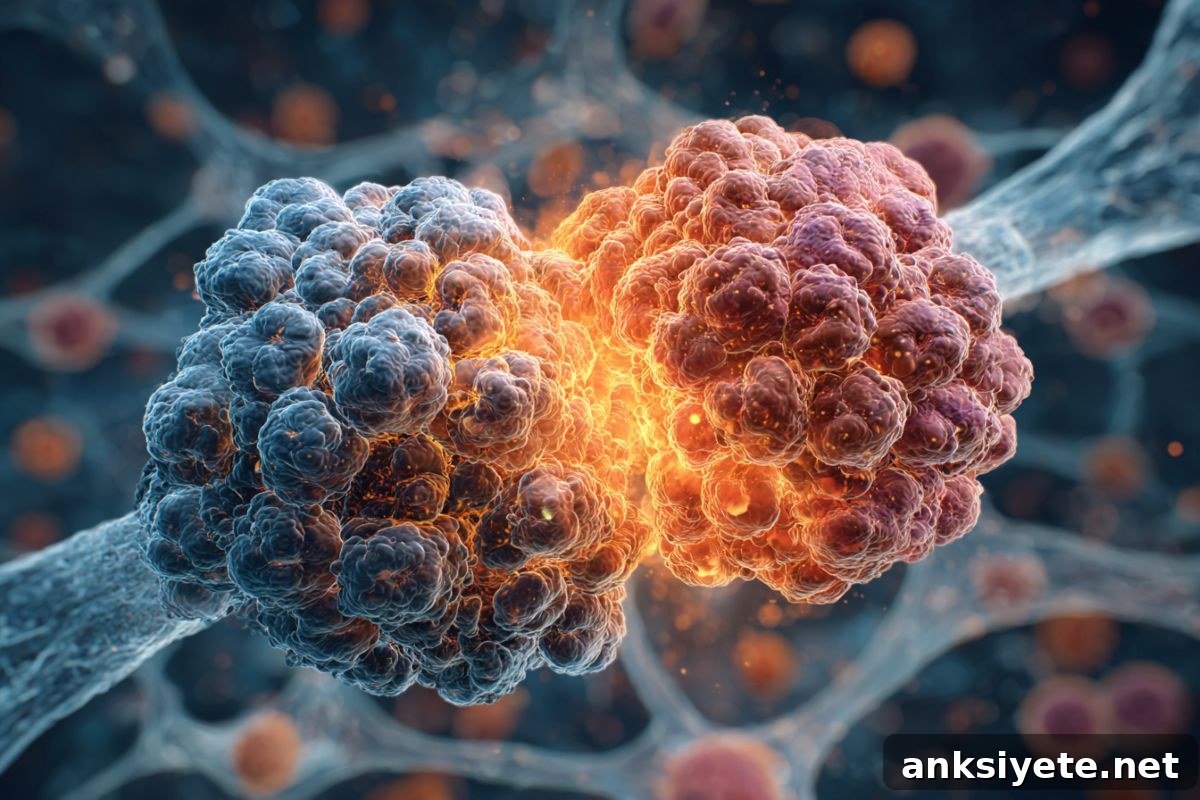
Glioblastoma is an aggressive brain tumor with a median survival a little over a year after diagnosis. Recurrence after initial therapy is nearly universal, and recurrent tumors are typically resistant to further treatment. The study provides a plausible explanation: dispersed glioblastoma cells show increased plasticity, the ability to switch states and adopt new phenotypes, which is strongly linked to therapy resistance.
Using the CosMx platform for spatial transcriptomics, the investigators profiled thousands of genes at single-cell resolution and precisely mapped each cell’s neighbors. In prior work they had defined four distinct glioblastoma cell types based on gene-expression programs. In this study they examined how those cell types are spatially arranged and discovered two contrasting patterns: homotypic clusters, where like cells group tightly together, and dispersed regions, where different cell types intermingle.
Cells in homotypic clusters showed coherent gene-expression programs and expressed surface adhesion proteins that promote cell-cell cohesion. Dispersed cells, by contrast, downregulated those adhesion molecules, upregulated alternative gene programs, and adopted a glycolytic-plurimetabolic phenotype associated with greater plasticity. These dispersed cells also appear to influence the tumor microenvironment differently than clustered cells.
The team validated the intrinsic tendency of glioblastoma cells to form these spatial patterns in orthotopic mouse models and in patient-derived specimens. Pharmacologic disruption of adhesion in preclinical models increased dispersion, while the researchers are now exploring whether promoting adhesion can preserve the less plastic clustered state. They are also investigating whether dispersed cells produce factors that actively disrupt adhesion and could therefore serve as drug targets.
Importantly, the same spatial relationship between clustering and plasticity was observed in breast cancer samples: circulating clustered breast cancer cells retained a more stable identity, while single, dispersed breast cancer cells were more plastic. This suggests the phenomenon is not limited to glioblastoma but may represent a wider principle of solid tumor biology.
While glioblastoma rarely metastasizes like other solid tumors, understanding the drivers of cell plasticity can illuminate why some tumors invade, resist therapy, and recur. The researchers caution that the idea—standard treatments breaking clusters and thereby increasing plasticity—remains a hypothesis needing direct clinical testing, but the spatial patterns they observed are clear and reproducible.
The investigators propose that therapies designed to maintain homotypic clustering or to block the signals that enable dispersal and plasticity might reduce the emergence of therapy-resistant cells. If successful, such approaches could improve outcomes by keeping malignant cells in a less adaptable, more treatable state.
About this glioblastoma brain cancer research news
Author: Sandy Van
Source: University of Miami
Contact: Sandy Van – University of Miami
Image: The image is credited to Neuroscience News
Original Research: Open access. “Restraint of cancer cell plasticity by spatial homotypic clustering” by Anna Lasorella et al., Cancer Cell
Abstract
Restraint of cancer cell plasticity by spatial homotypic clustering
Tumor heterogeneity driven by cancer cell plasticity is a major factor in treatment failure. This study defines how local interactions among malignant cells influence glioblastoma plasticity. We find that cells organized in homotypic clusters maintain a consistent state and specific relationships with non-malignant neighbors, while randomly dispersed cells downregulate their original programs, adopt alternative phenotypes, and reshape the microenvironment. In orthotopic mouse models and patient-derived glioblastoma specimens, glioblastoma cells intrinsically form clustered and dispersed patterns. We experimentally validate cell state–specific adhesion mechanisms that prevent phenotype deviation and show that disrupting adhesion increases dispersion. Extending these observations to breast cancer, we establish that clustered circulating tumor cells preserve a clustered identity while single cells are more plastic. The glioblastoma dispersed state marked by glycolytic-plurimetabolic features correlates with shorter survival, underscoring the clinical significance of spatial patterning in human tumors.