

Summary: New findings show that individual differences in the severity of depressive symptoms after a relationship breakup are linked to measurable changes in resting-state whole-brain dynamics.
Source: UPF Barcelona
Overview: Stressful life events can precipitate depressive symptoms even in people without a clinical diagnosis. A relationship breakup is a common and emotionally significant example: it can reduce quality of life and increase the risk of developing major depressive disorder. While resting-state neuroimaging has revealed altered whole-brain communication in clinically depressed patients, less is known about the neural signatures of depressive symptoms in non-clinical populations who experience stressful events.
Published online in NeuroImage: Clinical (26 May), the study examines whether differences in how strongly people report depressive symptoms following a romantic breakup are reflected in changes to the brain’s spontaneous, resting-state dynamics across the whole brain.
The research was led by Sonsoles Alonso Martínez under the supervision of Gustavo Deco, ICREA research professor in the Department of Information and Communication Technologies (DTIC) and director of the Center for Brain and Cognition (CBC) at Pompeu Fabra University (UPF). Co-authors include researchers from institutions in Groningen (Netherlands), Oxford (UK), Aarhus (Denmark) and Minho (Braga, Portugal). Gustavo Deco contributed substantially to the study’s methodology.
“We applied an intrinsic ignition framework to resting-state data from 69 participants who reported varying levels of depressive symptoms after a breakup,” explains Gustavo Deco. “We tested the hypothesis that higher self-reported depressive symptoms would be associated with lower global integration and with decreased spatiotemporal variability in brain functional organization.”
The intrinsic ignition approach, proposed by Deco and Morten L. Kringelbach (2017) and used in this study, quantifies how spontaneous local events in brain activity propagate across the network. Each event measures a region’s capacity to ignite or trigger activity in other regions, contributing to levels of integration—the ability of the brain to interconnect and share information. Key ignition-based metrics include integration (how well the brain integrates information globally), hierarchy or spatial diversity (how varied regional contributions are across the brain), and metastability or temporal variability (how flexibly network patterns change over time).
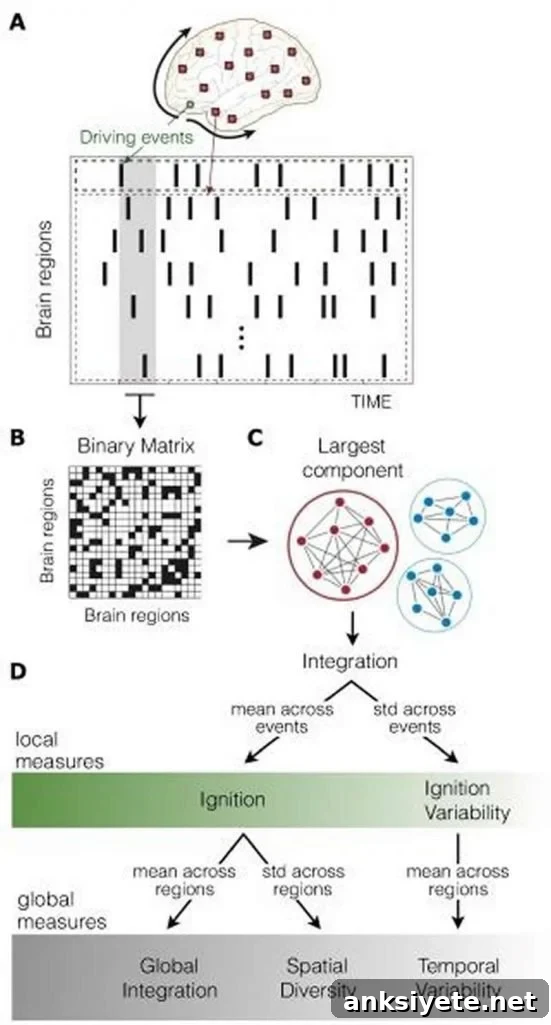
Using ignition measures averaged across regions to produce global indices, the team evaluated whether these measures correlated with depressive symptom severity. Temporal variability was used as an index of dynamic flexibility (metastability), while spatial diversity reflected hierarchical differences across regions.
Results indicate a clear relationship between depressive symptom severity and constrained brain dynamics. Participants who reported more severe depressive symptoms after the breakup showed deficits in the brain’s ability to integrate and process information globally over time. Higher symptom levels were associated with reduced spatial diversity—meaning a flatter hierarchy of regional contributions—and decreased temporal variability, indicating less flexible, more rigid functional organization during rest.
These findings suggest that even in non-clinical individuals who are vulnerable but not diagnosed with depression, constrained dynamical complexity—what the authors describe as brain rigidity—relates to depressive symptom levels. Given accumulating evidence of altered resting-state dynamics across psychiatric conditions, the authors propose that measures of reduced spatiotemporal complexity may serve as potential markers of risk for mental health problems.
About this research
Source: UPF Barcelona
Media contacts: Nuria Perez – UPF Barcelona
Image credit: UPF
Original research (open access):
Title: “Reduced spatiotemporal brain dynamics are associated with increased depressive symptoms after a relationship breakup.” Authors: Sonsoles Alonso Martínez, Jan-Bernard C. Marsman, Morten L. Kringelbach, Gustavo Deco, Gert J. ter Horst. NeuroImage: Clinical. DOI: 10.1016/j.nicl.2020.102299
Abstract (concise summary)
Depressive symptoms after stressful events like relationship breakdowns are common and increase risk for major depression. While abnormal whole-brain communication has been documented in clinical depression, this study assessed whether depressive symptom severity in a non-clinical sample is associated with altered complex brain dynamics at rest. Using an intrinsic ignition method on resting-state data from 69 participants, ignition-based measures of integration, hierarchy, and metastability were computed. All three measures negatively correlated with depressive ratings. Greater depressive symptoms related to reduced global integration, diminished spatial diversity (hierarchy), and lower temporal variability (metastability). The results indicate that constrained dynamical complexity of resting brain activity is sensitive to depressive symptom levels even outside clinical populations.