
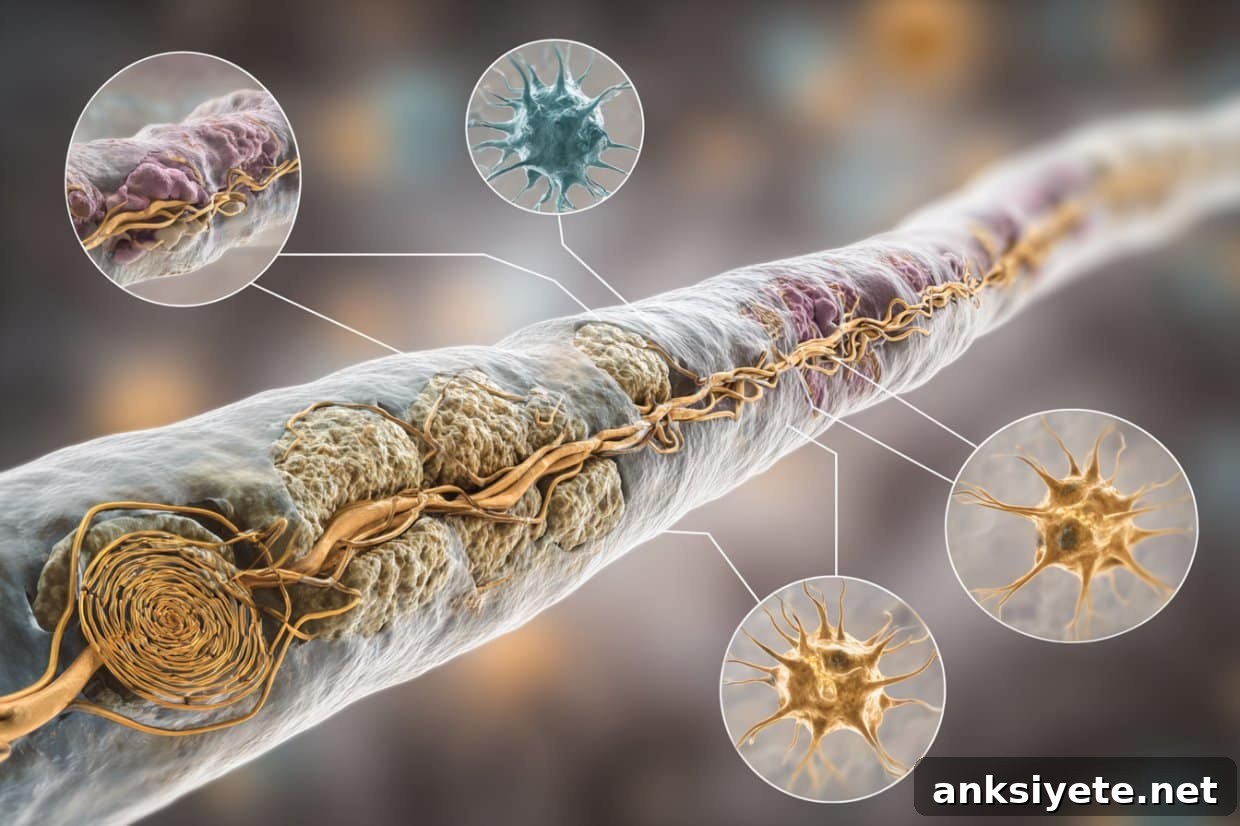
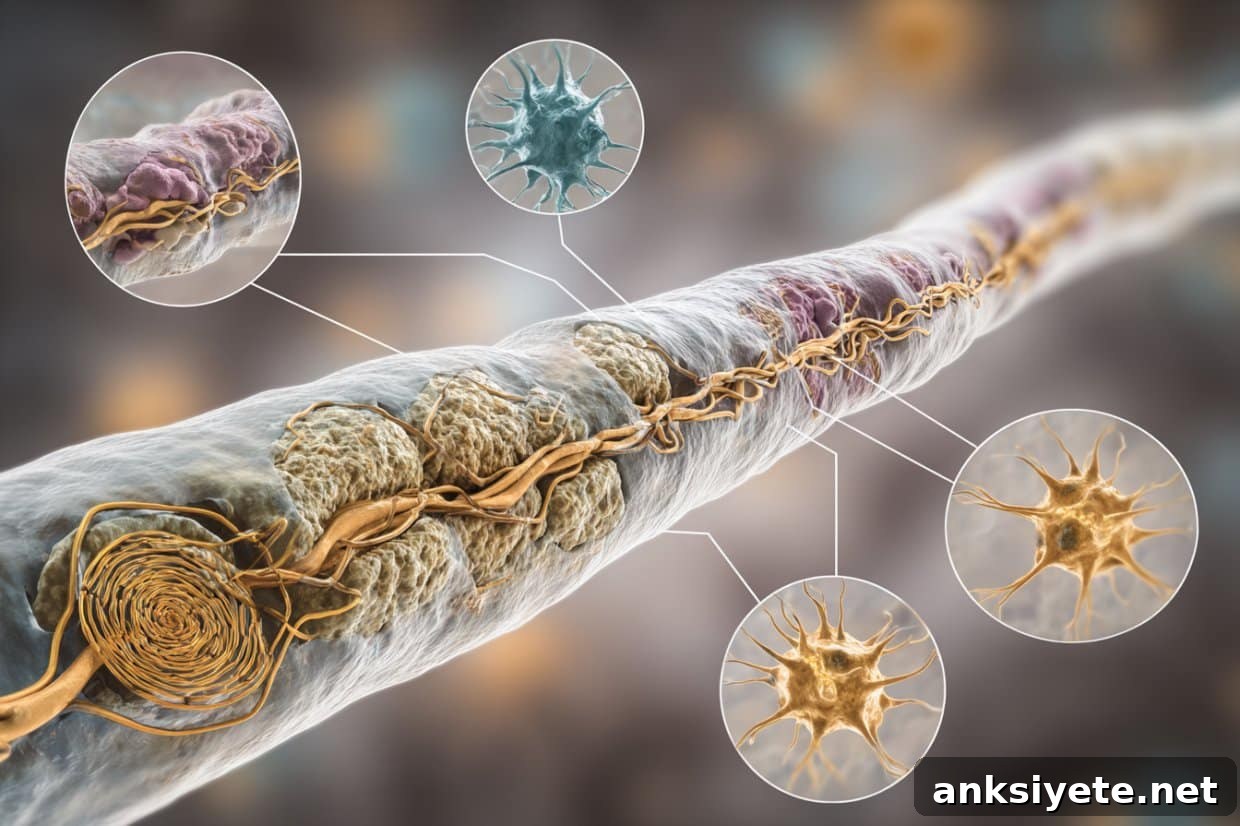
Summary: New research from Yale indicates that Alzheimer’s disease may disrupt nerve function not by wholesale loss of myelin but by changing the protein composition at the critical interface where myelin meets the axon. Researchers identified structural changes in the paranodal region—where myelin adheres to axons—including accumulation of spiral-shaped amyloid deposits that appear to block nutrient channels and interfere with signal transmission.
Surprisingly, overall myelin levels remained largely intact, pointing to a microscopic, structural dysfunction at the myelin–axon boundary rather than broad demyelination. These results shed light on how axonal signaling fails in Alzheimer’s and point to new, underexplored targets for therapeutic intervention.
Key facts:
- Paranode alterations: Protein changes at the axon–myelin junction can impair electrical conduction along nerve fibers.
- Amyloid accumulation: Spiral-like amyloid assemblies appear in periaxonal spaces and paranodal channels, potentially obstructing nutrient flow and contributing to axonal swelling.
- Myelin quantity preserved: Total myelin coverage does not show major loss, but its molecular organization and function at the interface are disrupted.
Source: Yale
Background: Axons are the thin projections of neurons that carry electrical impulses. Myelin, a lipid-rich sheath produced by oligodendrocytes, insulates axons and enables rapid, efficient signal conduction—much like the plastic coating around an electrical wire. When myelin or its attachment to axons is disturbed, signal transmission slows or fails.
To investigate how Alzheimer’s pathology affects the myelin–axon interface, a Yale team profiled proteins in postmortem human brain tissue with a focus on the narrow subcellular compartment between axon and myelin. They compared samples from individuals with Alzheimer’s disease to age-matched controls and complemented human studies with mouse models.
Using proximity-labeling proteomics, the researchers selectively tagged proteins localized within the myelin–axon interface, then identified and quantified them with mass spectrometry. This subcellular approach allowed detection of subtle but potentially important changes that would be missed in bulk tissue analyses.
The protein signature at this interface differed between Alzheimer’s and non-Alzheimer’s brains, with altered pathways linked to amyloid processing, axonal growth, and lipid metabolism—processes that are essential for myelin integrity and axon health. Because myelin depends heavily on lipids, disruptions in lipid metabolism could impair myelin function even when overall myelin abundance appears unchanged.
High-resolution imaging reveals paranodal defects
The team applied expansion microscopy, a super-resolution imaging method, to visualize subcellular structures in greater detail. Consistent with the proteomics data, total myelin coverage was similar between Alzheimer’s and control tissues, but the fine architecture at nodes of Ranvier and their adjacent paranodal regions was altered.
Nodes of Ranvier are short, unmyelinated gaps that boost the electrical signal, while paranodes are the tight junctions that anchor the myelin sheath and organize ion channels for rapid conduction. Although myelin quantity was preserved, proteins that maintain paranodal structure were changed in Alzheimer’s samples, which can undermine the nerve’s ability to conduct signals efficiently.
The researchers observed amyloid-β aggregates forming in spiral loops within the periaxonal and paranodal channels. These deposits appear to clog the narrow passages that normally allow nutrient exchange and waste clearance between myelin and axon.
“These channels are clogged up by accumulation of amyloid proteins,” explains Jaime Grutzendler, MD, the study’s senior author. The obstruction may compromise axonal function and the metabolic support that myelin provides.
In multiple samples, amyloid accumulation was associated with localized axonal swelling and the appearance of axonal spheroids—bulb-like enlargements that further disturb conduction. Abnormal patterns of myelination around these spheroids suggest a compounded effect: structural interruption of electrical signaling plus altered insulation around swollen axon segments.
The authors compare the process to tightening a knot around a straw: constriction of the channel followed by pressure leads to enlargement—here, amyloid constricts paranodal channels and contributes to swelling of the axon.
Looking ahead, the team plans to use the proteomic signatures they identified to test whether specific molecular interventions can reverse or mitigate the paranodal abnormalities at the myelin–axon interface. For now, the work provides new, hypothesis-generating evidence that the myelin–axon boundary is a vulnerable and therapeutically relevant site in Alzheimer’s disease.
Co-authors include Fuyi Chen, Tram Huynh, Jean Kanyo, Peiyang Tang, Lukas Fuentes, Amber Braker, Rachel Welch, Anita Huttner, Lei Tong, Peng Yuan, TuKiet Lam, Angus Nairn of Yale; Iguaracy Pinheiro-de-Sousa and Evangelia Petsalaki of the European Bioinformatics Institute; and Mykhaylo Slobodyanyuk and Jüri Reimand of the Ontario Institute for Cancer Research.
Funding: This research was supported by the National Institutes of Health (awards RF1AG058257, R01NS115544, R01NS111961) and Yale University. Additional support came from the Cure Alzheimer’s Fund, a Yale/NIDA Neuroproteomics Center Pilot Project Grant, the BrightFocus Foundation, the Yale Alzheimer’s Disease Research Center, the Alzheimer’s Association, and the EMBL Corporate Partnership Programme. The content is the responsibility of the authors and does not necessarily represent official NIH views.
About this Alzheimer’s disease research news
Author: Isabella Backman
Source: Yale
Contact: Isabella Backman – Yale
Image: The image is credited to Neuroscience News
Original Research: Closed access.
“Myelin–axon interface vulnerability in Alzheimer’s disease revealed by subcellular proteomics and imaging of human and mouse brain” by Jaime Grutzendler et al. Nature Neuroscience
Abstract
Myelin–axon interface vulnerability in Alzheimer’s disease revealed by subcellular proteomics and imaging of human and mouse brain
Myelin ensheathment is vital for rapid axonal conduction, metabolic support and neuronal plasticity. In Alzheimer’s disease (AD), myelin and axonal structures are disrupted, but the mechanisms are not fully understood.
We applied proximity labeling subcellular proteomics to the myelin–axon interface in postmortem human AD brains and in 15-month-old male and female 5XFAD mice. The analysis uncovered dysregulated signaling pathways and ligand–receptor interactions associated with amyloid-β processing, axonal outgrowth and lipid metabolism.
Expansion microscopy validated the subcellular localization of key proteomic hits and revealed amyloid-β aggregation within internodal periaxonal spaces and paranodal/juxtaparanodal channels. While overall myelin coverage remained preserved, patrol density at paranodes was reduced, myelination became aberrant, and paranodal positioning was altered around amyloid-plaque-associated dystrophic axons.
These findings identify the myelin–axon interface as a critical locus of protein aggregation and disrupted neuro-glial signaling in Alzheimer’s disease.