
Summary: Researchers have developed an advanced AI system called YORU that identifies specific animal behaviors in real time with over 90% accuracy across multiple species. Integrated with precision optogenetics, YORU can trigger light-based interventions that silence targeted neurons in a single individual while leaving nearby animals unaffected. This capability enables experiments that isolate how particular brain circuits shape social behaviors in ants, zebrafish, mice, and fruit flies.
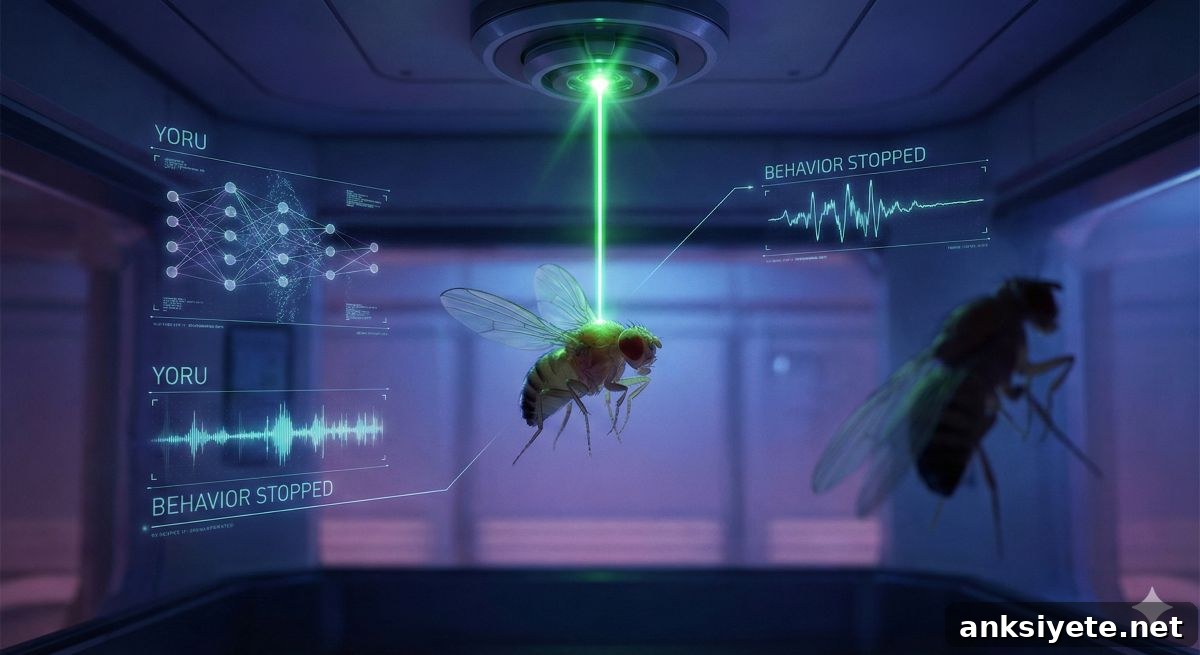
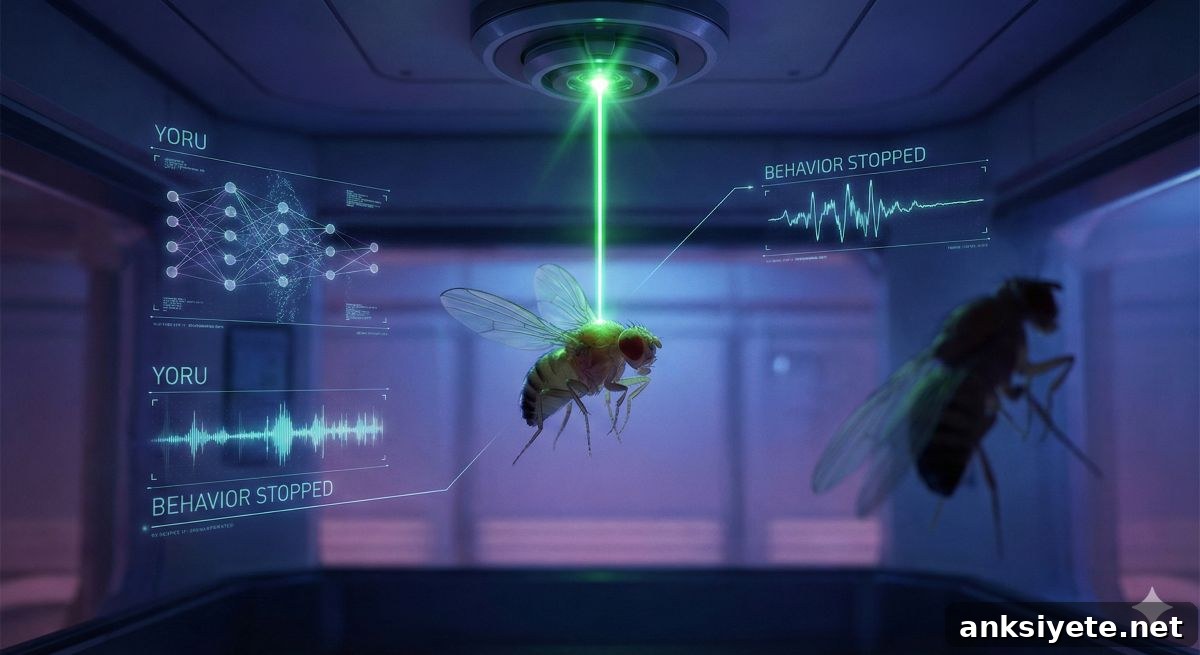
In a striking demonstration, the system detected a male fruit fly beginning its courtship wing extension and immediately activated a focused light to silence the neurons responsible for producing its courtship song. The birdlike serenade stopped mid-note and the female fly disengaged—showing that YORU can both detect a behavior instantly and manipulate the neural activity of one animal among many.
Key Facts
- Speed and accuracy: YORU recognizes whole behaviors from single video frames rather than tracking individual body parts over time. That object-based approach yields 90–98% accuracy across tested behaviors and runs about 30% faster than pose-based tools, even when animals overlap.
- Precision optogenetic targeting: The system couples high-speed detection with a movable, AI-controlled light source to illuminate only the intended animal. This lets researchers manipulate one subject’s neurons without altering the behavior of neighbors in the same arena.
- Cross-species versatility: YORU is designed to be plug-and-play across diverse species and behaviors. The team validated it on food-sharing in ants, social orientation in zebrafish, grooming in mice, and courtship in Drosophila, with minimal training data and no programming required for end users.
Source: Nagoya University
A male fruit fly in a lab chamber extends and vibrates his wings to perform a courtship song while a female listens nearby. In one experiment, a brief green flash of light interrupted the performance and the male’s wings folded. The interruption came from an automated system: YORU detected the wing-extension posture and triggered targeted photostimulation to silence the neurons that generate the song.
Developed by researchers at Nagoya University with collaborators from Osaka University and Tohoku University, YORU combines object-based deep learning for behavior detection with closed-loop optogenetic control. The work, published in Science Advances, presents an integrated tool for identifying which animal in a group performs a behavior and delivering light stimulation precisely to that individual in real time.
YORU—short for Your Optimal Recognition Utility—classifies social behaviors at the level of whole-body postures rather than individual joints or landmarks. This object-based approach identifies a behavior from a single frame by recognizing the animal’s overall shape and posture, which makes detection faster and more robust when multiple individuals interact or occlude one another.
The most powerful aspect of the system is its closed-loop capability. When YORU detects a target behavior, it instantaneously signals a controllable light source. Animals are genetically engineered to express light-sensitive opsins in selected neurons; the brief, targeted illumination opens or closes ion channels in those neurons, thereby activating or suppressing their activity and producing immediate changes in behavior.
According to Hayato Yamanouchi, co-first author from Nagoya University’s Graduate School of Science, “Instead of tracking body points over time, YORU recognizes entire behaviors from their appearance in a single video frame. It detected behaviors across flies, ants, and zebrafish with 90–98% accuracy and ran about 30% faster than competing tools.”
Senior author Azusa Kamikouchi emphasized the combination of speed and targeted photostimulation as the breakthrough: “We can silence fly courtship neurons the instant YORU detects wing extension. In a separate experiment, a spotlight followed an individual fly and selectively blocked its hearing neurons while other nearby flies remained unaffected.” This capability removes a longstanding limitation of optogenetic experiments, which previously required illuminating entire chambers and thus influenced all animals simultaneously.
How the brain control system operates
Step 1: Genetic preparation
Animals used in these experiments are engineered to express light-sensitive proteins (opsins) in specific neurons. Depending on the opsin type, light exposure can activate or inhibit those neurons.
Step 2: Real-time detection and triggering
• A camera captures the group’s behavior continuously.
• YORU analyzes each video frame and detects predefined behavior objects in real time.
• Upon detection, YORU sends an electrical trigger to a movable light source aimed at the detected individual.
Step 3: Photostimulation modulates neural activity
• The targeted light illuminates the individual and reaches the opsin-expressing neurons.
• Opsins respond by opening or closing ion channels, which activate or suppress specific neurons.
• The manipulation alters the animal’s brain activity and thereby affects the detected behavior.
YORU’s design allows it to be trained on new behaviors with only a small amount of labeled data and to be used without programming expertise, which makes it accessible to researchers studying social neuroscience and neuroethology worldwide. The developers have made the system available for the scientific community to accelerate studies that link specific neurons to social actions.
Key Questions Answered
A: Traditional software typically uses pose estimation to track specific body points frame by frame, which struggles when animals overlap or cluster. YORU treats whole postures as “behavior objects,” detecting the shape and appearance of a behavior in a single frame. This object-based detection is faster and maintains high accuracy in crowded social contexts.
A: Previous optogenetic setups illuminated entire arenas, affecting all animals at once and preventing causal tests of an individual’s role in group behavior. YORU’s rapid detection and AI-directed light source enable millisecond-scale targeting of a single animal, so researchers can observe how manipulating one individual influences interactions with others.
A: Yes. The system has been validated across a range of body plans—ants, zebrafish, and mice—demonstrating 90–98% accuracy in detecting social behaviors. Its low data requirements and user-friendly interface are intended to make it broadly useful for behavioral neuroscience experiments across taxa.
Editorial Notes
- This article was edited by a Neuroscience News editor.
- The original journal paper was reviewed in full by the editorial team.
- Additional context was added by staff to explain technical details and experimental implications.
About this AI and neuroscience research news
Author: Merle Naidoo
Source: Nagoya University
Contact: Merle Naidoo – Nagoya University
Image credit: Neuroscience News
Original research (open access): “YORU: animal behavior detection with object-based approach for real-time closed-loop feedback” by Azusa Kamikouchi et al., published in Science Advances. The study presents the YORU framework, its object-based detection pipeline, cross-species validation, and demonstrations of real-time closed-loop photostimulation targeting single individuals during social interactions.
Abstract
YORU: animal behavior detection with object-based approach for real-time closed-loop feedback
Deep learning has transformed animal behavior analysis, yet social behaviors—driven by dynamic interactions among multiple individuals—remain difficult to quantify. YORU introduces an object-detection strategy that recognizes behaviors as whole-body “behavior objects,” enabling robust detection even when individuals are close or overlapping. The system supports real-time analysis and closed-loop photostimulation, allowing targeted delivery of light to specific individuals during social interactions. YORU addresses limitations of conventional pose estimation and offers an alternative approach for behavioral analysis in neuroethology.