
Summary: Researchers have created CapuchinAI, an open-source, battery-powered platform that automates cognitive testing of wild primates by combining facial-recognition vision, touchscreen tasks, and automated food rewards.
Tested in Costa Rica’s Taboga Forest Reserve, the system uses a YOLO-based computer-vision pipeline to detect and identify white-faced capuchins with high accuracy, runs individualized touchscreen experiments on a Raspberry Pi, and dispenses food rewards automatically to reinforce correct responses.
By merging the experimental control of laboratory methods with the realism of natural habitats, CapuchinAI provides a low-cost, scalable framework for measuring individual cognitive differences across wild primate populations without removing animals from their environment.
Key Facts
- Closed-loop automated testing: CapuchinAI packages facial-recognition vision, interactive touchscreen tasks, and a motor-driven food dispenser into a single battery-operated field unit built around a Raspberry Pi.
- High computer-vision accuracy: Trained on GoPro imagery using open-source YOLO architecture, the vision model distinguished individual capuchins in the field with approximately 97 percent accuracy in the prototype tests.
- Fast habituation and learning: Wild white-faced capuchins (Cebus capucinus / Cebus imitator) rapidly learned the touchscreen–reward association during field trials, engaging with the system without hand-feeding or direct human handling.
- Individualized testing: The software detects identities in real time and can present tailored cognitive tasks across domains such as learning speed, impulse control, cognitive flexibility, and memory.
- Balanced participation and resource control: The control software tracks each animal’s reward history during a session and temporarily restricts access after a set limit to prevent dominant individuals from monopolizing the device.
Source: Emory University
Scientists developed an AI-driven, field-deployable system that uses facial recognition and real-time touchscreen testing to study capuchin cognition in the wild.
A proof-of-concept paper in the American Journal of Primatology describes CapuchinAI, a collaborative project from Emory University and the Georgia Institute of Technology that outlines a first practical method for systematic cognitive assessment in natural settings.
“The primate brain evolved in complex, competitive natural environments, not in laboratories,” says Marcela Benítez, assistant professor of anthropology at Emory and senior author on the paper. “Yet most cognitive research happens in captive settings because achieving experimental control in the wild is difficult. CapuchinAI brings that control into the field while preserving ecological validity.”
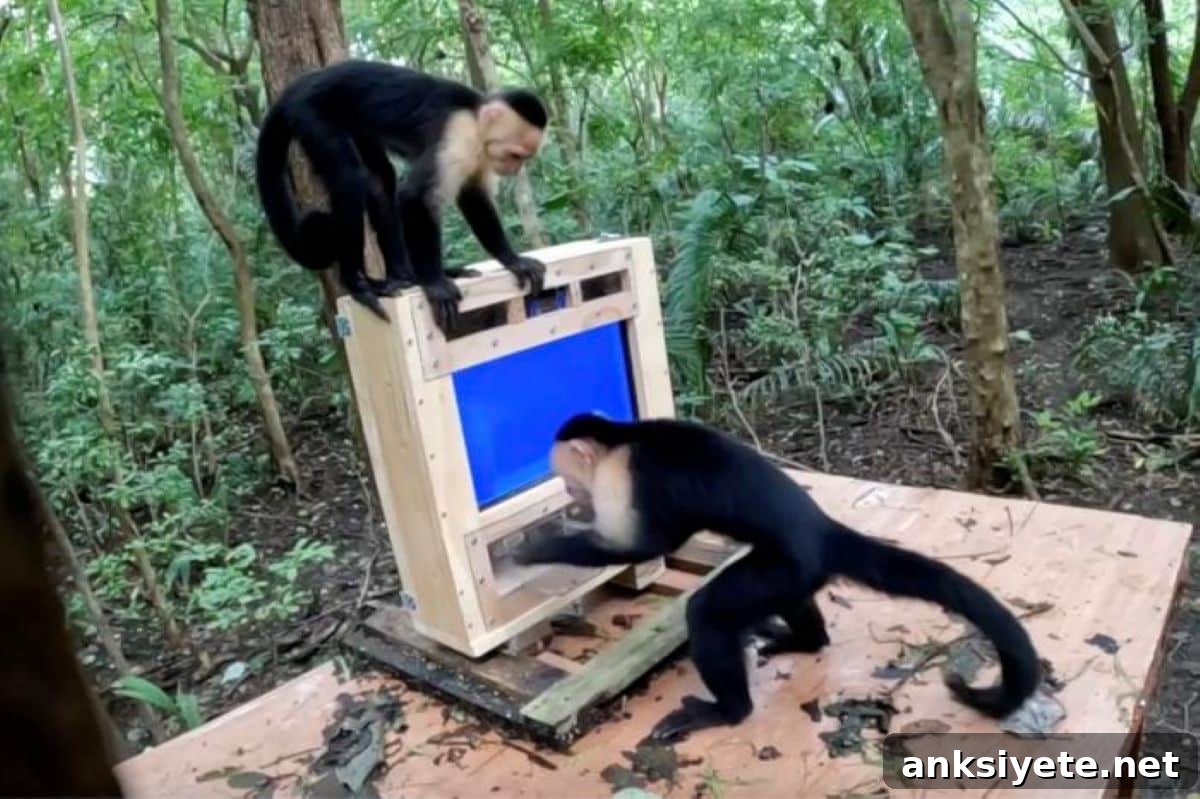
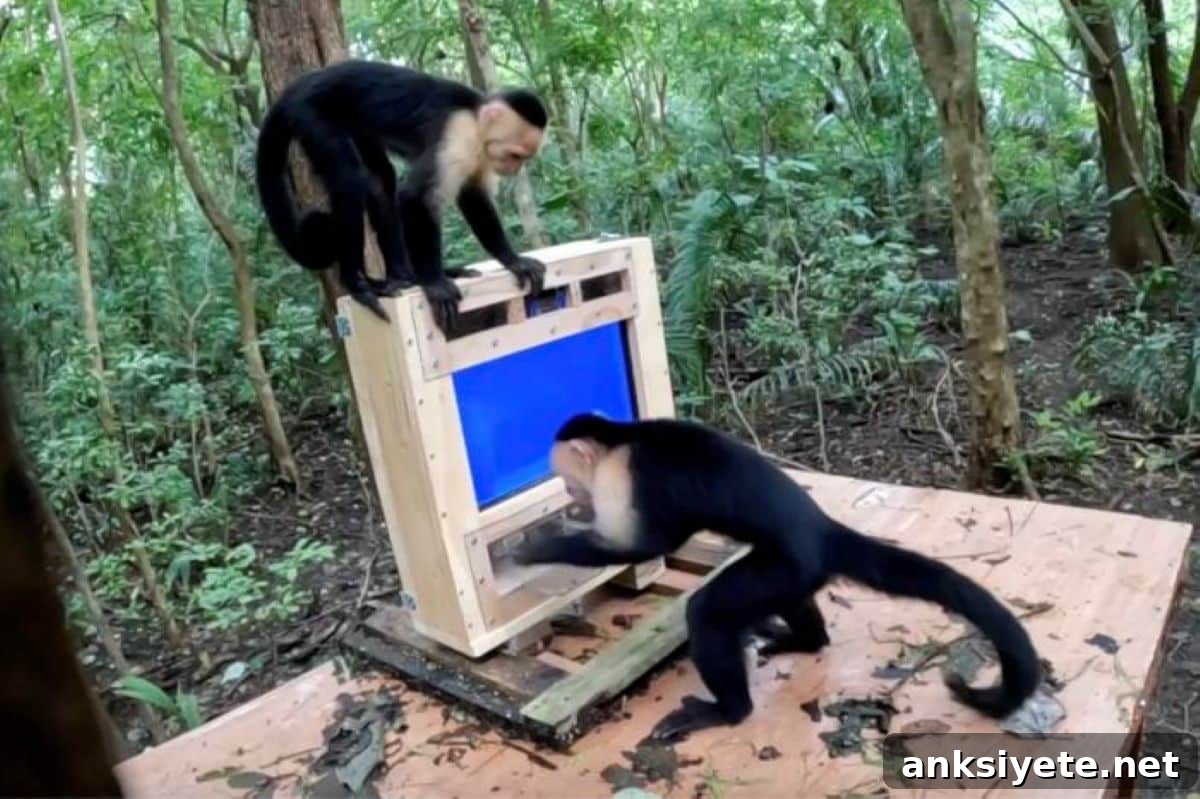
CapuchinAI integrates a compact, battery-powered computer into a weatherized field box. The system recognizes an approaching monkey, presents an appropriate touchscreen task for that individual, and automatically releases a food reward when the animal responds correctly. Field trials showed rapid learning and durable screen–reward associations among interacting capuchins.
“The minds behind the personalities”
“This project builds on the intellectual legacy of Frans de Waal,” says Federico Sánchez Vargas, the paper’s first author and an Emory doctoral student. De Waal, a pioneering primatologist, emphasized the importance of studying animals as individuals—an approach CapuchinAI extends by automating individual cognitive measurements in natural contexts.
Sánchez Vargas explains that the method complements long-term behavioral observations: automated testing provides standardized, quantifiable measures of cognition while field records supply rich individual life histories, together revealing how experience and environment shape minds and behavior.
Co-authors include Jacob Abernethy from Georgia Tech and software engineer Sai Rakshith Potluri, who helped develop the vision and control software. The team released the code and build plans as open-source materials to encourage adoption and adaptation across research sites and species.
Bridging lab and field
Benítez studies social behavior and cognition across captive and wild capuchin groups. Laboratory experiments offer tight control but lack natural social and ecological context; field observations preserve context but are hard to standardize. CapuchinAI aims to bridge that divide by enabling repeatable cognitive trials in the animals’ natural settings.
Initial efforts were funded by a seed grant and brought together expertise in anthropology, computer vision, and engineering. Using YOLO (You Only Look Once) object-detection software, the team trained a face-recognition model on high-quality GoPro footage. Students annotated thousands of images to produce a model that achieved strong identification performance on the prototype set.
DIY, low-cost engineering
Sánchez Vargas then reworked the system to run reliably in the field on inexpensive hardware. He adapted the recognition model so the unit could first detect any capuchin and then trigger a webcam to record interactions, producing a growing dataset of faces for further training. Interactive stimuli and reward control run on Python scripts and a lightweight Raspberry Pi. The entire field box can operate for roughly eight hours on a portable battery, emphasizing affordability and minimal ecological footprint.
The team built a weatherproof, animal-resistant enclosure from common materials and a 3D-printed rotary food dispenser. After assembly, they deployed the prototype at the Taboga Forest Reserve.
Field deployment
Early visits were slow, but after a few days a bold male capuchin discovered the box and learned within minutes to touch the screen in exchange for banana slices. That initial success encouraged more individuals to try the device. During the pilot, 16 capuchins interacted with the system; 10 triggered rewards and 8 formed clear screen–reward associations that persisted over sessions.
Researchers observed individual learning styles: some animals learned rapidly by interacting directly, others used lips or slow exploration, and a few waited to observe before approaching. The enclosure withstood attempts by curious animals, including coatis, and the vision filter prevented activation by non-capuchin wildlife.
The team is using recorded footage to expand the facial-recognition model and is designing a set of cognitive tasks across four domains—learning, impulse control, cognitive flexibility, and memory—that the system can present automatically based on each animal’s testing history.
A practical new research tool
CapuchinAI leverages decades of field observation and life-history data for the Taboga population to ask how environmental variation, social rank, and individual experience influence cognitive performance. The method enables standardized, repeatable trials in natural conditions while maintaining scalability across groups and sites.
“This adds a powerful tool to primatology,” Benítez says. “It doesn’t replace human fieldwork—detailed observational data remain essential—but it greatly expands what we can measure about cognition in the wild.”
Funding: Seed funding from AI.Humanities supported initial work. Additional support came from the National Institute on Drug Abuse (NIH), the U.S. National Science Foundation, the Lewis and Clark Fund for Exploration and Field Research, and the Emory Center for Mind, Brain and Culture.
Key Questions Answered:
A: Primate brains evolved to solve problems in complex, variable social and ecological settings, not under artificial laboratory conditions. Laboratory experiments offer control but remove animals from natural dynamics and life histories. CapuchinAI brings experimental rigor into natural habitats so researchers can observe how real-world environments shape cognitive strategies.
A: The system identifies individuals in real time and logs how many rewards each has received during a session. Once a preset reward cap is reached for an individual, the software temporarily suspends that animal’s access, encouraging lower-ranking group members to use the device and ensuring more balanced data collection.
A: The platform uses accessible, affordable parts: a Raspberry Pi microcomputer powered by a portable battery, a standard webcam, a low-cost touchscreen, and a 3D-printed rotary food dispenser housed inside a weatherized, monkey-proof wooden enclosure.
Editorial Notes:
- This article was edited by a Neuroscience News editor.
- Journal paper reviewed in full.
- Additional context added by staff.
About this neurodevelopment and mental health research news
Author: Carol Clark
Source: Emory University
Contact: Carol Clark – Emory University
Image: The image is credited to the researchers
Original Research: Open access. “CapuchinAI 1.0: Development of a Machine Learning-Based Touchscreen Paradigm to Test Cognition in Wild Capuchins” by Federico Sánchez Vargas, Sai Rakshith Potluri, Jacob Abernethy, Marcela E. Benítez. DOI: 10.1002/ajp.70194
Abstract
CapuchinAI 1.0: Development of a Machine Learning-Based Touchscreen Paradigm to Test Cognition in Wild Capuchins
Studying primate cognition effectively requires methods that preserve ecological validity while providing the experimental control typical of laboratory research. CapuchinAI v1.0 introduces a field-deployable touchscreen system that integrates real-time species recognition with automated cognitive testing. The approach adapts a YOLOv7-based facial-recognition model to run alongside a portable Raspberry Pi touchscreen–reward apparatus designed for use in natural habitats.
The system detects approaching capuchins, records interactions, presents stimuli (initially a simple touch-to-reward blue screen), and dispenses rewards. During a two-week deployment with habituated groups at the Taboga Forest Reserve, 16 individuals voluntarily interacted with the device; 10 triggered rewards and 8 developed robust screen–reward associations. These results confirm the feasibility of AI-mediated cognitive experiments in the wild and demonstrate the potential for autonomous, standardized, and scalable cognitive testing that can run in parallel with long-term behavioral data collection.
CapuchinAI offers a blueprint for integrating machine learning and touchscreen paradigms to study within- and between-individual cognitive variation under natural conditions, advancing comparative research on primate cognition by bridging the laboratory–field gap.