
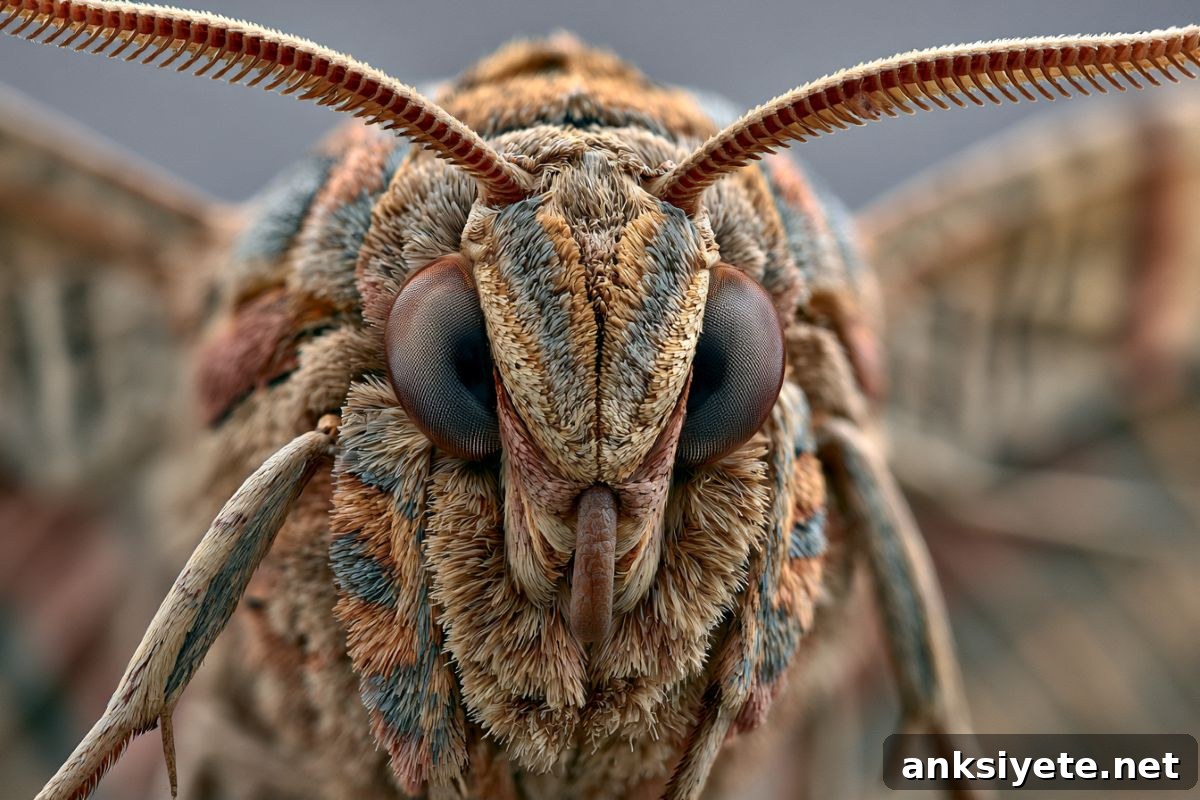
Summary: Using high-speed videography and automated pose estimation, researchers found that individual hummingbird hawkmoths consistently place the tip of their proboscis to one side of their body midline while inspecting flowers. This motor bias aligns with a dominant eye, forming a stable eye–proboscis–target control axis that reduces computational demands on the moth’s small brain.
Key Facts
- Lateralization of an unpaired appendage: Hummingbird hawkmoths show clear side preferences when extending their single, central proboscis, favoring either the left or right side during flower exploration.
- Innate bias: Side preferences appear from the very first flower visits, indicating that proboscis lateralization is an innate trait rather than a learned habit.
- Integrated eye–proboscis control axis: The preferred proboscis side consistently matches a dominant viewing eye, creating a coordinated visuomotor axis for precise targeting.
- Conserved behavior under perturbation: When part of the dominant eye was occluded, moths did not switch their proboscis to the other side; instead, they repositioned their body to preserve the original eye–proboscis alignment.
- Computational efficiency: Aligning an unpaired sensory-motor tool with a dominant eye reduces the neural processing needed to compute trajectories, an efficient solution for insects with compact nervous systems.
Source: University of Konstanz
Context: Many animals exhibit lateralization—preferential use of one side of the body—such as handedness in humans or foot preference in athletes. Lateral biases are widespread across taxa, from birds and octopuses to insects. But lateralization in organs that occur only once, like a tongue or an elephant’s trunk, is less obvious. This study shows that even a single appendage can be lateralized in a way that simplifies sensorimotor control.
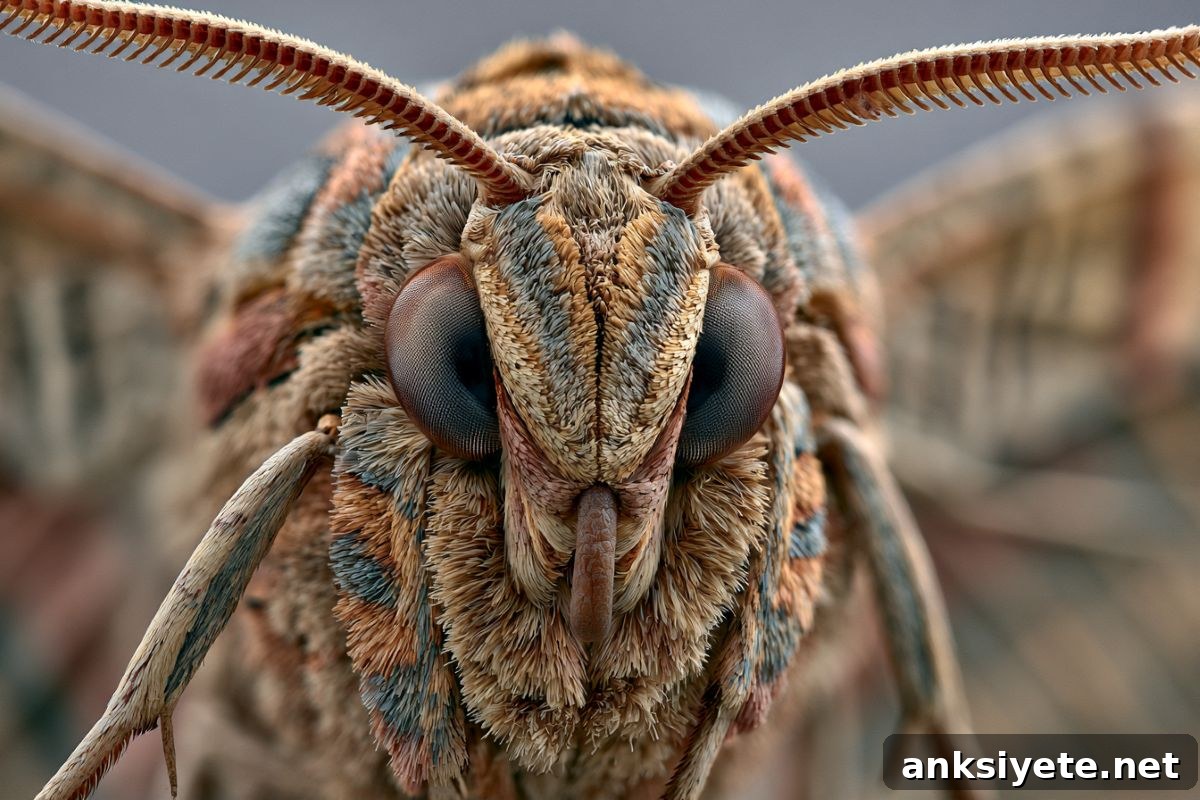
In a new paper published in PNAS, Lochlan Walsh and Anna Stöckl from the University of Konstanz and colleagues report that Macroglossum stellatarum—the day-flying hummingbird hawkmoth—prefers to extend its proboscis to one side when probing flowers. This side bias is tightly coupled with which eye the moth primarily uses to inspect the flower, forming a consistent visuomotor strategy across individuals.
A moth’s version of handedness
To quantify proboscis placement, the research team offered artificial flower surfaces while filming the moths with high-speed cameras and applying markerless computer-vision pose estimation. This allowed detailed reconstruction of proboscis movements relative to the body. Some moths showed a strong left-side bias, others a right-side bias, and the degree of preference varied among individuals—much like human handedness.
Importantly, individual moths displayed these side preferences from their first encounters with the flowers, supporting the conclusion that proboscis lateralization is an innate trait that guides inspection behavior.
“Touch where you look” — the eye–proboscis link
The team also reconstructed each moth’s visual field during probing. They found that the side the proboscis favored matched a dominant eye that viewed the portion of the flower being touched. By aligning the unpaired proboscis with the visual field of a single dominant eye, the moth reduces the need to compute trajectories from many viewing angles—an important advantage for an animal with limited processing resources.
When researchers occluded part of the dominant eye, moths did not switch their proboscis to the open eye. Instead, they changed their whole body posture so the uncovered portion of the dominant eye could still see the flower. This behavior contrasts with many vertebrates, which often compensate by moving a limb into the visual field of the unobstructed eye or by switching reliance to the other eye.
These findings show that the hawkmoths’ visuomotor axis is both conserved and prioritized over flexible limb-based strategies. The coordination between the dominant eye and the proboscis acts as a built-in shortcut, enabling accurate, rapid targeting without heavy neural computation.
Overall, the study demonstrates that precise and adaptive behaviors can arise from efficient bodily and sensory organization rather than from larger brains alone. Lateralization—here applied to a single, central appendage—appears to be one evolutionary solution for simplifying complex tasks such as nectar foraging.
Key questions answered
Q: Why is proboscis “handedness” surprising?
A: Motor lateralization is commonly studied in paired limbs. Demonstrating consistent side biases in a single, central organ like the proboscis reveals that lateralized control can extend to unpaired appendages, offering a broader principle of movement organization.
Q: How does this benefit a moth with a small brain?
A: By pairing the proboscis with a fixed dominant eye, the moth limits the number of reference frames required to guide movements. This simplifies trajectory computation, enabling rapid, precise targeting while conserving neural resources.
Q: What happened when researchers blocked part of the preferred eye?
A: Rather than switching eyes or moving the proboscis into the other eye’s field, moths reoriented their entire body so the unblocked portion of the dominant eye could view the flower, preserving the established eye–proboscis strategy.
Editorial notes
- Edited by a Neuroscience News editor.
- Journal paper reviewed in full by the editorial team.
- Additional explanatory context provided by staff editors.
About this research
Author: Helena Dietz
Source: University of Konstanz
Contact: Helena Dietz, University of Konstanz
Image credit: Neuroscience News
Original research: Open access. Title: “Conservation of a lateralized visuomotor axis in hawkmoth proboscis probing” by Lochlan Walsh, Sören Magnus Kannegieser, and Anna Lisa Stöckl. Published in PNAS. DOI: 10.1073/pnas.2609365123
Abstract (condensed): Lateralization of behavior and sensory processing is common across animals. In visually guided tasks, it often appears as an axis that aligns eye, appendage, and target. Using detailed videography and markerless pose estimation, this study shows that hummingbird hawkmoths display stable, individual proboscis lateralization tightly linked to instantaneous viewing angle, forming a persistent eye–proboscis–target axis. When challenged with monocular occlusion, moths preserved this geometry by adjusting body posture. These results reveal convergent control principles with vertebrate systems while highlighting differences in sensory–motor plasticity, contributing to our understanding of how lateralization shapes control strategies across nervous systems.