
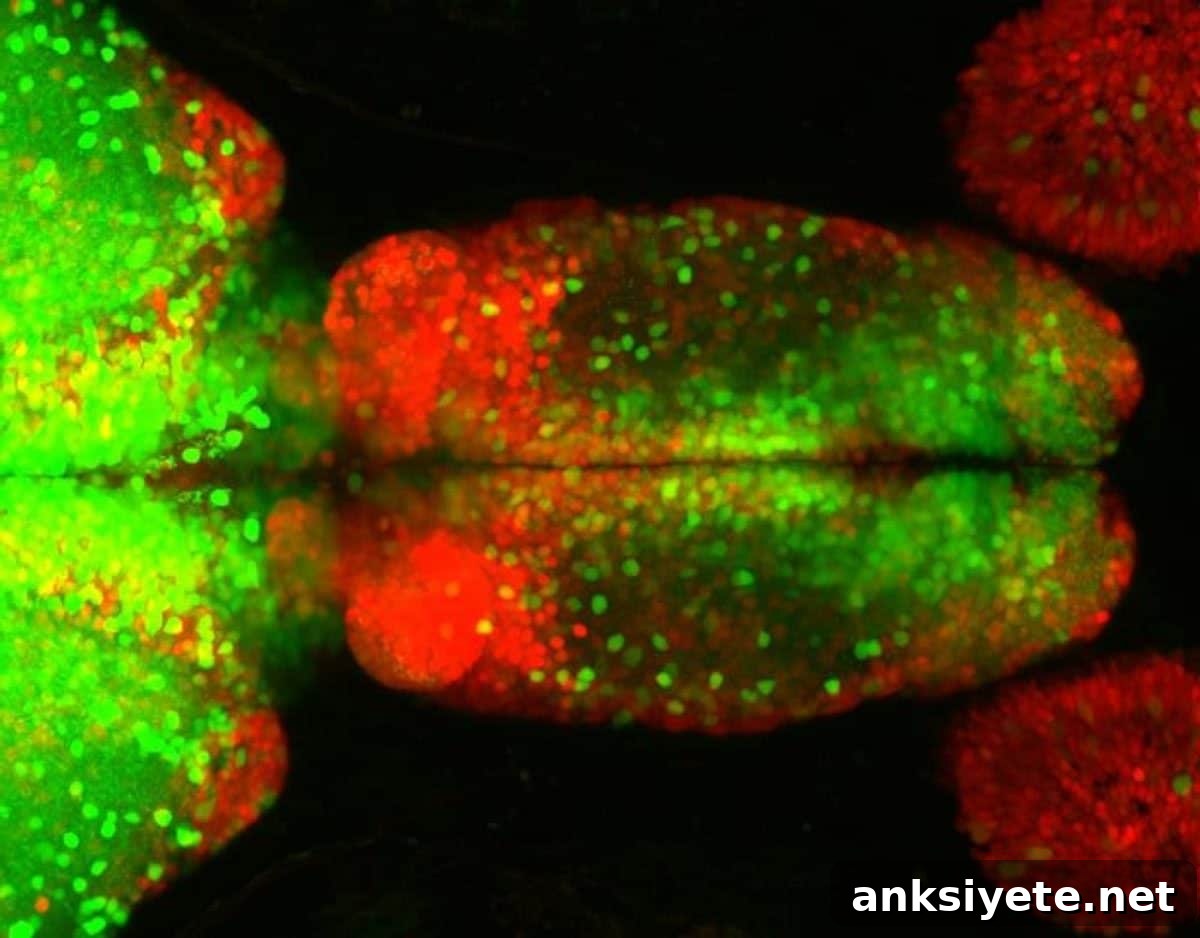
Summary: A new study mapped the functional blueprint of a living forebrain in real time using larval zebrafish. Researchers show that the zebrafish forebrain sorts and integrates sensory input in a ladder-like hierarchy strikingly similar to humans: separate sensory streams are routed at the entrance and progressively combined deeper inside into multisensory coincidence networks.
This work supports the idea that the computational principles required to unify separate senses into a single perceptual world are conserved across vertebrates and are not unique to mammals.
Key Facts
- The universal perception challenge: Physical stimuli reach the body through separate channels—light through the eyes, vibrations and sound through mechanoreceptors—yet the brain continually merges these different signals into a unified experience.
- Mammalian model: In mammals such as humans and mice, the thalamus serves as the central sensory gateway: it receives raw signals, segregates them by modality, and routes them to specialized regions of the cerebral cortex for higher-level integration.
- Preglomerular complex (PG) in zebrafish: The Yaksi lab found that zebrafish use a different anatomical hub, the preglomerular complex (PG), which receives midbrain input and performs the same fundamental sorting operation—directing visual information to one forebrain zone and vibrational input to another.
- Ascending multisensory ladder: Within the zebrafish pallium (a cortical analog), neurons transition from single-sense responses to multimodal and coincidence-sensitive responses in a systematic back-to-front hierarchy.
- Coincidence-detecting neurons: Deep pallial neurons were identified that remain silent to an isolated flash of light or an isolated water vibration but become strongly active when both inputs occur simultaneously, effectively binding the two events as one percept.
- Adaptive computation: While many routine behaviors do not require forebrain computation, the pallial circuitry appears specialized for unpredictable situations where cross-sensory binding and causal inference help animals learn and adapt.
Source: NTNU
Line up the brains of a fish, a bird and a mammal, and something unexpected emerges: you don’t find three completely different solutions for sensing the world. You find one basic solution expressed in different anatomical layouts.
“You can really see it’s almost like a continuum,” says Emre Yaksi of the Kavli Institute for Systems Neuroscience in Trondheim. Across evolutionary time, two ancient pathways carry sensory information into the forebrain of very different animals. What differs is which anatomical route does most of the work; the functional logic remains consistent.
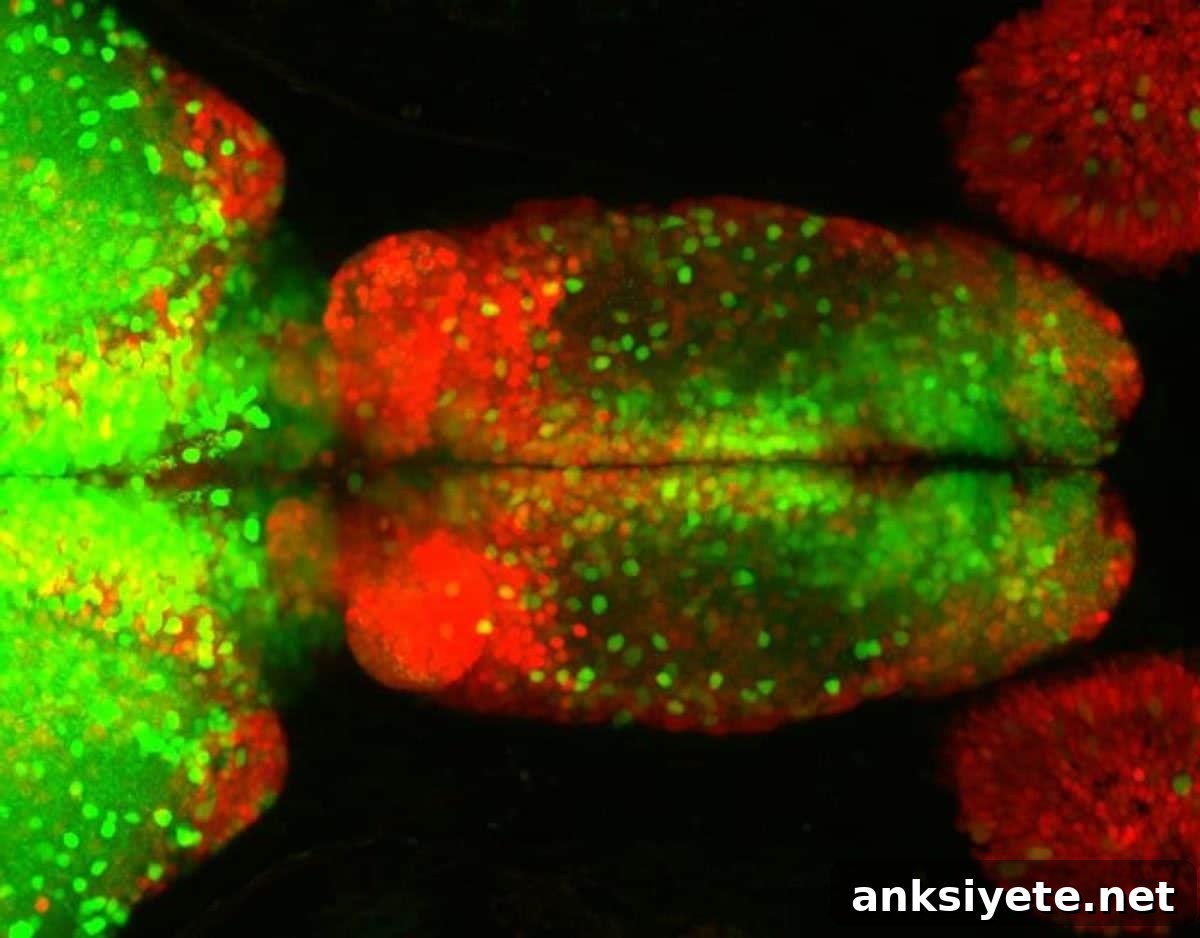
Evolution assembled vertebrate brains from different parts over hundreds of millions of years, yet it repeatedly arrived at the same functional arrangement: sort incoming senses near the entrance and combine them deeper in the forebrain. The Yaksi lab’s new study, led by first author Anh-Tuan Trinh and published in Science, set out to test whether zebrafish follow this same rule.
The problem every brain must solve
Sensation arrives as fragmented input. Light, sound and mechanical disturbances enter through distinct receptors and pathways. A successful brain must take these parallel streams and construct a coherent, single representation of the external world. How neural circuits are organized to perform this binding is a fundamental question in neuroscience.
A useful analogy is a house: incoming senses arrive at the door and a “receptionist” directs each to the appropriate room. In mammals, the thalamus performs that reception and routing. Integration occurs deeper in the cortex, where separate streams meet, are compared and transformed into perception and decision. The researchers asked whether a fish builds a comparable “house” with equivalent functional zones.
The experimental setup
To observe the brain in action, the team used transparent larval zebrafish under a high-resolution microscope. Each fish, under three weeks old and under a centimeter in length, was embedded in clear gel with a small water channel to keep it breathing comfortably. This preparation allows imaging of the entire forebrain at cellular resolution while the animal is alive and sensing.
Using controlled stimuli—brief red light flashes and gentle water vibrations presented individually and together—the researchers recorded where and how neurons across the forebrain responded.
Sorting and combining sensory signals
Responses showed a clear architecture: the preglomerular complex (PG), supplied by midbrain sensory centers, acts as the fish’s primary sensory gateway. The PG routes visual and vibrational signals to separate pallial regions, preserving modality-specific channels early in processing.
Progressing deeper into the pallium, single-modality neurons give way to multimodal neurons that respond to visual and vibrational stimuli. Deeper still are neurons that detect coincidence: they remain silent to each input alone but fire robustly when light and vibration occur together, effectively registering that two different sensory cues belong to the same event.
These coincidence detectors perform the binding operation that underlies perception of unified events—much like linking lightning and thunder into the single percept of a storm despite their physical delay.
Why a fish has such circuitry
Large parts of survival behavior are managed by subcortical structures and do not require forebrain computation. The forebrain, by contrast, supports flexible responses when the environment becomes unpredictable. The pallium’s circuitry appears adapted for that flexibility—integrating disparate signals to infer relationships and guide adaptive behavior when prewired reflexes fall short.
Yaksi offers a culinary metaphor: different ingredients can produce the same thickened soup. Similarly, distinct anatomical components across vertebrates can be assembled into functionally equivalent circuits. Whether these similarities reflect a shared ancestral blueprint or convergent solutions assembled from different cell types remains an open question the lab is pursuing at the molecular level.
A conserved organizing principle
The Trondheim team proposes that brains follow discoverable organizational recipes. This study documents one such recipe—sensory sorting at entry points followed by hierarchical, topographically organized transformation and multisensory coincidence detection—in the transparent, accessible forebrain of a small fish.
“I don’t argue that a fish has the equivalent of a mammalian cortex,” Yaksi says. “But a fish has something—the pallium—that evolved from the same vertebrate ancestors. We have now identified where external information enters and how it is transformed. That is how everything starts.”
If widely conserved, this processing logic suggests that the demands of integrating separate sensory channels strongly constrain neural solutions, steering different lineages toward the same functional designs even when the anatomical parts differ.
Key Questions Answered:
A: Professor Emre Yaksi compares this to two cooks thickening soup with different ingredients but achieving the same effect. Humans and zebrafish use different anatomical parts (thalamus and cortex versus preglomerular complex and pallium), yet both face the same problem—combining separate sensory streams into a coherent picture—so evolution converged on a similar organizational solution.
A: These neurons act as binding units that detect when two distinct sensory events belong together. They remain inactive to each stimulus alone but fire strongly when both occur simultaneously, signaling that the inputs are part of the same external event.
A: Transparent larval zebrafish allow whole-forebrain imaging. Fish were embedded in clear gel with a water flow to breathe while advanced calcium imaging captured every neuron’s activity in real time as stimuli were presented.
Editorial Notes:
- This article was edited by a Neuroscience News editor.
- The journal paper was reviewed in full.
- Additional context was added by staff.
About this sensory neuroscience research news
Author: Nina Tveter
Source: NTNU
Contact: Nina Tveter, NTNU
Image credit: Dr Stephanie Fore, Kavli Institute for Systems Neuroscience
Original research: Open access. “Hierarchical sensory processing in zebrafish thalamocortical-like circuits” by Anh-Tuan Trinh et al., Science. DOI: 10.1126/science.aec2171
Abstract
Hierarchical sensory processing in zebrafish thalamocortical-like circuits
Thalamocortical projections shape functional regionalization and parallel sensory computations across the mammalian cortex. However, principles of such computations in non-mammalian vertebrates remain underexplored.
This study investigated how the zebrafish pallium—a homolog of the vertebrate cortex—receives and transforms sensory information and how its architecture compares to thalamocortical circuits in other vertebrates. The preglomerular complex (PG), a thalamocortical-like pathway, is identified as the primary source of visual and vibrational input to the pallium. PG and its pallial projections show sensory-specific, topographically organized responses.
In contrast, pallial neurons exhibit topographic hierarchies ranging from sensory-specific responses to multimodal and coincidence-detecting nonlinear responses. These results suggest that hierarchies of sensory transformations across topographically organized thalamocortical-like circuits represent a convergent principle across vertebrates.