
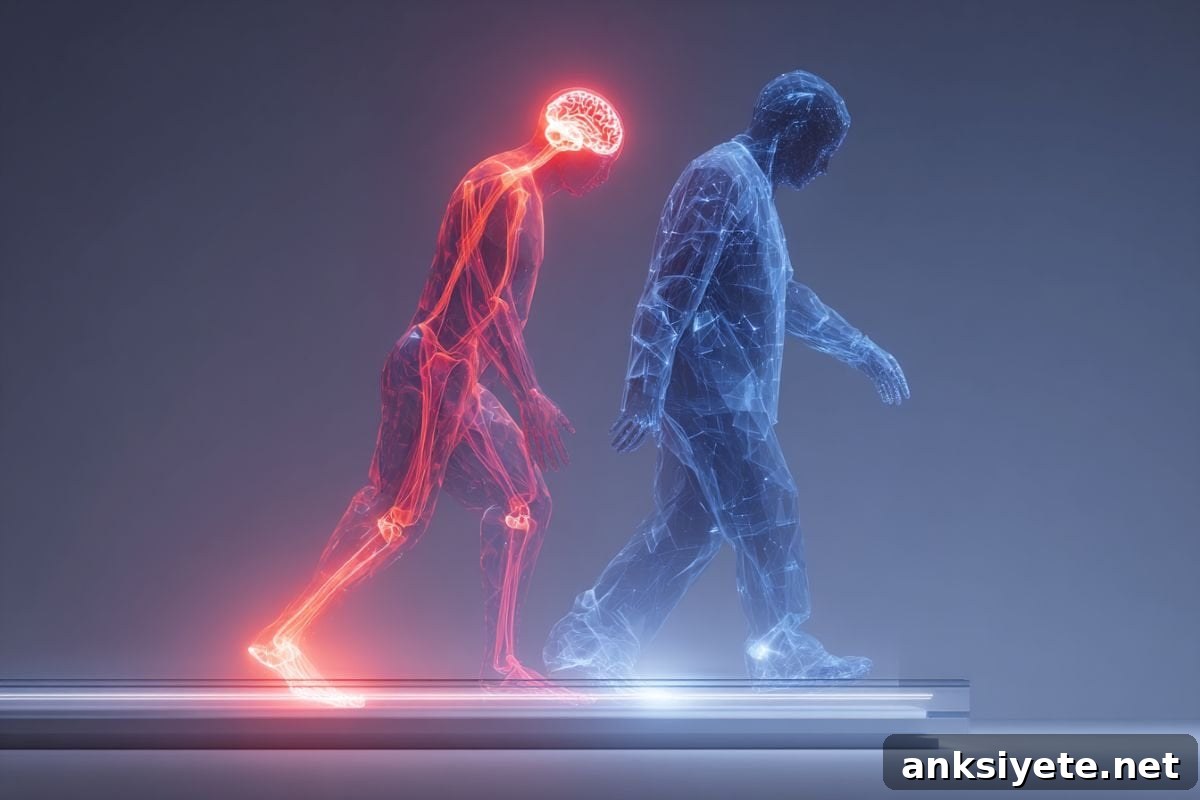
Summary: Aging and Parkinson’s disease force the brain into a higher level of engagement to preserve upright balance, but that extra neural effort does not yield stronger recoveries and may actually increase fall risk. Young adults recover from unexpected balance disturbances with a rapid, energy-efficient two-stage neural response. In contrast, older adults and people with Parkinson’s disease show disproportionately large brain and muscle activity even for minor perturbations, and they commonly rely on stiffening opposing muscles—a strategy associated with poorer balance performance.
This study indicates the aging and Parkinsonian brain is less efficient at allocating neural resources for balance. When the brain must work harder to correct small slips, it leaves fewer reserves for larger disturbances, producing weaker physical recovery despite heightened neural signals. The findings point toward practical clinical assessments that could detect elevated brain engagement through noninvasive muscle measurements and identify people at higher risk of falling.
Key Facts
- Neural inefficiency: Older adults and individuals with Parkinson’s disease generate larger cortical responses to small balance threats than young adults produce for more substantial perturbations.
- The stiffening trap: Many older adults respond to balance losses by activating opposing muscle groups simultaneously, creating joint stiffness that hampers recovery.
- Brain–balance tradeoff: Increased brain activity during balance tasks correlates with reduced physical ability to recover from slips or trips.
- Predictive testing: Measuring muscle responses during a sudden floor shift (a “rug-pull” test) may provide a noninvasive proxy for cortical engagement and help predict future fall risk.
Source: SfN
Lena Ting, from Emory University, and colleagues investigated how cortical and muscular activity during balance recovery change with aging and Parkinson’s disease.
Earlier work from Ting’s group showed that when young adults experience a sudden loss of balance—such as a rug being pulled from under their feet—they exhibit an immediate, involuntary brainstem-mediated muscle response followed by a second wave of brain and muscle activity during more challenging perturbations. That two-stage pattern supports efficient recovery in younger people.
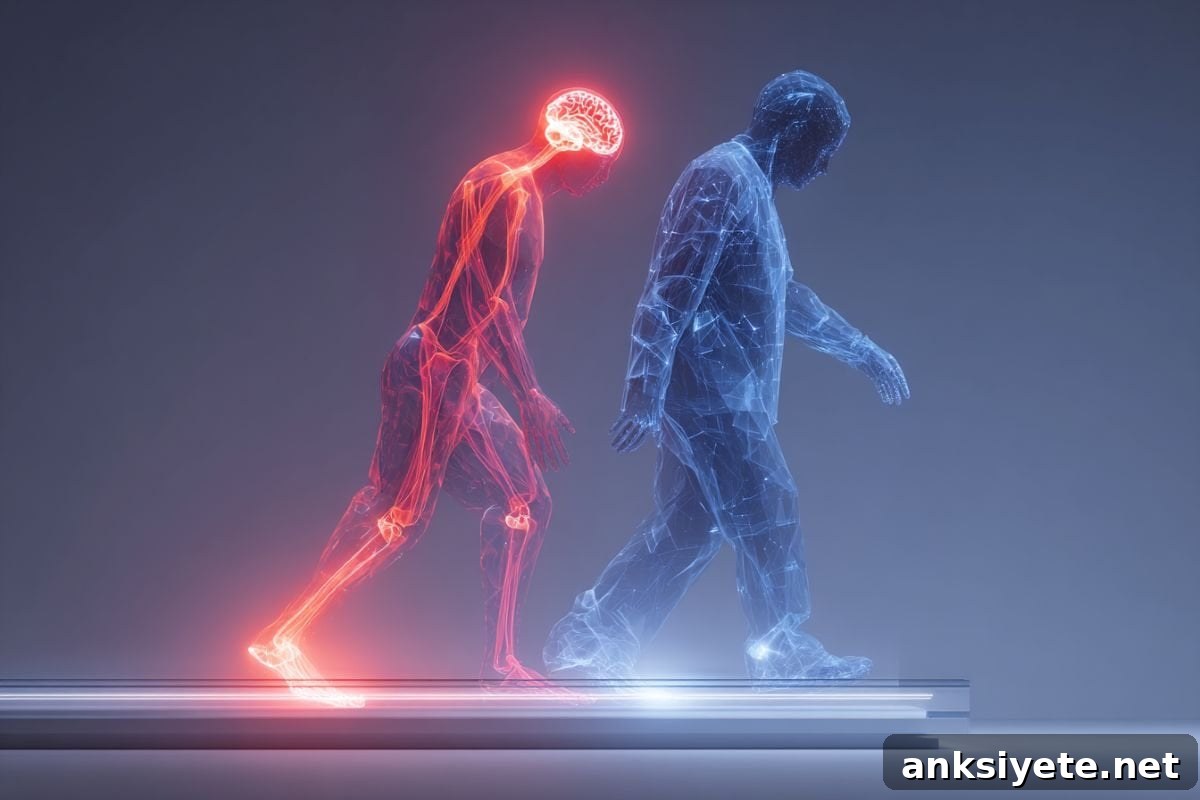
In the current study, published in eNeuro, the team measured brain- and muscle-related responses to balance perturbations in older adults with and without Parkinson’s disease. They found that both groups showed larger cortical responses and elevated muscle signals than young adults—even when the balance disturbance was relatively small.
Ting explains that balance recovery in these populations requires greater cortical involvement: when people need more brain activity to maintain posture, their actual ability to physically recover is reduced. In other words, higher neural engagement did not translate into a stronger, more reliable balance correction.
The investigators also observed a common compensatory pattern: when a balance-correcting muscle activated, opposing muscles often contracted simultaneously, producing stiffness around the joint. The degree of this co-contraction was associated with worse clinical measures of balance. Rather than stabilizing the person, this stiffening tactic appears to compromise the fluid movements needed for successful recovery.
The researchers note that their analytic approach can decompose perturbation-evoked muscle activity into distinct temporal components, revealing mechanistic changes in neural control without requiring direct brain recordings. This profile of muscle responses could become a practical clinical tool: by evaluating how muscles react during a controlled “rug-pull” test, clinicians may infer the level of cortical engagement and identify individuals who would benefit from targeted balance training.
Key Questions Answered:
A: The study highlights reduced neural efficiency with age and in Parkinson’s disease. If the brain must operate near full capacity to correct a small slip, it has limited reserve left for larger, unexpected disturbances. That lack of reserve results in weaker, less adaptable recovery responses.
A: Contrary to intuition, simultaneous activation of opposing muscles—producing stiffness—tends to worsen balance performance. Fluid, well-timed muscle activity, rather than rigid co-contraction, supports better recovery.
A: The authors suggest it can. By measuring muscle responses to a sudden floor shift, clinicians may estimate how much cortical effort a person needs to maintain balance and thus flag individuals with elevated risk long before a injurious fall occurs.
Editorial Notes:
- This article was edited by a Neuroscience News editor.
- The original journal paper was reviewed in full.
- Additional context was provided by staff editors.
About this neurology and aging research news
Author: SfN Media
Source: SfN
Contact: SfN Media – SfN
Image: The image is credited to Neuroscience News
Original Research: Closed access.
Article title: “Cortically Mediated Muscle Responses to Balance Perturbations Increase with Perturbation Magnitude in Older Adults with and without Parkinson’s Disease” by Scott E. Boebinger, Aiden M. Payne, Jifei Xiao, Giovanni Martino, Michael R. Borich, J. Lucas McKay and Lena H. Ting.
DOI: 10.1523/ENEURO.0423-25.2026
Abstract
Cortically Mediated Muscle Responses to Balance Perturbations Increase with Perturbation Magnitude in Older Adults with and without Parkinson’s Disease
A clear mechanistic understanding of how cortical contributions to balance control shift with aging and Parkinson’s disease remains limited. Basic balance corrections depend on brainstem circuits, but higher-order centers, such as the cortex and basal ganglia, are recruited as perturbation severity increases or when baseline balance function declines.
Previous work demonstrated that parallel sensorimotor feedback loops involving both brainstem and cortical pathways shape muscle responses during balance recovery in young adults. In this study, the authors analyzed data from older adults with and without Parkinson’s disease, separating perturbation-evoked activity in tibialis anterior and medial gastrocnemius muscles into hierarchical components based on latency that reflect different feedback control loops.
Balance-correcting muscle activity followed a characteristic pattern of long-latency responses: an early long-latency response (LLR1) around 120 ms and a later component (LLR2) near 210 ms, consistent with subcortical and cortical feedback timing, respectively. Both LLR components increased with greater balance challenge and were predictable from center-of-mass kinematics.
Antagonist muscle activity evoked by perturbations included destabilizing and stabilizing components, distinguished by whether they opposed the kinematic errors that triggered them. A destabilizing component around 180 ms correlated negatively with clinical balance measures in older adults but not in the Parkinson’s group. Exploratory comparisons showed that older adults and those with Parkinson’s displayed larger LLR2 responses at lower challenge levels than young adults, consistent with increased cortical engagement during balance as people age.
These results demonstrate that a neuromechanical modeling approach can decompose perturbation-evoked muscle responses into hierarchical elements linked to clinical balance ability and can reveal mechanistic changes in neural control of balance without direct brain recordings. Such insights may guide improved screening and intervention strategies to reduce fall risk in aging populations.