
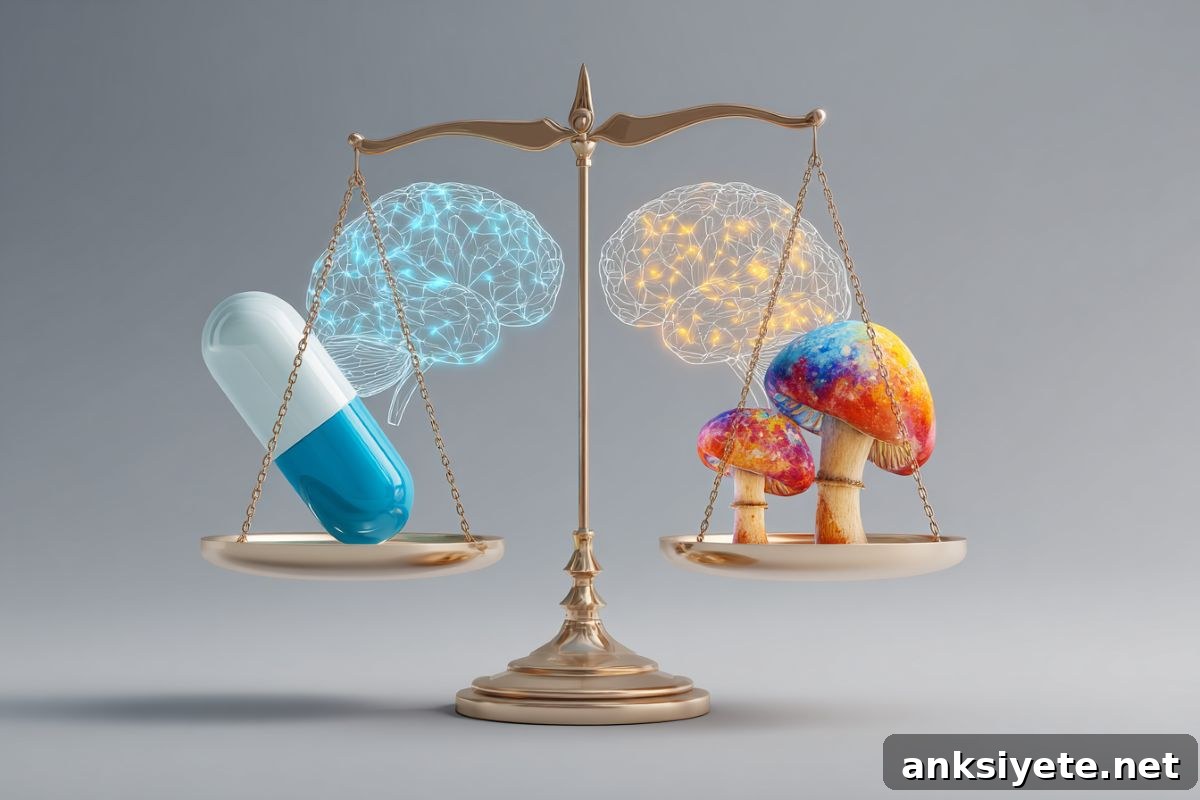
Summary: For years the “psychedelic renaissance” has suggested that substances like psilocybin and LSD could transform mental health care and surpass conventional antidepressants such as SSRIs. A new, rigorous analysis from researchers at UCSF, UCLA, and Imperial College London offers a more tempered picture: when patients know which treatment they receive, psychedelic-assisted therapy does not outperform traditional antidepressant treatment.
The investigators addressed a key methodological problem in psychedelic research: functional unblinding. Because psychedelics produce powerful subjective effects, participants in placebo-controlled trials usually realize whether they received the active drug or an inactive comparator. That recognition can inflate perceived benefits. To correct for this, the team compared psychedelic-assisted therapy (PAT) trials with open-label trials of traditional antidepressants (TADs), where participants also knew they were receiving an active medication. This created a fairer comparison by equalizing expectation effects across treatment types.
Key Facts
- Blinding challenge: Psychedelic trials are effectively unblinded because participants almost always detect the drug’s subjective effects, undermining standard placebo-controlled comparisons.
- Study design adjustment: Researchers compared PAT outcomes with open-label TAD trials so both groups benefited from patients knowing they received active treatment.
- Main finding: When expectation was balanced, PAT was not superior to open-label traditional antidepressants. Both approaches produced roughly the same clinical improvement — about a 12‑point reduction on standard depression rating scales.
- Expectation influence: Earlier trials likely overestimated psychedelic effects because participants who realized they had received a psychedelic experienced a strong psychological boost, while those who realized they had a placebo experienced disappointment, widening the apparent treatment gap.
- Clinical implications: The results do not dismiss psychedelics as a treatment option. They indicate that psychedelics are not the clearly superior, transformative cure many headlines have suggested when compared fairly to existing antidepressant approaches.
Source: UCSF
Headline finding: When patients are aware of what they are taking, psychedelic-assisted therapy appears to be about as effective as traditional antidepressants for major depression, according to a systematic review and meta-analysis published in JAMA Psychiatry.
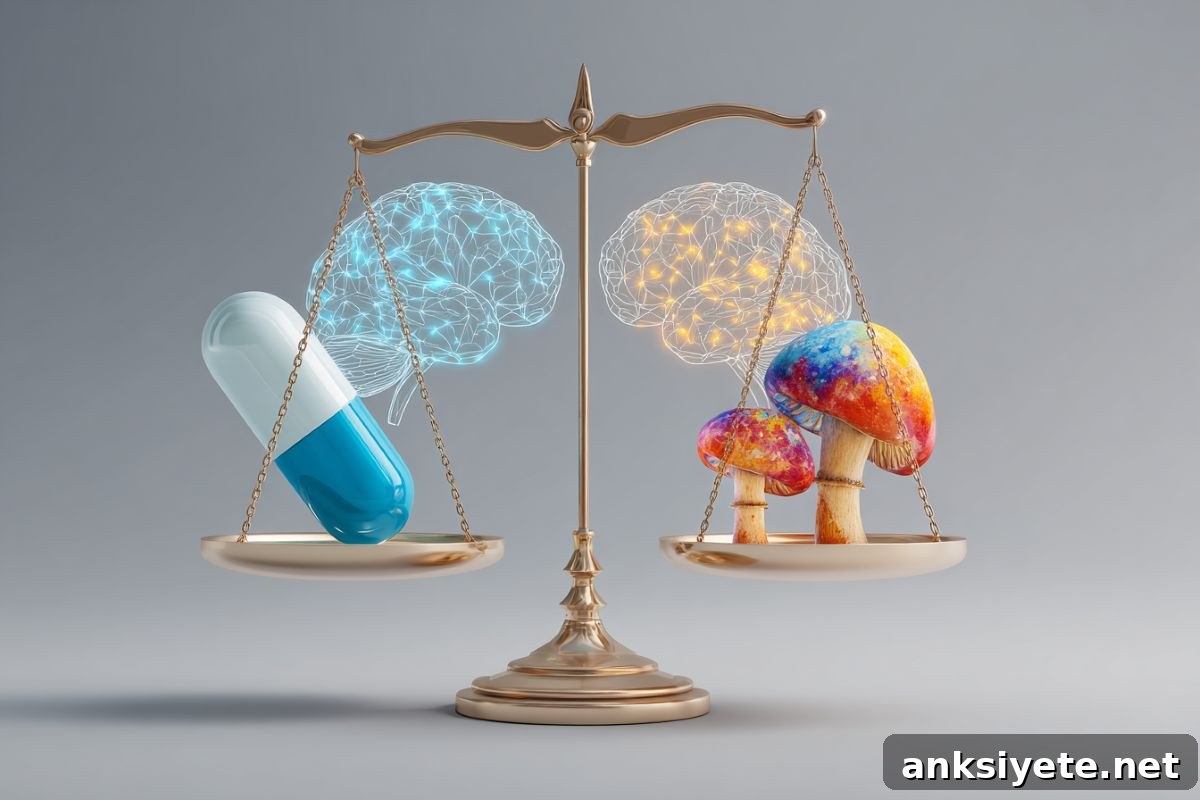
Psychedelic-assisted therapy has resisted conventional placebo-controlled methods because the subjective effects of drugs like psilocybin and LSD make true blinding nearly impossible. In contrast, many antidepressant trials achieve at least partial blinding, leaving direct comparisons between the two treatment types vulnerable to bias.
To address this, the authors pooled data from trials of PAT and from open-label TAD trials in adults with major depression without comorbid psychosis. By comparing within-arm improvement from baseline to the primary end point, the study sought to isolate treatment effects independent of blinding differences.
The results were surprising to the research team. Balázs Szigeti, PhD, a clinical data scientist at UCSF’s Translational Psychedelic Research Program and co‑first author, said the team expected psychedelics would retain a robust advantage even after accounting for unblinding. Instead, the advantage disappeared: estimated outcomes were essentially the same when expectation effects were matched.
Both PAT and open-label TADs produced meaningful reductions in depressive symptoms. The apparent superiority of psychedelics in prior studies appears largely attributable to the unblinding effect — patients who recognized they had received a psychedelic tended to improve more, while placebo recipients fared worse, exaggerating the between-group difference.
Szigeti emphasized that psychedelics may still offer important options for certain patients, particularly those who do not benefit from or cannot tolerate daily antidepressant medication. Psychedelic therapy protocols often involve one or two supervised dosing sessions combined with psychotherapy rather than continuous daily dosing, which can be an important consideration for patients and clinicians.
Funding: None declared.
Disclosures: Zachary J. Williams received consulting fees from Roche. Other authors reported no conflicts.
Key Questions Answered:
A: No. Both psychedelic-assisted therapy and traditional antidepressants significantly reduced depression scores. The study shows they appear to work at similar levels when the influence of unblinding is controlled.
A: Because psychedelic trials suffer from a blinding crisis: participants usually know whether they received the active drug. Comparing PAT to open-label traditional antidepressant trials creates a fairer “apples-to-apples” comparison that balances expectation effects.
A: Some patients do not respond to or cannot tolerate standard antidepressants. Psychedelic-assisted therapy typically involves limited supervised dosing combined with psychotherapy rather than daily medication, which may be preferred by some individuals based on side-effect profiles, treatment logistics, or personal preference.
Editorial Notes:
- This article was edited by a Neuroscience News editor.
- The underlying journal paper was reviewed in full.
- Additional context was added by editorial staff.
About this psychopharmacology research news
Author: Victoria Colliver
Source: UCSF
Contact: Victoria Colliver – UCSF
Image: Image credit to Neuroscience News
Original Research: Treatment of Depression Under Equal Unblinding Conditions: A Systematic Review and Meta-Analysis. Authors: Zachary J. Williams, Hannah Barnett, and Balázs Szigeti. Published in JAMA Psychiatry. DOI: 10.1001/jamapsychiatry.2025.4809. (Open access)
Abstract
Treatment of Depression Under Equal Unblinding Conditions: A Systematic Review and Meta-Analysis
Importance
Psychedelic-assisted therapy (PAT) trials exhibit high levels of functional unblinding, which biases comparisons with blinded interventions. Because PAT is effectively always open-label, comparing its outcomes with those of open-label traditional antidepressants (TADs) helps equalize expectation-related benefits between interventions.
Objective
To compare the effectiveness of PAT versus open-label TADs (including SSRIs and SNRIs) for treating major depression in outpatient adult populations without psychosis.
Data Sources
PubMed was searched in March 2024 for trials of PAT and open-label TADs. Data extraction was supplemented with results from prior reviews and meta-analyses of antidepressant trials to assess differences between blinded and open-label designs.
Data Extraction and Synthesis
Depression scores were independently extracted by two reviewers and pooled using Bayesian and frequentist mixed-effects models, following PRISMA guidelines.
Main Outcomes and Measures
The analysis compared mean within-arm change from baseline to the primary end point on the 17-item Hamilton Depression Rating Scale (HAM-D) for PAT versus open-label TAD trials. It also assessed differences between blinded and open-label designs for TADs to evaluate the impact of blinding.
Results
From 619 PubMed records, 24 trials met inclusion criteria. PAT (8 trials; 249 patients) was not more effective than open-label TADs (16 trials; 7,921 patients), with an estimated difference of 0.3 HAM-D points favoring open-label TADs (95% CI, −1.39 to 1.98; P = .73). Open-label TADs showed slightly better outcomes than blinded TAD trials (difference 1.3 HAM-D points; 95% CI, 0.07–2.51; P = .04), while the blinded versus open-label difference was not observed for PAT.
Conclusions and Relevance
When expectation effects are balanced by comparing PAT with open-label traditional antidepressants, PAT does not demonstrate superior effectiveness for depression. These results caution against overly optimistic narratives about psychedelics and underscore the importance of blinding integrity in clinical research.