
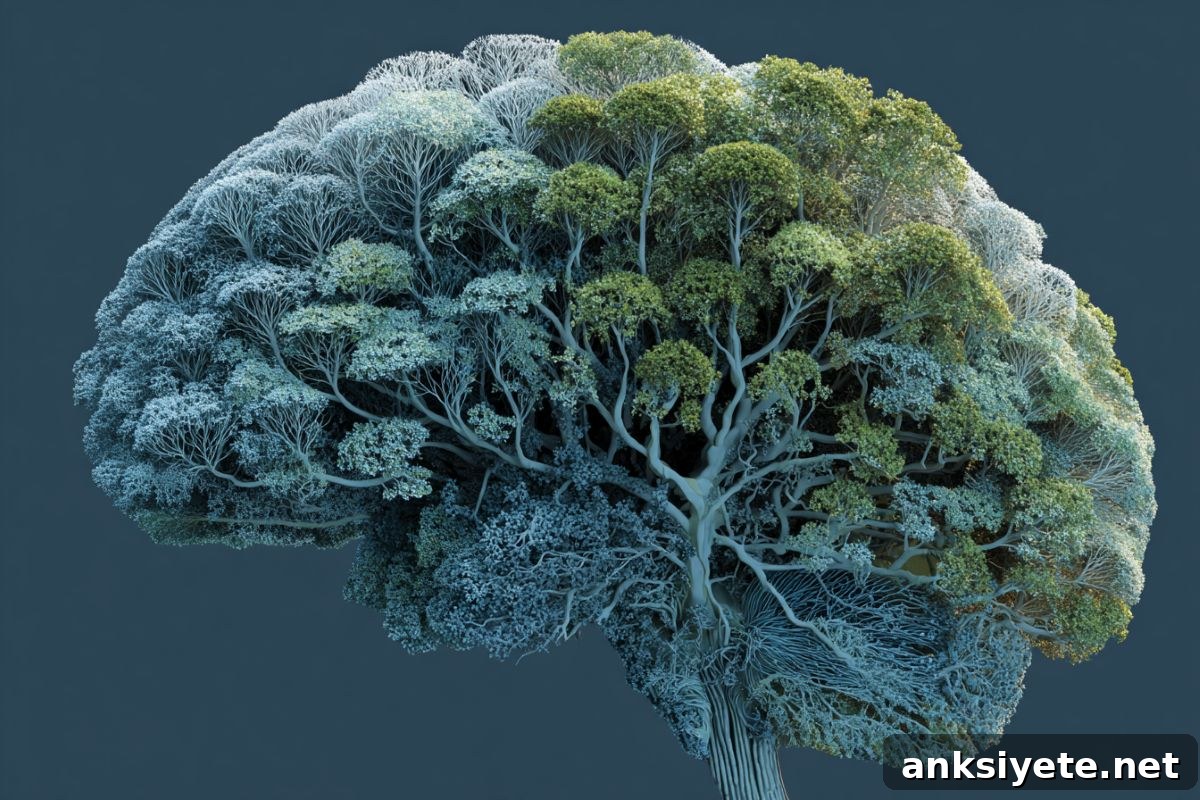
Summary: Spending time in nature does more than feel good—it produces measurable physiological and neural changes that act like a reset for the brain. A comprehensive review of over 100 brain-imaging studies shows that connecting with natural environments shifts brain activity toward restoration, relaxation, and lower stress.
Drawing together decades of research across imaging methods and settings, the authors identify a consistent cascade of effects—from reduced sensory load to calmer patterns of thought—that helps explain why even brief contact with nature can quickly improve mental clarity and well-being.
Key Facts
- Three-minute threshold: Just a few minutes in a natural setting can produce detectable brain changes; longer, more immersive experiences produce larger and longer-lasting benefits.
- Amygdala downregulation: Time in nature reduces activity in the amygdala, the brain region involved in threat detection, moving the body out of an active “fight-or-flight” state.
- Easier sensory processing: Fractal patterns common in nature—such as those in leaves, branches, and water—are less demanding for the brain to process than the dense, rapidly changing inputs of urban or digital environments.
- Restorative attention: Nature allows effortful, task-focused attention to rest and supports a gentler, restorative mode of attention that the environment naturally guides.
- Reduced rumination: Networks associated with repetitive, self-focused thinking quiet down during nature exposure, helping to reduce mental clutter and intrusive thoughts.
Source: McGill University
Brief nature exposure can lower stress, restore focus, and quiet repetitive thinking, according to a new synthesis of neuroimaging studies.
Researchers at McGill University, together with colleagues at Adolfo Ibáñez University in Chile, reviewed more than 100 brain-imaging studies spanning real-world, laboratory, and virtual reality settings. This scoping review is among the most thorough accounts to date of how the brain responds when people are exposed to natural stimuli.
The analysis strengthens the scientific foundations of the growing field of nature connectedness, which examines how human interactions with nature influence mental and physical health—an insight long recognized across cultures as central to well-being.
“We often feel that nature restores us, and neuroscience helps explain why,” said co-lead author Mar Estarellas, a postdoctoral researcher in the Division of Social and Transcultural Psychiatry at McGill University. “This evidence can inform health policy and how we design public and private spaces to support mental health.”
Four markers of a more settled brain
From many independent studies, the authors describe a cascading pattern of neural changes that together point to a calmer brain state when people encounter nature:
- Simplified sensory processing: Fractal and repeating patterns in natural scenes require less effortful processing than the visually busy, rapidly changing stimuli of cities and screens.
- Stress systems ease: As sensory demands fall, physiological stress responses decrease—heart rate and breathing settle—and threat-detection regions such as the amygdala show lower activity.
- Attention replenishes: With stress reduced, the brain shifts from effortful, task-driven attention to a restorative mode where attention is softly guided by environmental features.
- Rumination decreases: Networks tied to repetitive self-focused thought become less active, supporting reduced mental clutter and a calmer sense of self.
What counts as “being in nature”?
Nature exposure spans a continuum: from full immersion—walking in a forest, sitting beside a river, or hiking—down to shorter or smaller encounters like visiting a park, keeping indoor plants, or viewing natural images. The review finds that even brief contact—on the order of three minutes—can produce measurable neural effects, while longer, real-world exposure generally enhances and prolongs those benefits.
“Short experiences can help, but more immersive time outdoors tends to give stronger, more durable effects,” Estarellas noted.
Nature as a practical mental reset
As concerns grow about excessive screen time and its cognitive toll, this review suggests that nature provides a distinct kind of mental recovery that simple digital breaks may not fully achieve. The findings bolster initiatives such as green urban design and social prescribing—where clinicians recommend time in nature as part of a health plan.
“When people feel connected to nature, they’re more likely to act in environmentally responsible ways,” Estarellas added. “Supporting access to nature benefits both individual health and the environment.”
Funding: The study received support from the Mind & Life Institute.
Key Questions Answered:
A: Exposure exists on a spectrum. Looking at images or having plants indoors can generate modest positive effects, but the most substantial and lasting neural benefits come from direct, real-world experiences like walking in a park or spending time near water.
A: Nature-based prescriptions are a valuable addition to mental health care, not a wholesale replacement for clinical treatments. They provide a specific form of cognitive and physiological recovery—particularly from screen-related fatigue—that complements, rather than substitutes, standard therapies.
A: Natural scenes contain repeating, fractal-like patterns that our perceptual systems are well adapted to process with minimal effort. Urban environments and digital content tend to be visually “loud,” which keeps the brain in a heightened state of alert and continuous processing.
Editorial Notes:
- This article was edited by a Neuroscience News editor.
- The full journal paper was reviewed as part of this summary.
- Additional context was provided by our editorial staff.
About this neuroscience research news
Author: Aurelie Boucher
Source: McGill University
Contact: Aurelie Boucher – McGill University
Image: The image is credited to Neuroscience News
Original Research: Open access.
“Your brain on nature: A scoping review of the neuroscience of nature exposure” by Constanza Baquedano, Antonia Olguín, Luis Sebastian Contreras-Huerta, Fernando E. Rosas, and Mar Estarellas. Neuroscience & Biobehavioral Reviews
DOI:10.1016/j.neubiorev.2026.106565
Abstract
Your brain on nature: A scoping review of the neuroscience of nature exposure
Interest in how natural environments influence cognition and well-being has grown across neuroscience, environmental psychology, and public health. A growing body of empirical research finds that exposure to nature consistently benefits psychological and physiological health, but the neural mechanisms behind those benefits have been less clear.
This scoping review aggregates neuroimaging evidence—from EEG, fMRI, fNIRS, and structural MRI—across field studies, lab experiments, and virtual simulations. The convergent results indicate that natural stimuli are associated with: (i) acute reductions in activity within stress-related and self-referential neural circuits, (ii) shifts toward alpha- and theta-dominated patterns and more integrated large-scale network states consistent with attentional restoration, and (iii) longer-term structural and white-matter differences linked to cognition.
Although study designs vary and many findings are correlational, these patterns highlight candidate neural mechanisms and potential moderators that future work should test with preregistered, longitudinal, and mechanistic approaches. Overall, the evidence points to a meaningful role for natural environments in promoting mental health, with implications for neuroscience research and public policy aimed at improving human well-being.