
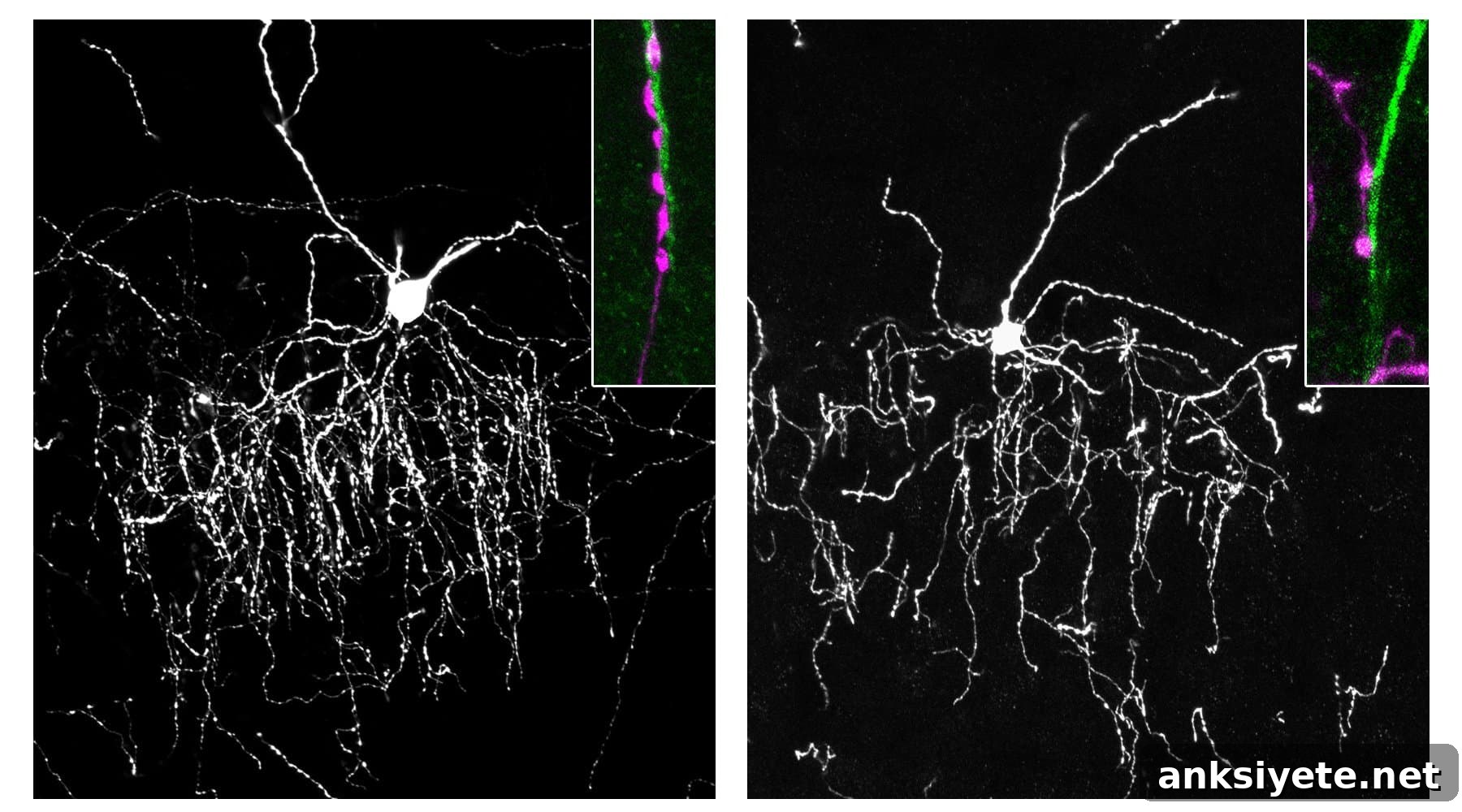
Summary: Researchers have identified specific molecular partners that enable inhibitory chandelier cells to form precise synapses with excitatory pyramidal neurons at the axon initial segment. This targeted connection is essential for controlling neuronal output and maintaining electrical balance in the brain. Disruptions in this process are implicated in neurological and psychiatric disorders such as epilepsy, schizophrenia, autism, and depression.
Source: Ohio State University
The brain depends on a fine-tuned balance between neurons that drive activity and neurons that restrain it. New work reveals how a small group of inhibitory neurons — chandelier cells — locate and connect precisely to their excitatory targets to control that balance.
A recent study reported by Ohio State University describes how chandelier cells, a distinct class of inhibitory interneurons, establish highly specific synapses on the axon initial segment (AIS) of excitatory pyramidal neurons. The research team identified a molecular “handshake” that guides this precise targeting and supports the formation of powerful inhibitory contacts.
Chandelier cells exert strong influence because they innervate the axon initial segment, the subcellular site where action potentials are generated. By forming synapses at that location, chandelier cells can directly regulate whether an excitatory neuron fires, effectively acting as critical gatekeepers that prevent runaway excitation in local circuits.
In the news coverage, two molecules were highlighted as central to this targeting: CNTNAP4, reported to be present on chandelier cells, and gliomedin, localized at the axon initial segment on target neurons. The original research paper further clarifies that Neurofascin-186 (NF186), a cell adhesion molecule specifically enriched at the AIS, interacts with gliomedin to mediate the subcellular specificity of chandelier cell innervation.
The Molecular Handshake: Gliomedin and AIS Proteins
The study demonstrates that a precise molecular interaction between ligands and receptors is required for chandelier cells to form a characteristic string of synaptic boutons along the AIS of pyramidal neurons. Gliomedin, previously known for roles at nodes of Ranvier, is preferentially expressed in chandelier cells and functions as a receptor recognizing AIS-specific proteins.
- Chandelier cell component: Gliomedin is enriched in chandelier cells and acts in axon cartridge development.
- Axon initial segment component: Neurofascin-186 (NF186) is localized at the AIS of pyramidal neurons and is necessary for chandelier cells to assemble synapses along that segment.
Using visualization techniques in developing mouse brains, the team showed that removal of genes encoding AIS components disrupted chandelier cell innervation. When gliomedin or NF186 function was impaired, chandelier cells failed to form proper contacts along the AIS, breaking the “handshake” and reducing their ability to control excitatory neurons.
Functional and Clinical Implications
The axon initial segment is the site where action potentials are initiated, so inhibitory inputs at this subcellular domain wield disproportionate influence over neuronal output. Chandelier cell innervation effectively regulates the “faucet” of information flow from excitatory neurons to the rest of the circuit.
Loss of precise chandelier cell targeting or disruptions in the molecular cues that guide it can disturb the excitation/inhibition balance. Such disruption has been associated with a range of conditions, including epilepsy, schizophrenia, autism spectrum disorders, and mood disorders. While the direct causal links between specific molecular defects and clinical syndromes remain to be established, understanding these developmental mechanisms points toward possible targets for therapeutic investigation.
As senior author Hiroki Taniguchi and lead author Yasufumi Hayano emphasize, identifying the molecular tags and their matching receptors is a foundational step in mapping how interneuron subtypes assemble precise brain circuits. This knowledge opens avenues for exploring how alteration of these pathways contributes to disease and whether restoring molecular interactions could rebalance affected networks.
About this neuroscience research news
Author: Media Relations
Source: Ohio State University
Contact: Emily Caldwell – Ohio State University
Image: The image is credited to Ohio State University
Original Research: Closed access.
“The highly localized interaction between Neurofascin-186 and Gliomedin promotes subcellular innervation by the chandelier cell” by Yasufumi Hayano et al., published in The Journal of Neuroscience.
Abstract (summary)
The study reports that Neurofascin-186 (NF186), a cell adhesion molecule specifically expressed at the axon initial segment of pyramidal neurons, is required for chandelier cells (ChCs) to develop their characteristic string of synaptic boutons along the AIS. Gliomedin, known as a ligand for NF186 at nodes of Ranvier, is preferentially expressed in chandelier cells and acts as a major receptor for NF186 during ChC axon cartridge development. The authors conclude that intercellular interactions between subcellularly restricted ligands and cell type–specific receptors provide the molecular basis for interneuron subcellular synapse specificity, a key mechanism in establishing precise brain circuitry.