
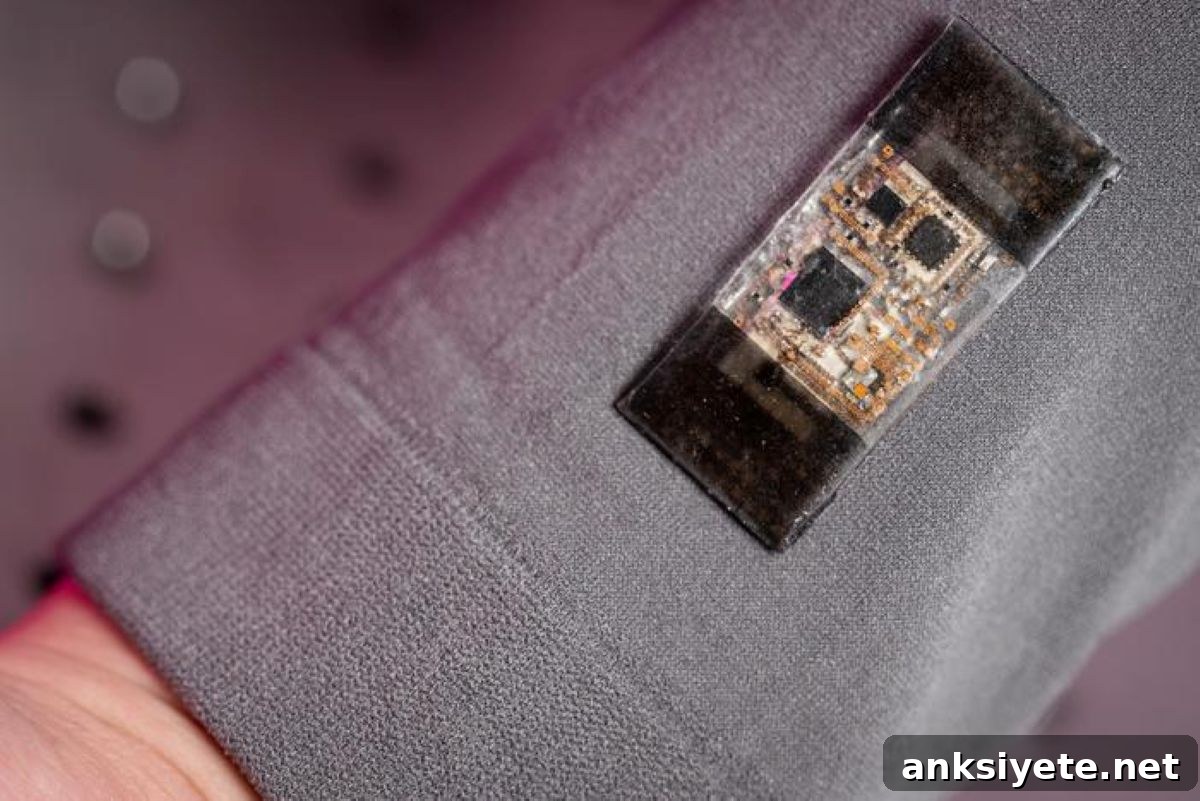
Summary: A new wearable system combines stretchable electronics with deep learning to interpret human gestures accurately in chaotic, high-motion environments. Unlike many gesture-based wearables that fail when motion noise overwhelms signals, this soft, patch-based device filters interference in real time so everyday gestures can reliably control machines such as robotic arms.
Validated across activities from running to simulated ocean turbulence, the system demonstrates robust, low-latency performance in challenging real-world conditions. This advance brings practical, noise-tolerant gesture-based human–machine interaction closer to deployment in rehabilitation, industrial operations, emergency response and underwater applications.
Key Facts:
- Noise-tolerant control: A tailored deep-learning pipeline removes motion artefacts in real time, enabling stable gesture recognition under intense movement.
- Proven in varied environments: The system was validated during running, high-frequency vibration, combined disturbances and simulated ocean wave motion.
- Next-generation wearable design: A multilayer armband integrates stretchable sensors, electromyography channels, a Bluetooth microcontroller and a soft, stretchable battery into a compact patch.
Source: UCSD
Overview
Engineers at the University of California San Diego have developed a wearable human–machine interface that interprets natural gestures reliably even during intense motion. Published in Nature Sensors, the work pairs stretchable sensor hardware with a deep convolutional neural network to separate gesture signals from motion noise in real time.
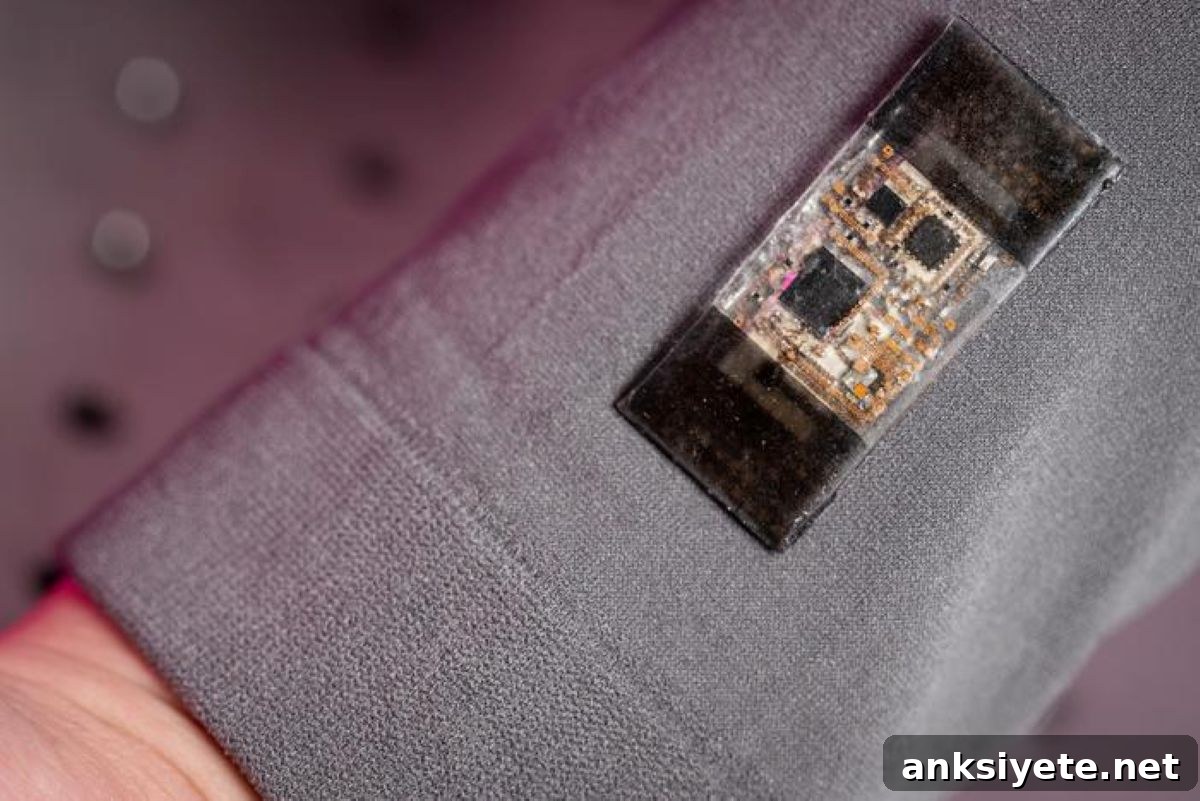
Traditional wearable gesture systems perform well when users are still, but their signals degrade rapidly when motion artefacts—created by running, vehicle movement or turbulent water—interfere with sensor readings. The UC San Diego team addressed this limitation by building an end-to-end platform that captures motion and muscle activity, cleans the data with AI, and converts gestures into continuous control commands for external devices.
The soft electronic patch mounts to a fabric armband and combines a six-channel inertial measurement unit (IMU), electromyography (EMG) sensing, a Bluetooth microcontroller unit and a stretchable battery. Collected signals feed a convolutional neural network trained on a composite dataset that includes gestures recorded under multiple motion artefacts. The trained network extracts robust gesture features while parameter-based transfer learning improves generalizability across different users.
A sliding-window decoder translates the cleaned signals into continuous, low-latency commands to control a robotic arm and other machines. The researchers demonstrated real-time control while subjects were running, subjected to high-frequency vibration and exposed to combined disturbances. The system was also tested in a simulated ocean environment at UC San Diego’s Scripps Institution of Oceanography, where lab-generated and recorded sea motion were reproduced to evaluate performance in turbulent water conditions.
“By integrating AI to denoise sensor data on the fly, our system allows everyday gestures to reliably control machines even in highly dynamic environments,” said Xiangjun Chen, a co-first author and postdoctoral researcher in the Aiiso Yufeng Li Family Department of Chemical and Nano Engineering. The approach was developed collaboratively by the labs of Sheng Xu and Joseph Wang at the UC San Diego Jacobs School of Engineering.
Potential applications span healthcare—helping patients in rehabilitation or individuals with limited mobility control robotic aids using natural gestures—to industrial settings and emergency response, where hands-free and dependable control is essential in hazardous, motion-heavy situations. The method could also enable divers and remote operators to command underwater robots despite turbulent seas, and could improve gesture controls in consumer electronics where everyday motion often degrades performance.
According to the research team, this is the first wearable human–machine interface demonstrated to maintain reliable function across a wide range of motion disturbances, aligning device performance with how people actually move during daily activities.
Funding: This work was supported by the Defense Advanced Research Projects Agency (DARPA), contract number HR001120C0093.
Key Questions Answered:
A: It reliably interprets gesture signals even during intense motion, overcoming a major limitation of current gesture-based wearables.
A: A stretchable sensor patch captures motion and muscle signals while a deep-learning framework filters motion artefacts in real time before sending commands to external machines.
A: Patients in rehabilitation, people with mobility limitations, industrial workers, first responders, divers and consumers who need reliable gesture-based control in dynamic environments.
Editorial Notes:
- This article was prepared by an editor at Neuroscience News.
- The original journal paper was reviewed in full by the reporting team.
- Additional contextual information was provided by staff to clarify applications and testing conditions.
Author: Liezel Labios
Source: UCSD
Contact: Liezel Labios – UCSD
Image: Credit to David Baillot/UC San Diego Jacobs School of Engineering
Original Research: “A noise-tolerant human–machine interface based on deep learning-enhanced wearable sensors” by Sheng Xu et al., published in Nature Sensors. The study is closed access.
Abstract
A noise-tolerant human–machine interface based on deep learning-enhanced wearable sensors
Wearable human–machine interfaces that use inertial measurement units (IMUs) and electromyography are widely applied in healthcare, robotics and interactive technologies. Extracting reliable signals in real-world settings remains difficult due to motion artefacts.
This work presents a wearable human–machine interface that tolerates diverse motion artefacts by combining stretchable multi-channel IMUs, an EMG module, a Bluetooth microcontroller unit and a stretchable battery for wireless data capture and transmission. A convolutional neural network trained on a composite dataset of gestures and motion artefacts extracts robust gesture signals. Parameter-based transfer learning enhances user-to-user generalization. A sliding-window decoding approach converts the extracted gestures into continuous, real-time control of a robotic arm during dynamic activities such as running, high-frequency vibration, posture changes, ocean wave motion and combinations thereof. These results demonstrate the potential for robust wearable human–machine interfaces in complex, real-world applications.