
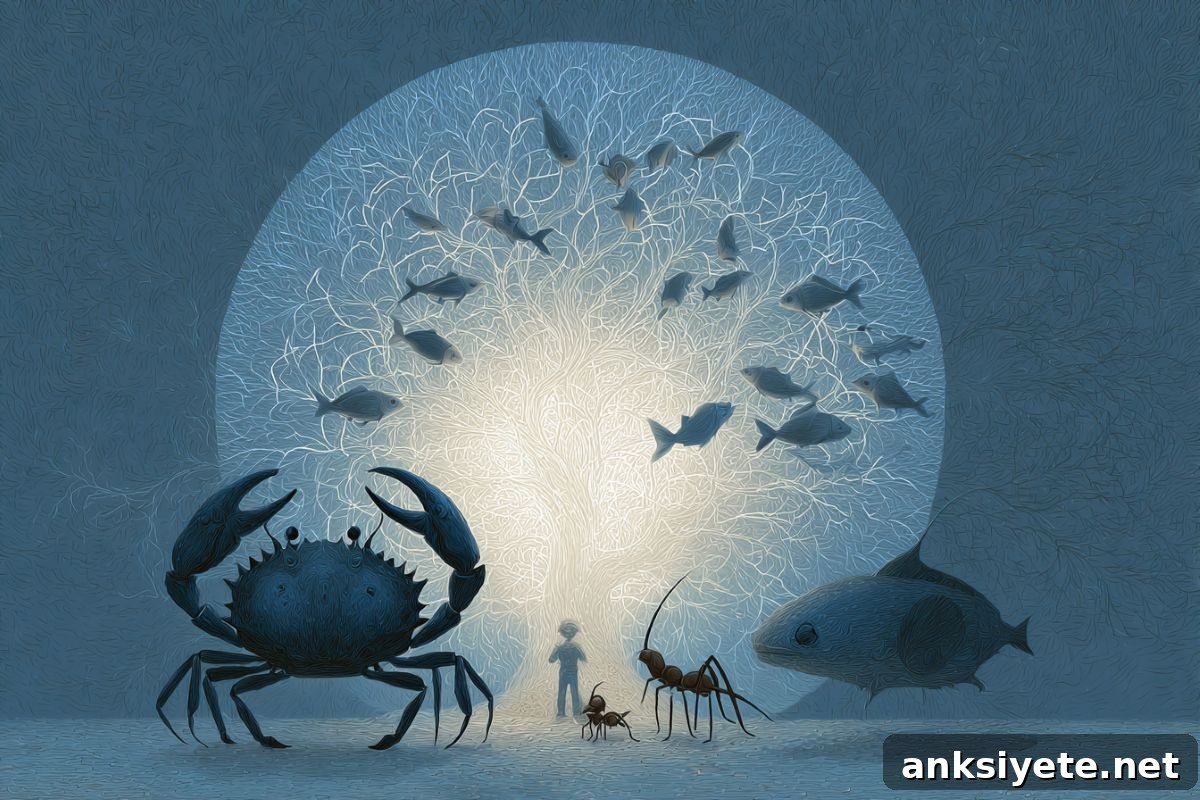
Summary: A philosophy researcher has created a practical decision tree to help scientists, ethicists, and policymakers evaluate which animals may be conscious. This new framework clarifies long-standing debates about whether creatures such as crabs, fish, insects, or other simple organisms can experience pain, emotion, or a first-person perspective.
The framework distinguishes two central approaches: one that requires clear evidence of consciousness markers before attributing experience, and another that holds absence of observable markers does not definitively rule out consciousness. The model is intended to guide more consistent, nuanced decisions in research, conservation, and animal welfare policy.
Key Facts:
- Decision Tree for Consciousness: A structured tool to evaluate whether an organism is likely to have conscious experiences based on observable markers such as neural structures, cognitive behaviors, and other correlates.
- Symmetry vs. Asymmetry: The framework clarifies two main philosophical positions: the symmetry view, which treats absence of markers as grounds for exclusion, and the asymmetry view, which treats absence as inconclusive.
- Ethical and Policy Impact: By making assumptions explicit, the decision tree offers a firmer foundation for animal welfare decisions, research protocols, and conservation priorities.
Source: Michigan State University
Why this matters: Beyond fueling dinner-table debates, determining which beings are conscious has real-world consequences for how we treat animals in science, farming, fishing, and conservation. Jonah Branding, a philosophy PhD candidate at Michigan State University, presents a decision tree in Biology & Philosophy that helps sort through these difficult questions.
Branding’s tool addresses practical examples researchers and ethicists frequently ask: Do fish suffer when hooked? Do ants experience alarm when defending a colony? Do simpler creatures like banana slugs have subjective experiences while feeding? The decision tree focuses attention on observable “markers” — anatomical, neurological, behavioral, or cognitive traits that are thought to correlate with conscious experience.
Markers can range from complex patterns of behavior and cognitive abilities to specific neural architectures. When an organism displays many of the relevant markers, it becomes reasonable to infer consciousness. The controversy arises when an organism lacks those markers or displays them sparsely.
Branding identifies two opposing attitudes toward that gap. The symmetry view treats the absence of markers as evidence that an organism probably lacks consciousness. The asymmetry view accepts that while markers provide positive evidence for consciousness, their absence does not justify a confident conclusion that the organism is non-conscious.
To bridge these positions, Branding traces how different methods for identifying markers—specifically theory-based, analogy-based, and function-based approaches—can lead to different stances on exclusion. Depending on the auxiliary assumptions attached to each method, the same evidence can support either symmetry or asymmetry. From these relationships he develops a decision tree to make those links explicit.
The decision tree is not a definitive solution but a clarifying tool. It helps researchers and ethicists identify which assumptions drive their judgments and pinpoints where debates should focus next. For instance, hermit crabs display few traditional markers like large brains or overtly complex cognition, but they do select and trade shells and navigate mazes—behaviors that complicate simple exclusionary judgments.
Branding emphasizes that these are practical questions about how humans interact with other beings and what moral obligations follow. Clarifying whether and when to exclude organisms from consideration matters for policy decisions about animal welfare, experimental design, and conservation priorities.
Key Questions Answered:
A: It is a structured, practical tool that links methods for identifying consciousness markers to conclusions about whether an organism likely has conscious experience. The tree clarifies which assumptions lead to exclusionary or non-exclusionary judgments.
A: Knowing which animals may feel or think influences ethical decisions, research practices, and conservation policy. A clear framework reduces inconsistent treatment and highlights where more evidence is needed.
A: The approach maps different marker-identification strategies to philosophical positions on exclusion, producing a decision tree that helps researchers and ethicists make consistent, explicit, evidence-based judgments.
About this consciousness research news
Author: Sue Nichols
Source: Michigan State University
Contact: Sue Nichols – Michigan State University
Image: The image is credited to Neuroscience News
Original Research: Open access. “Can a marker approach exclude?” by Jonah Branding. Biology & Philosophy
Abstract
Can a marker approach exclude?
When an organism exhibits enough of the right neural, cognitive, or behavioral markers, researchers commonly infer phenomenal consciousness. But what should we conclude when those markers are absent or scarce? Recent debates have split into two positions. The symmetry view treats marker absence as evidence against consciousness, while the asymmetry view treats absence as inconclusive.
Branding argues this dispute partly reflects deeper disagreements about how markers are identified. He outlines three routes—theory-based, analogy-based, and function-based approaches—and shows how, with different auxiliary assumptions, they can support either the symmetry or asymmetry view. The result is a decision tree that connects views about marker identification to stances on exclusion, highlighting productive directions for future debate and research.