
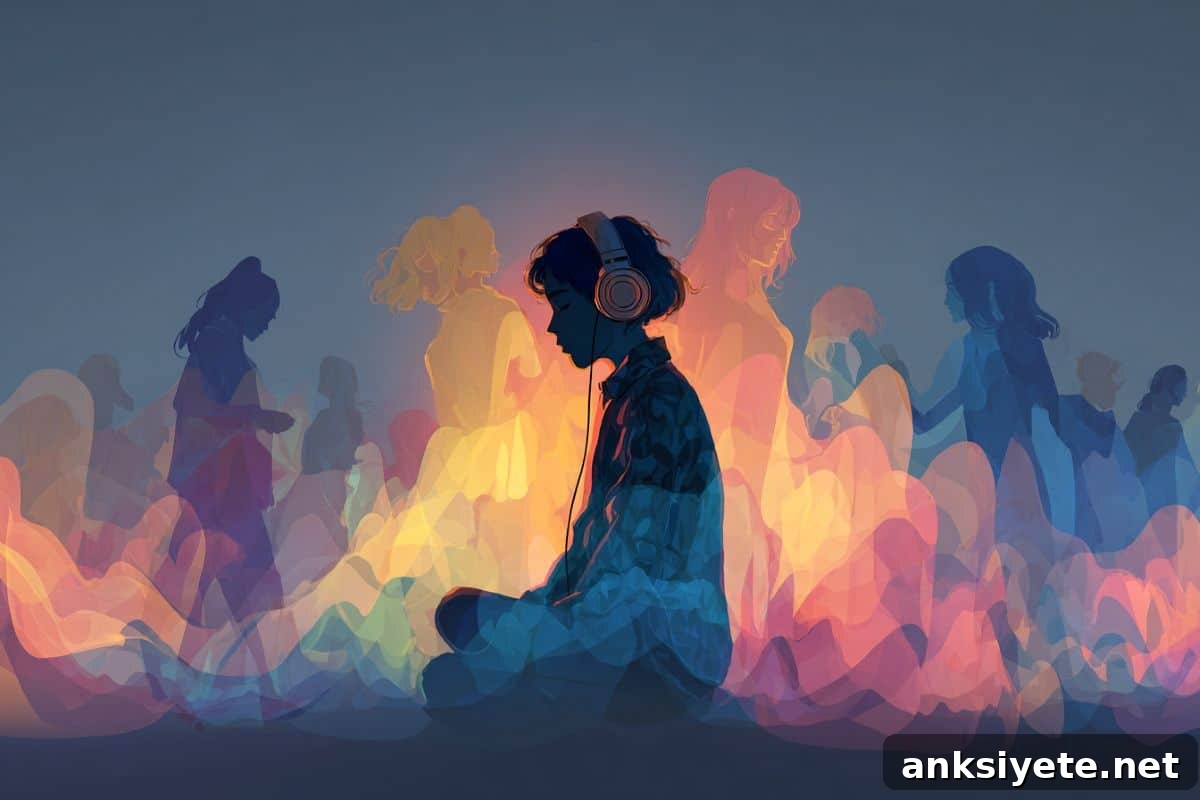
Summary: A large-scale study of 600 participants demonstrates that music can genuinely evoke feelings of companionship by activating social imagination. When participants listened to folk music—even with lyrics removed—they reported vivid social scenes, such as being with friends or dancing together.
Compared with silence, music consistently amplified mental imagery related to warmth, connection and shared activity. These findings point to music’s promise as an affordable, accessible tool to reduce loneliness and enhance mental-health approaches that rely on imagery.
Key Facts
- Social imagery: Instrumental or vocal music prompted vivid scenes of togetherness, independent of lyrics.
- Global study: 600 participants produced a publicly available dataset of over 4,000 imagined journeys and descriptions.
- Therapeutic potential: Results suggest practical applications for clinical and recreational mental imagery interventions to support wellbeing.
Source: University of Sydney
Have you ever felt that music keeps you company? Is that just a figure of speech or a real psychological effect?
A new study led by Dr Steffen A. Herff of the Sydney, Music, Mind and Body Lab at the Sydney Conservatorium of Music provides empirical evidence that music can act as a companion by encouraging imagined social interactions. “Music appears to be a catalyst for social imagination,” Dr Herff explains. “Even without words, it can evoke thoughts of connection, warmth and companionship.”
Music keeps you company
“Whether we are celebrating or grieving, people often turn to music,” Dr Herff said. “Our results show that beyond influencing mood, music can shape the content of thought itself—guiding imagination toward social themes and making music feel like good company.”
The study offers new insight into how music interacts with higher-order cognitive processes such as mental imagery. The research team suggests these effects could be harnessed to develop low-cost, widely accessible approaches to reduce loneliness and support mental-health care, particularly when people face isolation. The findings also reinforce the potential of music to complement existing therapeutic imagery techniques used in cognitive behavioural therapy.
“We observed robust evidence that music systematically strengthens and shapes mental imagery, promoting social themes in imagination,” Dr Herff said. “That has important implications for both theory and practice.”
For example, music might be used to enhance treatments that rely on guided visualisation or exposure-based mental imagery, such as interventions for specific phobias or trauma-related disorders.
The full study is published in Scientific Reports. Dr Herff is a University of Sydney Horizon Research Fellow, an ARC DECRA Fellow, and leader of the Sydney, Music, Mind and Body Lab at the Sydney Conservatorium of Music.
Can music help shape your thoughts?
Dr Herff and colleagues set out to test whether music produces a measurable effect on social thought and mental imagery. Over four years, they ran a global experiment with 600 participants to investigate how music influences imagination.
Participants closed their eyes and imagined journeys toward topographical landmarks, such as a mountain, either in silence or while listening to folk music. After each imagined journey they described what came to mind in freeform responses. The researchers then applied computational topic models to identify common themes across these descriptions.
Compared to silence, music increased the vividness and social content of imagined scenes: participants reported activities like laughing, dancing and spending time with others. Crucially, this effect appeared across different songs and persisted even when vocals were removed, indicating that the feeling of companionship was driven by musical sound rather than lyrics or language comprehension.
The team selected folk music from Italy, Spain and Sweden because of its historical association with communal activities and social bonding. To separate vocal and semantic effects, music was presented with and without vocals and participants included both native speakers and non-speakers of the languages used.
Using generative AI, the researchers created visual representations of participants’ imagined content. These images were used in follow-up tests: a different group of participants could distinguish images that had been generated from music-evoked descriptions versus silence-evoked descriptions, but this improved discrimination only when the viewers listened to the corresponding music while performing the task. “This suggests a form of shared perspective-taking—a theory of mind—for music-evoked imagery,” Dr Herff noted.
The dataset, now publicly available, contains over 4,000 imagined journeys with sentiment ratings, topic weights and AI-generated visuals. The authors emphasise the need for further research across other musical styles and cultural contexts—particularly non-Western genres—to broaden understanding and develop culturally appropriate therapeutic uses of music-evoked imagery.
Funding: This research was supported by the Australian Research Council (Discovery Early Career Researcher Award DE220100961) and a Sydney Horizon Fellowship awarded to Dr Steffen A. Herff, and by the Swiss National Science Foundation (SPARK grant CRSK-1_196567 / 1). The authors declare no competing interests.
About this music and social neuroscience research news
Author: Elissa Blake
Source: University of Sydney
Contact: Elissa Blake – University of Sydney
Image: The image is credited to Neuroscience News
Original Research: Open access. “Solitary silence and social sounds: music can influence mental imagery, inducing thoughts of social interactions” by Steffen A. Herff et al., Scientific Reports
Abstract
Solitary silence and social sounds: music can influence mental imagery, inducing thoughts of social interactions
During the COVID-19 pandemic many people reported using music to self-regulate and to feel less alone. Whether this reported comfort reflects a real effect on social thought and imagination was unclear. This study addresses that question by testing 600 participants who performed a directed mental-imagery task—imagining a journey toward a landmark—while exposed to silence or to task-irrelevant folk music in Italian, Spanish or Swedish.
To disentangle the contribution of vocals and semantic understanding, music tracks were presented either with or without vocals and participants included both native and non-native speakers of the languages. Compared to silence, music increased vividness and shaped the emotional tone of imagined content. Computational topic modelling revealed social interactions as a distinct thematic cluster in descriptions, and Bayesian mixed-effects models confirmed that music raised the presence of imagined social content relative to silence regardless of vocals or language comprehension.
Using stable diffusion, the team generated visualisations of participants’ reported imagery. In a separate experiment, observers were better able to distinguish images derived from music-evoked imagery when they listened to the same music themselves, supporting the idea that music evokes a shared imaginative perspective. These convergent findings indicate that music can indeed function as a form of company by inducing social imagery.