
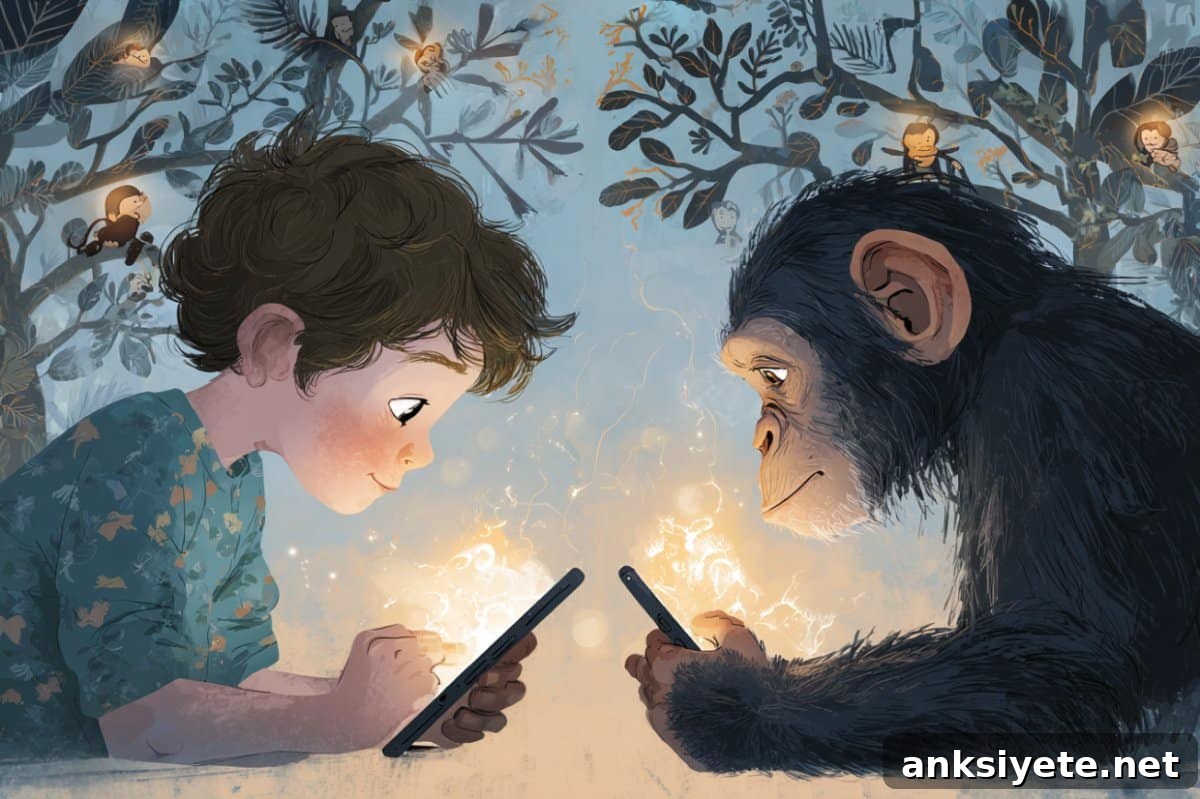
Summary: A recent comparative study finds that both chimpanzees and young children show a clear preference for observing social interactions over watching lone individuals. When given a choice, participants from both species repeatedly selected videos of social behavior, and some even sacrificed a tangible reward to continue watching. These results indicate that social curiosity appears early in human development and is shared with our close primate relatives.
The research reveals that in some cases—particularly among young children and male chimpanzees—subjects were willing to give up food or toys to watch social scenes, underlining that the drive to learn about others’ relationships and actions is not purely a human cultural phenomenon but likely has deeper evolutionary roots.
Key Facts:
- Shared preference: Both chimpanzees and children preferred videos showing interactions between individuals rather than solitary behavior.
- Value of social information: Some participants forfeited rewards (fruit for chimpanzees, tokens or toys for children) to access social content.
- Evolutionary implication: Social curiosity emerges early in childhood and is present in chimpanzees, suggesting a trait inherited from a common ancestor.
Source: University of Portsmouth
Do you ever find yourself people-watching in a café or tuning into a show just to see how others relate to one another? You may be observing the same impulse that drives primates to monitor social interactions.
An international research team compared social curiosity in chimpanzees and children and found a shared interest in third-party social interactions, even when obtaining that information required sacrificing a reward. Published in Proceedings of the Royal Society B: Biological Sciences, the study provides experimental evidence that curiosity about the social world—who is cooperating, who is in conflict, who is trustworthy—is present in both species.
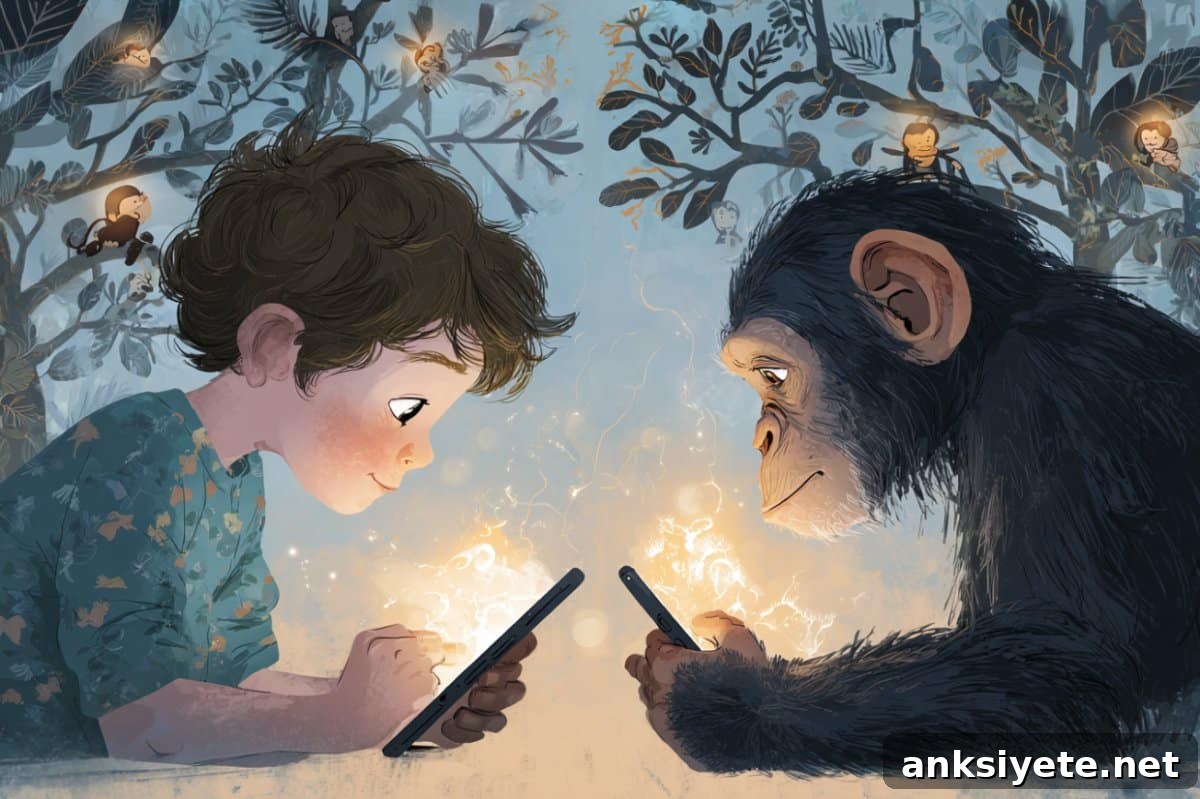
Lead author Dr Laura Simone Lewis of the University of California, Santa Barbara, explained that years of informal observation of both species inspired a controlled investigation into social curiosity: researchers had often seen children and chimpanzees interrupt tasks to watch peers, which suggested a specific motivation to learn about others. Until now, the developmental and evolutionary origins of that motivation had been little studied.
Co-author Dr Esther Herrmann from the University of Portsmouth’s Centre for Comparative and Evolutionary Psychology emphasizes the adaptive value of social curiosity. She notes that paying attention to others’ actions and relationships helps individuals navigate complex social environments—supporting decision-making, risk avoidance, and relationship building.
Study design
To measure social curiosity, the researchers designed two “curiosity boxes,” wooden enclosures that each held a tablet playing a different video. The experiments were conducted at the Ngamba Island Chimpanzee Sanctuary in Uganda and at sites in California, including the Oakland Zoo and the Lawrence Hall of Science. Participants—27 chimpanzees and 94 children aged 4 to 6—could choose which box to open and watch.
In the first experiment, subjects repeatedly preferred the box showing social interactions (grooming, play, or conflict) over videos of a single individual acting alone. The second experiment introduced a trade-off: participants could either open a box to watch a social video or accept a small material reward (jackfruit seeds for chimpanzees; marbles or similar tokens for children). A notable subset—particularly younger children and male chimpanzees—chose the social information over the reward, indicating they valued watching social scenes enough to pay a cost.
The third experiment explored preference for the emotional tone of interactions. Unlike children, who showed age- and sex-related differences—boys becoming more drawn to negative interactions with age while girls tended toward positive interactions—chimpanzees showed no clear preference between positive and negative social scenes in this setup.
By applying the same experimental setup to both species, the study provides direct, comparable evidence that interest in others’ social behavior is a shared feature of human and chimpanzee cognition. The authors argue that this social curiosity likely supports important social learning functions: identifying allies and competitors, anticipating social risks, and guiding cooperative decisions.
The research team recommends further work to track how social curiosity develops in younger chimpanzees, how it varies across human cultures, and how adults of both species respond under similar conditions. They also suggest testing other great apes—such as bonobos and orangutans—and examining how familiarity with the individuals in the videos (friends versus strangers) influences attention.
About this social development research news
Author: Robyn Montague
Source: University of Portsmouth
Contact: Robyn Montague – University of Portsmouth
Image: Image credited to Neuroscience News
Original research: Open access. “Chimpanzees and children are curious about social interactions” by Laura Simone Lewis et al., Proceedings of the Royal Society B: Biological Sciences
Abstract
Chimpanzees and children are curious about social interactions
Curiosity promotes learning and reduces uncertainty; social curiosity specifically refers to the drive to seek information about others’ actions, relationships, and intentions. Across three comparative experiments, researchers tested whether chimpanzees (n = 27) and children aged 4–6 (n = 94) preferentially attend to social interactions between third parties. Both species favored videos showing social interactions over videos of an individual alone (Experiment 1), and some participants—particularly male chimpanzees and younger children—were willing to forgo a material reward to view social content (Experiment 2). Experiment 3 found developmental differences in children’s interest in positive versus negative interactions, while chimpanzees showed no consistent preference. Together, these findings indicate that social curiosity emerges early in human development and is shared with chimpanzees, pointing to evolutionary continuity in attention to social information.