
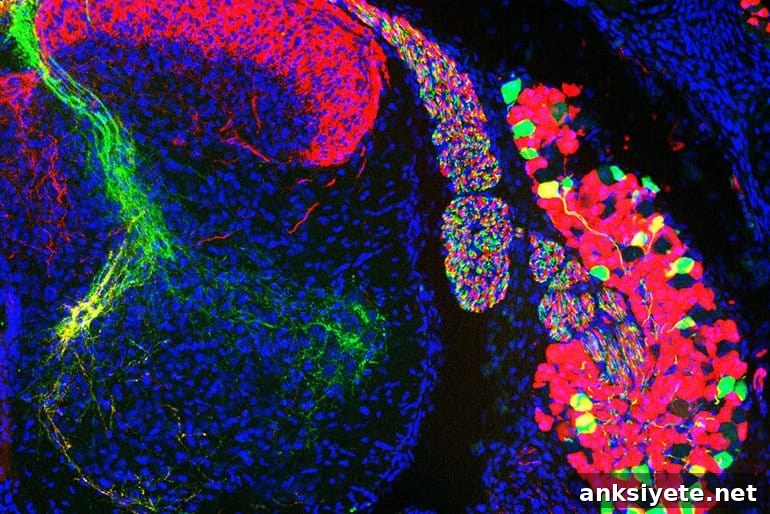
Summary: Researchers have identified molecular and genetic markers that distinguish proprioceptive sensory neurons linked to different muscle groups. These discoveries reveal how these neurons guide coordinated movement and offer directions for therapies and neuroprosthetic design.
Source: Max Delbrück Center
Coordinated movement depends on specialized sensory neurons in muscles and joints. Without these cells, the brain would lack essential information about the body’s position and motion.
A research team led by Dr. Niccolò Zampieri at the Max Delbrück Center has mapped molecular markers of proprioceptive sensory neurons and published their findings in Nature Communications.
We commonly recognize five senses—sight, hearing, smell, taste and touch—but an often-overlooked sixth sense, proprioception, is critical for movement and balance. “Proprioception collects information from muscles and joints about movement, posture and spatial position, then conveys that information to the central nervous system,” explains Dr. Zampieri, head of the Development and Function of Neural Circuits Lab. This unconscious sense enables the brain to direct motor neurons accurately, allowing precise actions such as lifting a cup with eyes closed or maintaining balance in the dark.
People who lack proprioception cannot perform coordinated movements. To better understand how proprioceptive sensory neurons (pSNs) acquire muscle-specific identities and form precise connections, Zampieri’s team investigated the molecular programs that differentiate pSNs innervating different muscle groups.
Precise connections and muscle specificity
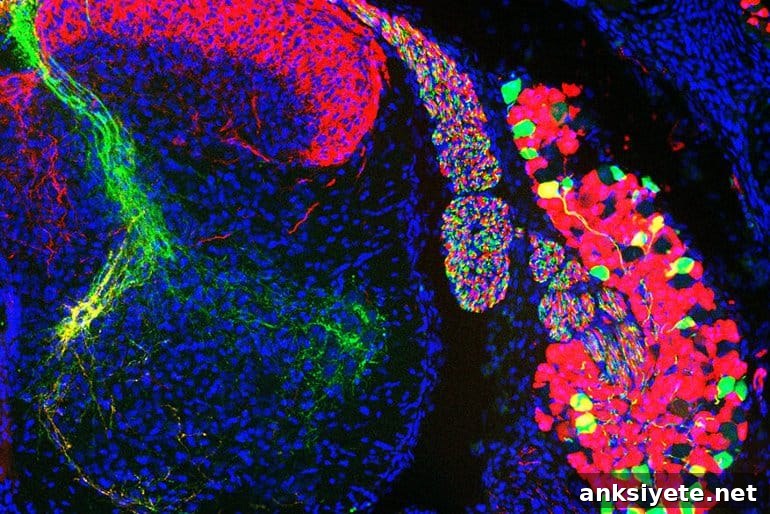
Proprioceptor cell bodies reside in the dorsal root ganglia and extend long axons to sensory organs in muscles—muscle spindles and Golgi tendon organs—that continuously monitor stretch and tension. The pSNs relay this information to the central nervous system to fine-tune motor neuron output. For accurate motor control, pSNs must connect selectively to specific muscles, but until now the molecular cues that determine these precise connections were not well defined.
Using single-cell transcriptomics, the researchers profiled gene expression in pSNs that innervate abdominal, back and hindlimb muscles in mice. They discovered distinct gene expression signatures that reliably distinguish proprioceptors targeting each muscle group. Importantly, many of these markers are active during embryonic development and persist beyond birth, indicating that muscle-target identity is established early through stable genetic programs.
Guidance molecules and wiring specificity
Among the key findings, the team identified differential expression of guidance molecules—including ephrins and their receptors—across proprioceptor subtypes. Ephrins are known to steer growing axons toward appropriate targets during nervous system development. In mouse models lacking ephrin-A5, the authors observed disrupted connectivity between proprioceptors and hindlimb muscles, demonstrating that these molecules contribute to wiring specificity and correct muscle innervation.
Applications: neuroprostheses and skeletal health
These molecular markers open new experimental possibilities. For example, optogenetic tools can be targeted to specific pSN populations to activate or inhibit them selectively, revealing each population’s role in proprioceptive function and motor control. This level of precision will inform the design of neuroprosthetic devices intended to restore lost motor or sensory capabilities after injury.
Beyond neuroprosthetics, a clearer understanding of proprioception has implications for musculoskeletal conditions. The researchers note links between impaired proprioceptive signaling and skeletal disorders. For example, altered muscle tension due to dysfunctional proprioception may contribute to scoliosis—the abnormal curvature and rotation of the spine that can arise during childhood growth. Faulty proprioceptive input could also play a role in hip dysplasia. By elucidating how proprioceptive circuits form and function, the work may ultimately inform therapies that prevent or mitigate such skeletal deformities.
About this genetics and neuroscience research news
Author: Press Office
Source: Max Delbruck Center
Contact: Press Office – Max Delbrück Center
Image: The image is credited to Stephan Dietrich, Zampieri Lab, Max Delbrück Center
Original Research: Open access.
“Molecular identity of proprioceptor subtypes innervating different muscle groups in mice” by Stephan Dietrich et al. Nature Communications
Abstract
Molecular identity of proprioceptor subtypes innervating different muscle groups in mice
Coordinated movements require accurate proprioceptive feedback about body position in space, yet the molecular basis of proprioceptor subtype identity has remained incompletely characterized. The authors used single-cell transcriptomics to categorize mouse proprioceptors by the muscle groups they innervate and identified molecular signatures linked to back (Tox, Epha3), abdominal (C1ql2), and hindlimb (Gabrg1, Efna5) muscles. The study shows that muscle-type identity emerges during early development before receptor function is fully acquired and includes genetic programs that guide wiring specificity to muscle targets. These results establish muscle identity as a core element of proprioceptor subtype differentiation and provide molecular leads for studying development and function of muscle-specific sensory networks.