
Summary: Social trauma disrupts the brain’s reward system, so social interaction ceases to be rewarding and prompts broad social avoidance.
Source: Mount Sinai Hospital
Key finding: A population of stress- and threat-responsive neurons in the lateral septum records prior social trauma and becomes hyperactive during later encounters with otherwise non-threatening social partners.
Researchers at the Brain and Body Research Center at Mount Sinai report that past social trauma can transform previously rewarding social targets into perceived threats, producing generalized social avoidance and impairing social reward processing. The study, led by Long Li, Ph.D., and published on November 30 in Nature, links behavioral changes after traumatic social experience to specific neural circuitry in the lateral septum.
In people, traumatic social experiences are known to blunt brain reward responses to social contact, which can lead to severe avoidance of social situations. In rodents, chronic social defeat stress (CSDS) has been used as a model of social trauma to examine why some individuals are susceptible to long-term behavioral effects while others remain resilient. However, how CSDS specifically alters social reward — the capacity to find social interaction rewarding — has been unclear.
Many earlier experiments measured responses to an adult aggressor similar to the one used to produce the trauma. Avoidance in that context may reflect fear or submission rather than a loss of social reward. To separate fear-driven avoidance from reduced social reward, the Mount Sinai team measured responses to a non-threatening same-sex juvenile mouse, a social target that is normally experienced as rewarding.
After undergoing CSDS, adult male and female mice were tested for social behavior. The researchers first classified mice as resilient or susceptible according to their interactions with an aggressive adult. They then performed a resident-intruder test using a 4–6 week old juvenile of the same sex and a social conditioned place preference test to determine whether the subjects developed a context-dependent preference for the juvenile — an index of social reward.
Control and resilient mice showed similar levels of active social behavior toward juveniles, including approaches, close following and investigative sniffing. These mice rarely withdrew and freely engaged with the juveniles. By contrast, stress-susceptible mice displayed markedly reduced active investigation, a longer delay before engaging (increased latency), and pronounced social avoidance. Measures of social investigation time, avoidance and latency correlated with the mice’s prior social interaction behavior toward aggressive adults, indicating that susceptibility generalizes broadly to non-threatening social partners.
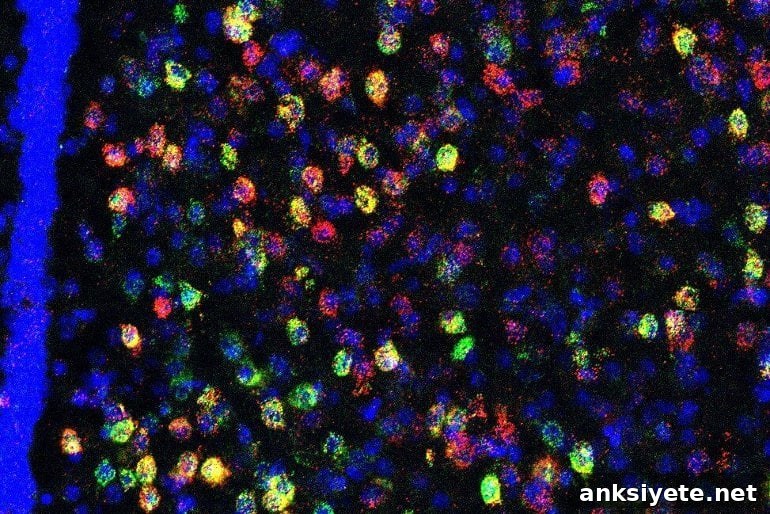
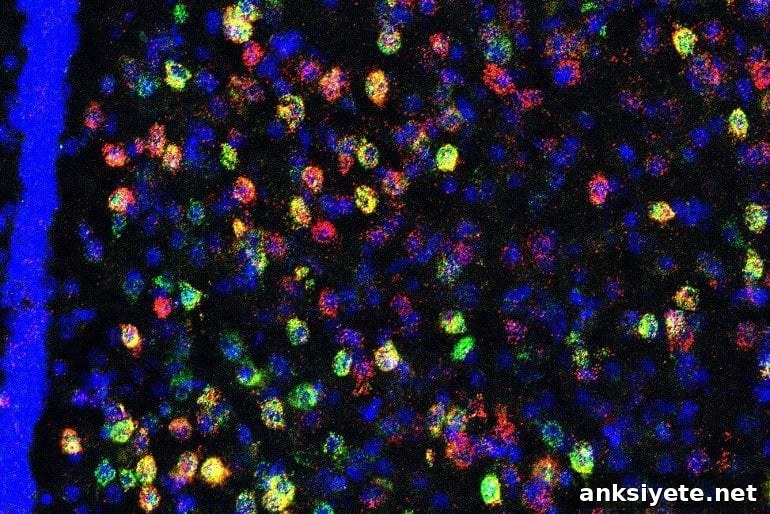
To pinpoint brain regions linked to this heightened perception of social threat, the team combined whole-brain Fos mapping, in vivo calcium imaging and electrophysiology. These approaches revealed a distinct population of neurotensin-expressing neurons in the lateral septum (NTLS) that respond to juvenile social interactions only in susceptible mice, not in resilient or unstressed controls.
Causal tests using optogenetic and chemogenetic tools showed that manipulating NTLS neurons and their downstream pathways changes social behavior: activating these neurons can suppress social reward signals, while inhibiting them can restore interaction and preference for social targets. As Scott Russo, Ph.D., explained, activation of NTLS cells in a social-threat context dampened activity in brain regions that normally encode social reward, effectively occluding the rewarding quality of social contact.
Together, the findings indicate that social trauma can reconfigure lateral septum circuitry so that previously rewarding social cues are reinterpreted as threats. This circuit-level shift helps explain how traumatic social experiences produce durable deficits in social reward processing and widespread social avoidance, which are features of several psychiatric conditions.
The Mount Sinai team plans to extend this work to human studies to test whether lateral septum circuitry similarly influences social threat perception and reward sensitivity in people who have experienced trauma. Understanding these mechanisms could guide development of targeted therapies to restore social reward processing after trauma.
About this social trauma and psychology research news
Author: Press Office
Source: Mount Sinai Hospital
Contact: Press Office – Mount Sinai Hospital
Image: The image is credited to Long Li
Original Research: Open access. “Social trauma engages lateral septum circuitry to occlude social reward” by Scott Russo et al. Nature
Abstract
Social trauma engages lateral septum circuitry to occlude social reward
Traumatic social experiences in humans can contribute to psychiatric disorders by blunting the brain’s reward response to social interaction, producing severe social avoidance. In rodents, chronic social defeat stress (CSDS) models this type of trauma but its effects on social reward have been understudied.
This study shows that after CSDS, a subset of male and female mice — designated susceptible — avoid interactions with non-aggressive, same-sex juvenile mice and fail to form context-dependent social reward preferences after those encounters. Non-social stressors did not produce the same effect in either sex.
Using whole-brain Fos mapping, in vivo calcium imaging and whole-cell recordings, the researchers identified a population of lateral septum neurotensin neurons (NTLS) that become activated by juvenile social interaction only in susceptible mice. Optogenetic and chemogenetic manipulation of NTLS neurons and their downstream connections altered social interaction and social reward, supporting a causal role.
These results suggest that in susceptible mice, previously rewarding social targets are perceived as threats due to hyperactivity of NTLS neurons, which occludes normal social reward processing.