
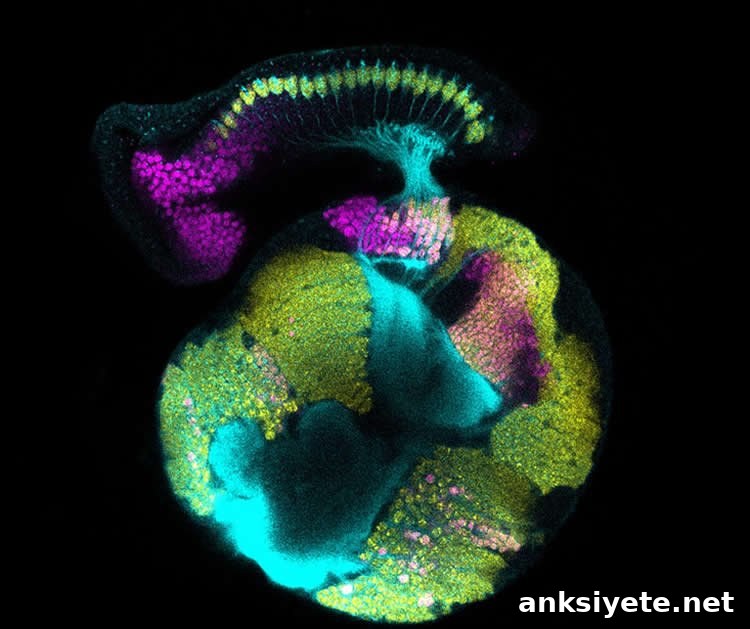
Summary: New research published in Science shows that glial cells play a crucial role in coordinating nerve cell development in the brain.
Source: NYU
Biologists have discovered an unexpected driver of brain development: glial cells. This finding changes how scientists understand the timing and coordination of nerve cell formation across different brain regions.
Published in the journal Science, the study reveals that glia — non-neuronal cells long considered mostly passive support for neurons — actively coordinate the birth and identity of neurons during brain development.
“These results prompt us to move beyond a strictly neuron-centered view of brain development,” says Vilaiwan Fernandes, a postdoctoral fellow in New York University’s Department of Biology and the lead author of the study. “Our work shows that key questions about when neurons are born, what kinds of neurons they become, and how their birth is coordinated across different brain areas cannot be fully understood without accounting for glial contributions.”
The brain is composed mainly of two cell classes: neurons, which form the circuits that process information, and glia, which are non-neuronal cells that occupy more than half of brain volume. Because neurons form functional networks, neurobiologists have historically focused on them. But the abundance of glia suggested to the NYU team that these cells might serve a more active developmental role.
To investigate this possibility, the researchers studied the visual system of the fruit fly (Drosophila), a model organism whose visual circuits are organized into repeated microcircuits across the visual field, similar in principle to human visual organization. This modular architecture makes the fly an ideal system for examining how neuron production in one region — the retina — is synchronized with neuron development in another distant region of the brain, the optic lobe.
The NYU team discovered that a specific population of glial cells acts as a signaling relay between the retina and the optic lobe. Photoreceptor cells in the retina release epidermal growth factor (EGF) as a differentiation cue. Rather than acting directly on the target neurons in the optic lobe, that cue triggers glia to produce insulin-like peptides. These glia-derived insulin-like signals then induce nearby brain cells to differentiate into the appropriate lamina neurons at the correct time and place.
“Glia serve as a precise signaling intermediary,” explains Claude Desplan, Professor of Biology at NYU and the senior author on the paper. “By relaying and transforming signals from the retina, glia control not only when and where neurons form but also influence the types of neurons they become. This mechanism explains how neuronal assembly and delayed differentiation are reconciled across separate brain regions.”
Funding: This research received support in part from the National Institutes of Health (grant EY13012).
Source: James Devitt, NYU
Image credit: Vilaiwan M Fernandes, Desplan Lab, NYU Department of Biology.
Original research: Fernandes, V. M., Chen, Z., Rossi, A. M., Zipfel, J., & Desplan, C. “Glia relay differentiation cues to coordinate neuronal development in Drosophila.” Science, published online September 1, 2017. DOI: 10.1126/science.aan3174.
Glia relay differentiation cues to coordinate neuronal development in Drosophila
Neuronal birth and specification must be coordinated across the developing brain to form functional circuits. Using the Drosophila visual system to study retinotopy — the coordinated mapping of the visual field — the authors show that photoreceptors induce their target lamina neurons through a multi-step signaling relay. Photoreceptor-derived EGF signals stimulate glia, which in turn produce insulin-like peptides that trigger lamina neuron differentiation. This glial relay reconciles the timing of column assembly with later neuronal differentiation and explains the spatial and temporal pattern of lamina neuron development across distinct brain regions.
This study highlights a broader principle: glia can actively shape neuronal development by relaying and modifying differentiation cues between regions. Recognizing the developmental role of glia provides a more complete picture of how complex nervous systems are assembled and may reshape future research directions in developmental neurobiology.