
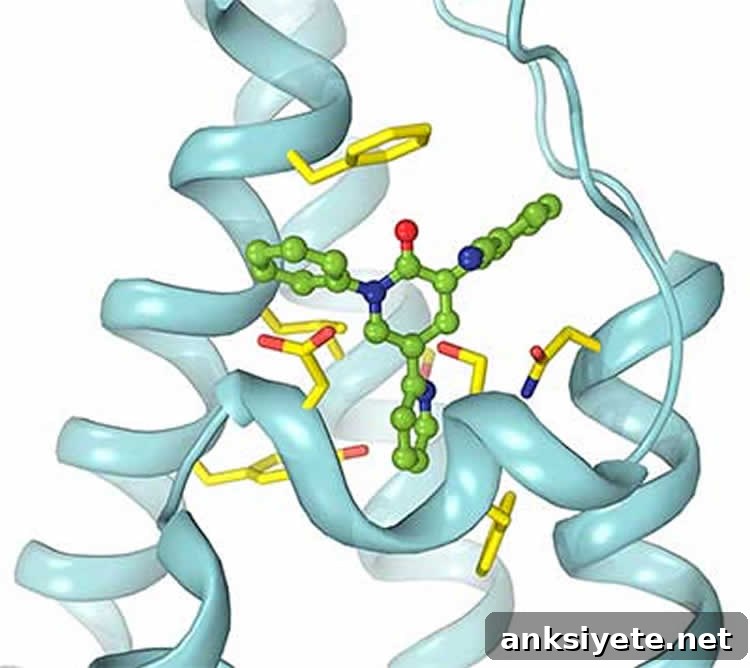
Summary: Computer simulations helped identify where a class of anti-seizure drugs bind to their target receptor in the brain.
Source: Carnegie Mellon University.
New Insights into How Epilepsy Drugs Block Excess Brain Activity
Up to one in four adults with epilepsy do not respond adequately to current medications, making development of better therapies a pressing need. Researchers led by Alexander Sobolevsky at Columbia University, together with computational chemist Maria Kurnikova from Carnegie Mellon University, report findings that clarify how a class of anti-seizure drugs inhibit the AMPA subtype of glutamate receptors—key conduits for excitatory electrical signals in the brain.
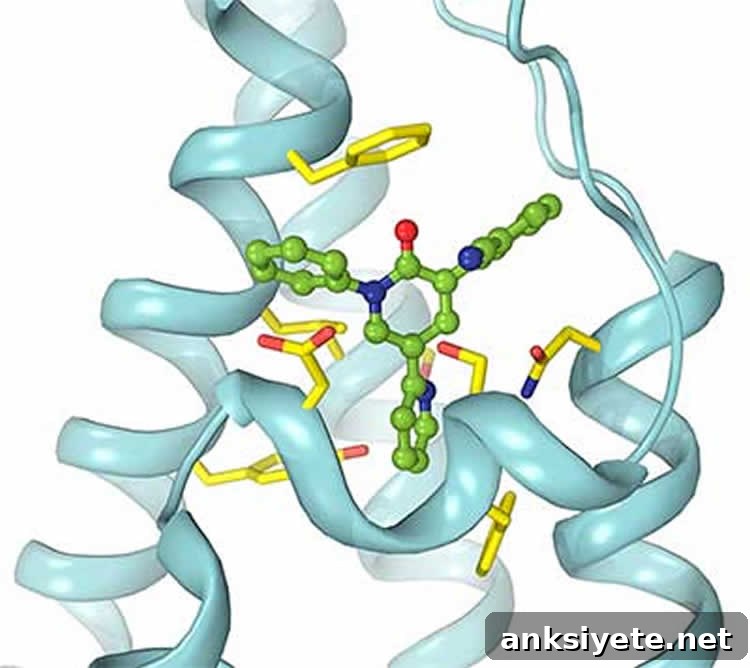
The team’s work, published in Neuron, combines structural biology and computational modeling to show that these drugs act at a previously unrecognized site on the AMPA receptor. The drugs bind at the interface between the receptor’s ion channel and the linkers to its ligand-binding domains, essentially wedging the channel closed and preventing the gating motions necessary for ion flow. This noncompetitive inhibition reduces the receptor’s ability to propagate the runaway electrical activity that underlies seizures.
Why AMPA Receptors Matter in Epilepsy
AMPA receptors mediate most fast excitatory neurotransmission in the brain. In epilepsy, excessive or hypersensitive AMPA receptor activity can permit the rapid spread of abnormal electrical discharges that characterize seizures. Limiting AMPA receptor opening is therefore a promising approach to interrupting seizure generation and spread. However, because these receptors are also essential for normal brain function, inhibitors can cause side effects such as drowsiness, nausea, and headache. The challenge is to design drugs that effectively curb pathological excitation while minimizing adverse effects.
Structural Biology Meets High-Performance Simulation
Sobolevsky’s group used crystallography and electrophysiology to visualize the receptor and drug molecules and to demonstrate how binding alters receptor function. Kurnikova, an expert in molecular simulations, augmented these experimental data by running large-scale computational docking and dynamics to define the precise binding locations and interactions. Her simulations show the drugs lodging like wedges between transmembrane segments, stabilizing the receptor’s closed conformation.
Identifying these binding sites required exploring millions of molecular configurations, which in turn demanded substantial computing power. Kurnikova performs much of this work on high-end desktop systems made possible by advances in graphics processing technology originally driven by the gaming industry—allowing researchers to purchase machines with dramatically greater parallel performance for relatively modest cost. In addition, she gains access to ANTON, a specialized supercomputer built by the D. E. Shaw Research team for molecular dynamics. With time on ANTON allocated through national peer-reviewed access, Kurnikova was able to simulate 30 microseconds of AMPA receptor behavior—an effort she describes as roughly 100 times faster than her local hardware could achieve.
Implications for Drug Design
The work helps explain how noncompetitive AMPA receptor inhibitors—including the marketed drug perampanel—can suppress seizures by mechanically preventing channel opening rather than by competing with the natural ligand. Importantly, the binding site and its molecular composition are conserved between rat and human receptors, offering a clear structural template for medicinal chemists to refine drug designs. Sobolevsky and Kurnikova suggest that by rationally redesigning molecules that occupy this allosteric site, it may be possible to retain seizure control while reducing side effects.
About the Researchers and Future Directions
Maria Kurnikova is an associate professor of chemistry at Carnegie Mellon University who trained at the Moscow Institute of Physics and Technology and earned a Ph.D. in theoretical chemistry from the University of Pittsburgh. Her international research career includes positions in Israel and the United States, and she joined Carnegie Mellon’s faculty in 2003. Alexander Sobolevsky leads the structural and electrophysiological components of the project at Columbia University. Together, their complementary approaches—experimental structure determination and detailed molecular simulation—create a powerful platform for rational drug design.
With additional funding, the team aims to propose and test new compounds targeted to the identified allosteric binding pocket. If their structural hypotheses prove correct, newly designed inhibitors could offer improved safety profiles for people with drug-resistant epilepsy.
Source: Mark Roth, Carnegie Mellon University
Image credit: Laboratory of Alexander Sobolevsky, PhD / Columbia University Medical Center.
Original research: Yelshanskaya MV, Singh AK, Sampson JM, Narangoda C, Kurnikova M, Sobolevsky AI. “Structural Bases of Noncompetitive Inhibition of AMPA-Subtype Ionotropic Glutamate Receptors by Antiepileptic Drugs.” Neuron. Published online September 8, 2016. doi:10.1016/j.neuron.2016.08.012
Abstract Summary
Excitatory neurotransmission contributes to epileptogenesis, and AMPA-type glutamate receptors are central to that process. The most effective and tolerable AMPA inhibitors act noncompetitively but have unwanted side effects. The lack of structural detail limited rational drug design. Crystal structures of the rat GluA2 AMPA receptor bound to three noncompetitive inhibitors reveal a novel, conserved allosteric site at the extracellular side of the ion channel. The inhibitors act as wedges between transmembrane segments, stabilizing a closed state and preventing the gating motions necessary for channel opening. This structural insight provides a basis for designing new antiepileptic agents with improved specificity and tolerability.