
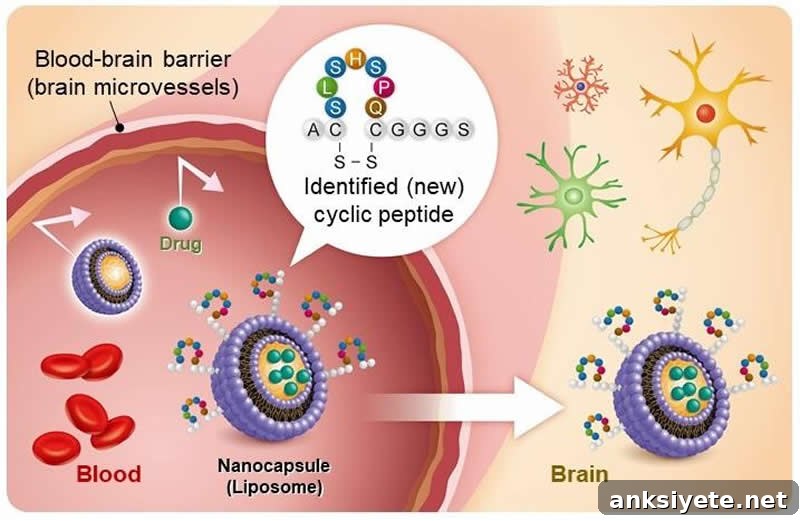
Summary: Researchers at Kumamoto University have identified a cyclic heptapeptide that significantly improves penetration of the blood-brain barrier (BBB), enabling nanoparticle carriers to deliver macromolecular drugs to the brain.
Source: Kumamoto University
New Cyclic Peptide Enhances Blood-Brain Barrier Penetration
Scientists from Kumamoto University in Japan have discovered a cyclic peptide that facilitates transport across the blood-brain barrier (BBB). By attaching this cyclic heptapeptide to the surface of nanoparticles such as liposomes, researchers created nanocarriers that can cross the BBB and deliver therapeutic cargo to brain tissue. This development offers a promising route for delivering large-molecule therapeutics and biopharmaceuticals that normally cannot reach the central nervous system.
Why BBB Penetration Matters
The BBB is a highly selective barrier that separates the bloodstream from the brain, preventing many substances—including numerous drugs—from entering brain tissue. While small, lipophilic drugs can sometimes cross the BBB, most macromolecular treatments and biologics cannot. As interest in biologic therapies and large-molecule drugs grows, effective strategies to transport these agents into the brain are essential for treating neurological disorders such as Alzheimer’s disease, Parkinson’s disease, and other central nervous system conditions.
Phage Display Screening Identifies Candidate Peptides
To find peptides capable of mediating BBB transport, the research team employed a phage display approach. They screened a library of cyclic peptides displayed on M13 phages to identify sequences that traversed a human BBB model composed of hCMEC/D3 cell monolayers. Because M13 phages are larger than many therapeutic nanoparticles and macromolecules, successful phage passage suggested that the selected cyclic peptides might enable transport of sizable drug carriers as well.
Results in Cell Models and Animals
From the screen, the team identified two cyclic heptapeptides with BBB-penetrating properties. One peptide in particular—designated SLSHSPQ (abbreviated SLS)—enhanced phage transport not only in the human BBB model but also in monkey and rat BBB co-culture models, suggesting cross-species activity. Following intravenous injection in mice, the SLS-displaying phage was detected in brain tissue within 60 minutes, demonstrating in vivo translocation across the BBB.
To test whether the peptide could facilitate nanoparticle delivery, researchers conjugated the cyclic peptide to the surface of liposomes, forming approximately 150-nanometer artificial nanoparticles. When these modified liposomes were administered intravenously to mice, they too were found in the brain after 60 minutes, confirming that the cyclic peptide can support nanoparticle-mediated transport across the BBB.
Mechanism and Therapeutic Potential
Cellular experiments showed that the SLS-displaying phage enters human BBB model cells via macropinocytosis and is subsequently released through pathways associated with exosome excretion. These findings suggest a transcellular transport route rather than simple paracellular leakage. Because liposomes and other nanocarriers can encapsulate a wide variety of therapeutic agents—including proteins, nucleic acids, and small molecules—conjugating the SLS cyclic peptide to nanocarrier surfaces offers a practical strategy to deliver macromolecular drugs to brain parenchyma.
Professor Sumio Ohtsuki and colleagues emphasize that this cyclic peptide provides a versatile carrier motif that could be applied to different nanoparticle systems and macromolecular drugs. The approach opens new opportunities for developing treatments directed at central nervous system diseases that have been difficult to treat due to limited BBB permeability.
Study Details
The discovery and validation of the SLS cyclic heptapeptide are described in the study titled “Novel cyclic peptides facilitating transcellular blood-brain barrier transport of macromolecules in vitro and in vivo,” published in the Journal of Controlled Release. The research includes screening with hCMEC/D3 cell monolayers, confirmation in monkey and rat BBB models, mechanistic analysis of cellular uptake and excretion, and demonstration of brain delivery in mice using both phage and peptide-conjugated liposomes.
Contact and Credits
Kumamoto University media contacts: J. Sanderson & N. Fukuda – Kumamoto University.
Image credit: Professor Sumio Ohtsuki.