
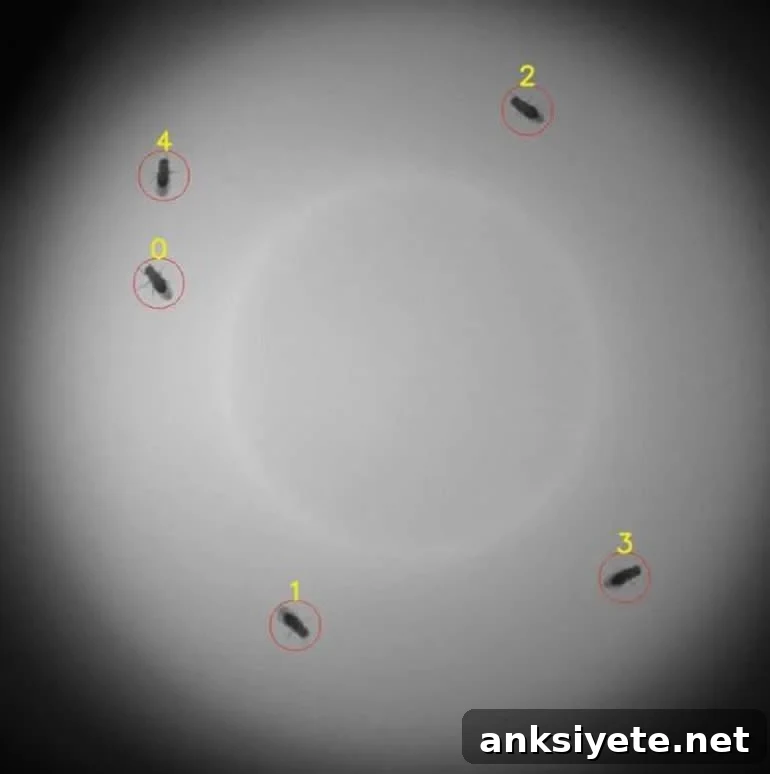
Summary: New research reveals how fruit flies use the movement of others as a social safety cue and identifies neural mechanisms that underlie freezing and the decision to resume activity.
Source: Champalimaud Center for the Unknown
Across animal groups—from schools of fish and herds of antelope to human crowds—one clear advantage of grouping is increased safety. Surrounded by peers, individuals can reduce vigilance and carry out other tasks such as foraging or attending to daily activities.
Safety in numbers is not just a matter of proximity. Communication among group members often shapes how animals detect threats and decide when it is safe to relax. Alarm signals—shrieks, yelps and barks—are well known social cues of danger. By contrast, social cues that signal safety, indicating that it is now safe to resume normal behavior, have not been clearly identified in any species until now.
A recent study using fruit flies uncovers the first clear example of a social safety cue. Published in Nature Communications, this work sheds light on how social information alters defensive behavior and pinpoints the visual neurons that mediate this effect.
A silent sign of danger
“Most research on social communication of danger has focused on alarm calls,” says Marta Moita, principal investigator at the Champalimaud Centre for the Unknown. “We wanted to study a different kind of cue: the defensive behaviors themselves.”
Freezing is one of the three canonical defensive responses—alongside fight and flight—and is especially adaptive when escape is impossible or when remaining motionless reduces detection. Freezing can also serve as a silent social signal: by remaining still, an animal may warn nearby conspecifics of danger without producing an attention-attracting noise.
Moita’s team had previously shown that individual fruit flies respond to inescapable threats by freezing. This raised a new question: how does this behavior change when flies are in a group?
Safety in (exactly how many) numbers
To investigate, lead author Clara Ferreira ran controlled experiments with groups ranging from one to ten flies. Flies were placed in a transparent chamber and repeatedly exposed to an expanding dark disc that mimics an object on a collision course—an artificial looming stimulus similar to an approaching hand. Many animals, including humans, react to such looming visual stimuli with defensive responses such as freezing.
Group size had a clear impact. All groups—from pairs up to tens—frozen less overall than solitary flies, but the pattern depended on how many flies were together. In groups of six or more, flies showed brief freezing when the threat appeared and then quickly resumed movement after the threat passed. In groups of five or fewer, the flies’ behavior more closely resembled that of single flies: although they froze less than lone individuals overall, their total freezing time increased across repeated exposures to the stimulus.
“This was the first systematic characterization of group-size effects on freezing in any species,” Ferreira explains. “The results revealed a nuanced relationship: larger groups promote rapid recovery from freezing, while smaller groups produce a gradual increase in freezing across trials.”
Should I stay or should I go?
The observations made it clear that flies adjust their defensive responses depending on the behavior of others. To identify the specific social cues driving this change, the researchers analyzed data from experiments that included blind flies and magnetic “dummy” flies whose motion could be controlled.
They found a twofold effect. First, an individual fly was more likely to enter a freezing state when nearby flies (real or dummy) also froze in response to the looming threat: the cessation of movement functions as a social cue of danger. Second—and more striking—the resumption of movement by others served as a social safety cue: when peers began moving again, frozen flies were more likely to break out of their immobility and resume activity.
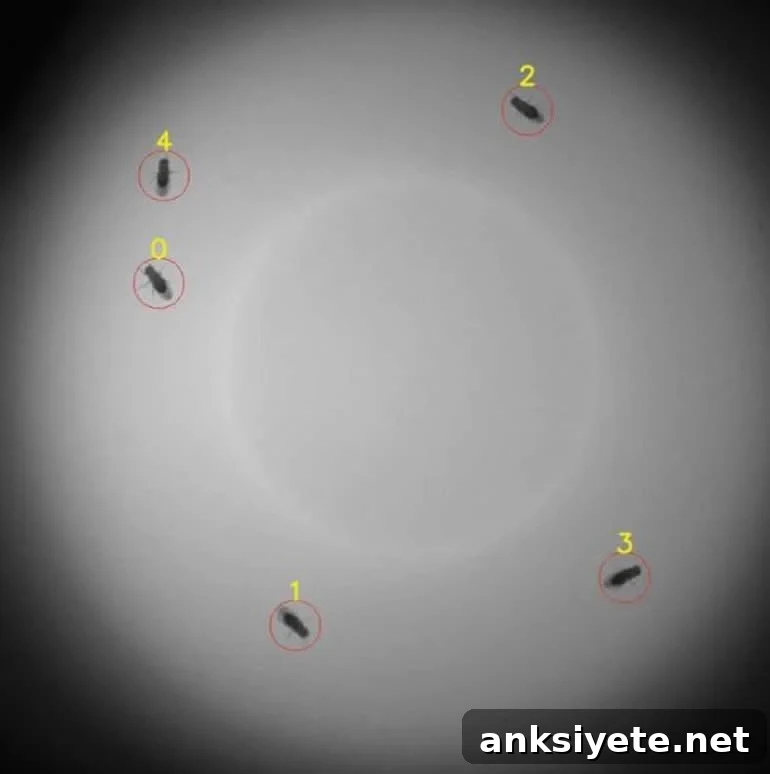
“This discovery identifies the resumption of movement as the first documented social safety cue in any animal,” Moita says. “The sudden stop of movement signals danger, while the restart of movement signals safety—two sides of the same social cue mediated by motion.”
Next stop — the brain
Because fruit flies offer powerful genetic and neurobiological tools, the team could probe the neural circuits that transform observed motion into behavioral change. Ferreira reports that a specific class of visual neurons—the lobula columnar neurons known as LC11—are essential for perceiving other flies’ movement as a safety signal that prompts frozen flies to resume activity.
The identification of visual motion cues and their neural substrates provides a foundation for exploring how social information is encoded and acted upon in the brain. Although flies and mammals differ in nervous system complexity, the basic principle—using others’ motion to infer safety—may reflect conserved strategies across species. The work opens a path to understand general neural mechanisms that mediate the well-known phenomenon of safety in numbers.
About this neuroscience research article
Source:
Champalimaud Center for the Unknown
Contacts:
Afonso Vaz Pinto – Champalimaud Center for the Unknown
Image Source:
Image credited to Clara Ferreira.
Original Research: Open access
“Behavioral and neuronal underpinnings of safety in numbers in fruit flies” by Clara H. Ferreira & Marta A. Moita. Nature Communications. DOI: 10.1038/s41467-020-17856-4.
Abstract
Behavioral and neuronal underpinnings of safety in numbers in fruit flies
Living in a group allows individuals to decrease their defenses, enabling other beneficial behaviors such as foraging. The detection of a threat through social cues is widely reported, however, the safety cues that guide animals to break away from a defensive behavior and resume alternate activities remain elusive. Here we show that fruit flies display a graded decrease in freezing behavior, triggered by an inescapable threat, with increasing group sizes. Furthermore, flies use the cessation of movement of other flies as a cue of threat and its resumption as a cue of safety. Finally, we find that lobula columnar neurons, LC11, mediate the propensity for freezing flies to resume moving in response to the movement of others. By identifying visual motion cues, and the neurons involved in their processing, as the basis of a social safety cue this study brings new insights into the neuronal basis of safety in numbers.