
Summary: Sesaminol, a compound derived from sesame seed shells, shows neuroprotective effects in laboratory and animal models of Parkinson’s disease.
Source: Osaka City University
Sesame seed oil is prized for its nutty aroma and high smoke point, produced by extracting oil from sesame seeds while the seed husks are typically discarded. Researchers at Osaka City University examined that agricultural byproduct and identified sesaminol, a compound abundant in sesame seed shells, as a promising neuroprotective agent against Parkinson’s disease.
“At present there is no approved preventive medicine for Parkinson’s disease,” explains OCU Associate Professor Akiko Kojima-Yuasa. “Available treatments address symptoms but do not prevent neuronal degeneration.” Professor Kojima-Yuasa led a research team that evaluated the effects of sesaminol using both in vitro cell models and in vivo animal models designed to mimic Parkinson’s pathology.
Parkinson’s disease is a progressive neurodegenerative disorder in which neurons that control movement progressively deteriorate. One major contributor to this neuronal damage is oxidative stress—an imbalance between the production of reactive oxygen species (ROS) and the body’s antioxidant defenses. The researchers focused on whether sesaminol could reduce oxidative stress and protect neurons from degeneration.
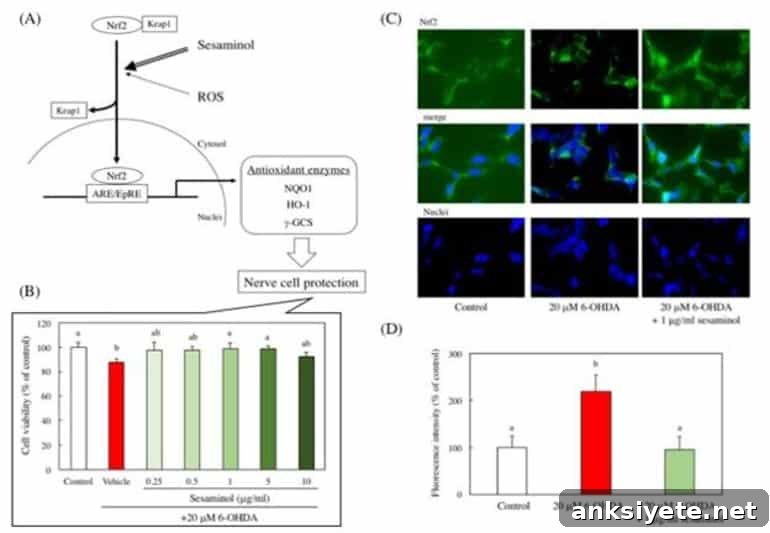
In cell-based in vitro experiments using the human neuroblastoma SH-SY5Y cell line, the team induced Parkinson-like damage with 6-hydroxydopamine (6-OHDA). Treatment with 6-OHDA reduced cell viability and increased intracellular ROS levels. When sesaminol was applied prior to the toxin, cell viability recovered to near-control levels and ROS production was significantly suppressed. The investigators observed that sesaminol promoted the nuclear translocation of Nrf2, a transcription factor that activates antioxidant defenses through the antioxidant response element (ARE). Increased activity of antioxidant enzymes, including NAD(P)H:quinone oxidoreductase (NQO1), was also detected in the presence of sesaminol, consistent with activation of the Nrf2-ARE pathway.
The animal studies provided additional support for sesaminol’s protective effects. The research group used rotenone, a toxin that reproduces several features of Parkinson’s disease in mice, including reduced dopamine production, impaired motor function, increased α-synuclein accumulation in the substantia nigra, and digestive tract abnormalities. Mice fed a diet supplemented with sesaminol for 36 days showed notable improvements: dopamine levels in the brain increased compared with rotenone-only animals; rotarod tests demonstrated improved motor coordination and endurance; and intestinal motility improved relative to untreated disease models.
Pathological assessment also revealed benefits in the sesaminol‑treated group. Rotenone exposure produced increased α-synuclein expression in the substantia nigra and caused shortening and damage to the colonic mucosa. These abnormalities were reduced or absent in mice receiving sesaminol, indicating protection of both central nervous system and gut tissues in this model.
Mechanistically, the data indicate that sesaminol’s antioxidant activity and its ability to activate Nrf2-ARE signaling play central roles in preventing oxidative damage to neurons. By enhancing cellular antioxidant defenses and reducing ROS, sesaminol limits the cascade of events that lead to neuronal dysfunction and the characteristic motor symptoms of Parkinson’s disease in these experimental systems.
Although further research, including controlled clinical trials, is required before any dietary recommendation or therapeutic use can be endorsed for humans, the findings are encouraging. The study highlights that sesaminol—a naturally occurring compound present in sesame seed husks—could be developed as a preventive approach or adjunctive intervention aimed at reducing oxidative stress and slowing neurodegeneration associated with Parkinson’s disease.
About this Parkinson’s disease research news
Source: Osaka City University
Contact: James Gracey – Osaka City University
Image: Image credited to Akiko Kojima‑Yuasa
Original Research: Open access. “Sesaminol prevents Parkinson’s disease by activating the Nrf2‑ARE signaling pathway” by Akiko Kojima‑Yuasa et al., published in Heliyon.
Abstract
Sesaminol prevents Parkinson’s disease by activating the Nrf2‑ARE signaling pathway
Parkinson’s disease (PD) is a neurodegenerative disorder characterized by degeneration of substantia nigra neurons driven in large part by oxidative stress. Sesaminol has documented antioxidant properties. Using in vitro and in vivo PD models, researchers investigated whether sesaminol could prevent PD‑like pathology. In SH‑SY5Y cells exposed to 6‑OHDA, sesaminol restored cell viability, suppressed intracellular ROS, promoted Nrf2 nuclear localization, and enhanced NQO1 activity. In rotenone‑treated mice, dietary sesaminol improved motor performance, preserved intestinal motility, reduced α‑synuclein accumulation in the substantia nigra, and protected colonic mucosa. These results support a preventative effect of sesaminol against PD pathology in experimental models, likely mediated by activation of the Nrf2‑ARE antioxidant signaling pathway.