
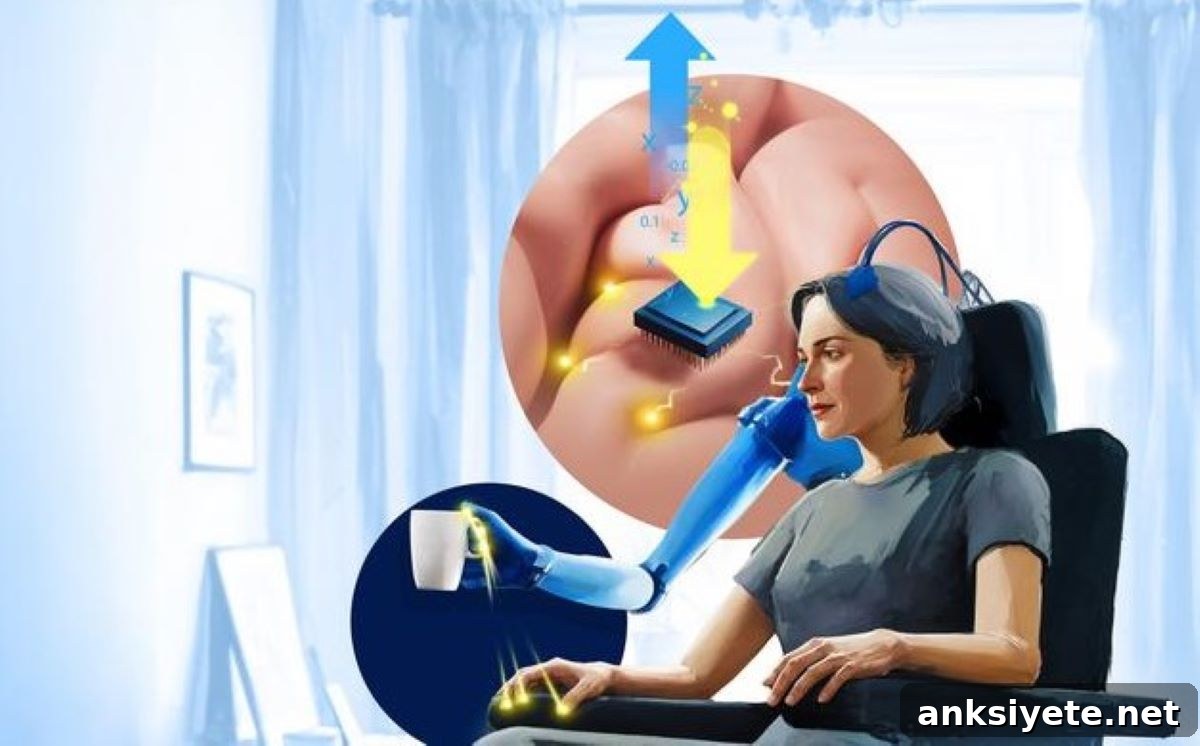
Summary: Researchers are advancing methods to restore touch to prosthetic limbs by stimulating the brain’s tactile regions. Using intracortical electrodes placed in the primary somatosensory cortex, teams have produced stable, precisely localized sensations and, with patterned stimulation, recreated motion and shape perception on the hand. These developments bring neuroprosthetics closer to delivering useful, intuitive tactile feedback for everyday tasks.
This progress could allow prosthetic users to perform fine motor tasks with greater confidence. Long-term testing shows consistent locations for evoked sensations—an essential feature for practical, daily use—while patterned stimulation provides richer, more natural-feeling touch experiences.
Key Facts:
- Stable Sensations: Intracortical microstimulation (ICMS) produced sensations that remained localized and consistent across months and years, supporting reliable use.
- Dynamic Touch: Sequential and patterned activation of electrode clusters produced perceptions of motion and contours, enabling users to sense objects sliding across the skin and to recognize simple shapes or letters.
- Broad Applications: The technique has potential beyond limb prosthetics, including restoring tactile perception after surgeries such as mastectomy.
Source: University of Chicago
Everyday tasks we take for granted—typing, pouring a drink, buttoning a shirt—depend heavily on touch and proprioception. When those senses are reduced or absent, simple actions become difficult and risky.
Remove proprioception—the awareness of body position and movement—and people must constantly watch their hands to avoid spills, breakage or injury. “Most people don’t realize how often they rely on touch instead of vision,” said Charles Greenspon, PhD, a neuroscientist involved in the research.
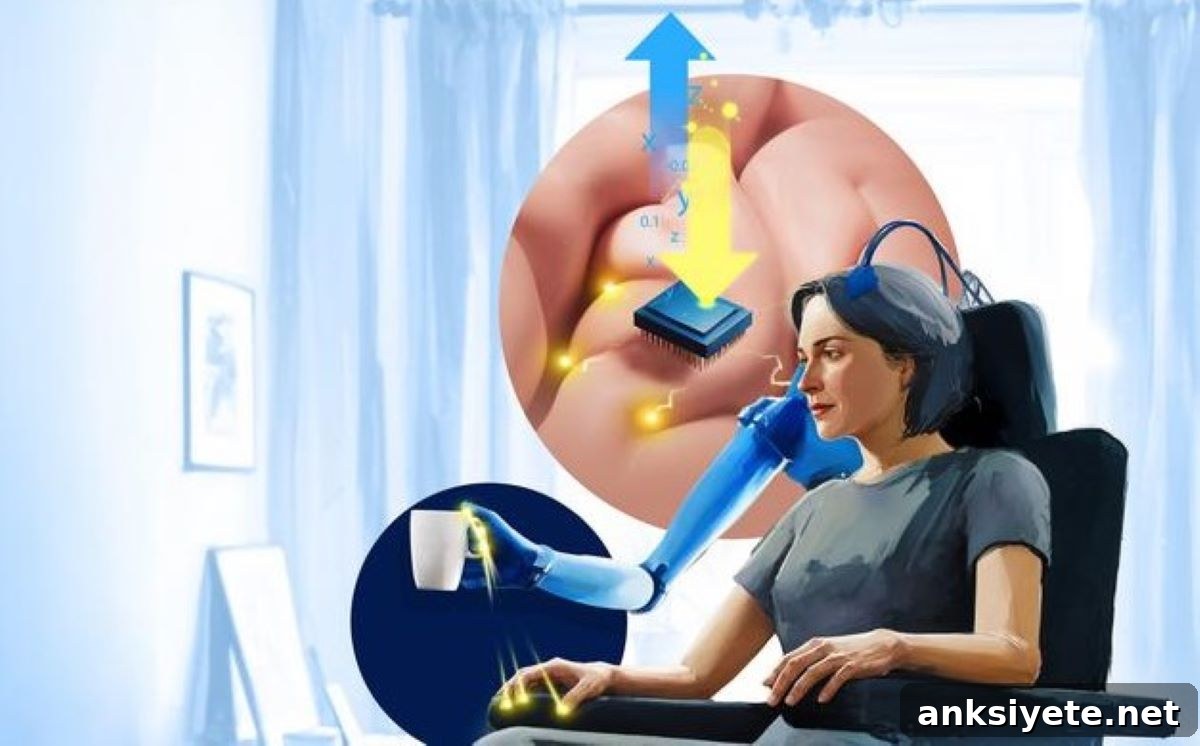
Greenspon and collaborators published complementary studies in Nature Biomedical Engineering and Science that document advances in delivering tactile feedback through precisely timed electrical pulses applied to the somatosensory cortex. Their work builds on multi-institutional collaborations involving UChicago, the University of Pittsburgh, Northwestern, Case Western Reserve and industry partners.
The science of restoring sensation
The approach relies on implanting small electrode arrays into brain regions that represent the hand. Motor-control arrays allow participants to drive a robotic arm through intention, while sensors on that arm convert contact and force into electrical stimulation—intracortical microstimulation (ICMS)—delivered to the brain’s touch area.
For years, ICMS mostly conveyed simple contact signals—an on/off feeling that was often weak or poorly localized. The new studies overcome several of those limitations by refining electrode use, stimulation patterns and long-term testing.
Advancing artificial touch: stability and precision
In the Nature Biomedical Engineering study, the team mapped how individual electrodes project sensations to specific regions of the hand. By delivering brief pulses and recording where participants perceived touch, researchers built detailed somatotopic maps and tested the consistency of those percepts over time.
They found that stimulating closely spaced electrodes together produced stronger, more localizable sensations than single-electrode pulses. Importantly, the perceived locations of sensations were stable: an electrode that elicited a thumb sensation on day one typically produced a similar thumb sensation months or years later. This stability is crucial for a clinically useful device because it reduces the need for frequent recalibration and helps users form reliable sensorimotor expectations.
Creating motion and shape perception
A Science paper led by Giacomo Valle explored how overlapping projected fields from nearby electrodes can be exploited to evoke perceptions of motion and edges. Sensory zones produced by electrodes overlap rather than forming discrete, tiled patches. By activating specific electrode clusters in carefully timed sequences, researchers generated a sensation that participants described as a smooth glide moving across their fingers—even though stimulation occurred in discrete steps.
Sequential activation improved the ability to recognize complex tactile shapes and respond to dynamic events. In tests, participants could sometimes identify letters traced electrically on the fingertips and could use a bionic hand to steady a slipping object such as a steering wheel. These patterned stimulation strategies leverage the brain’s natural capacity to integrate fragmented inputs into coherent percepts.
Implications and future directions
Researchers aim to refine electrode designs and surgical placement to increase coverage and resolution across the hand. Integrating findings from both stability-focused and pattern-based studies into robotic systems could further improve control of brain-driven prostheses. Prior work already shows that even basic stimulation strategies improve performance when people control robotic arms with their thoughts.
The overarching goal is to enhance independence and quality of life for people with limb loss or paralysis. The team is also exploring applications beyond limb prosthetics, such as restoring touch after mastectomy through related implantable devices.
While technical and clinical challenges remain, these studies demonstrate that restoring meaningful touch is becoming increasingly feasible. Each advance brings us closer to prosthetic devices that not only restore function but also provide rich sensory experiences that mirror natural touch.
About this neurotech and neuroprosthetics research news
Author: Grace Niewijk
Source: University of Chicago
Contact: Grace Niewijk, University of Chicago
Image credit: Chalmers University of Technology | Boid | David Ljungberg
Original Research:
Tactile edges and motion via patterned microstimulation of the human somatosensory cortex — Science (closed access)
Evoking stable and precise tactile sensations via multi-electrode intracortical microstimulation of the somatosensory cortex — Nature Biomedical Engineering (open access)
Abstract — Tactile edges and motion via patterned microstimulation of the human somatosensory cortex
Intracortical microstimulation (ICMS) of somatosensory cortex can evoke tactile sensations whose features depend on stimulation parameters. Current ICMS approaches provide a limited sense of touch, constraining dexterity and tactile experience. By leveraging knowledge of how tactile features are encoded in primary somatosensory cortex (S1), researchers delivered spatially and temporally patterned ICMS through electrodes with overlapping projected fields to evoke sensations of edges and controlled apparent motion. These spatiotemporal patterns improved perception of local geometry and motion across the skin, enhancing users’ tactile experience while operating brain-controlled bionic hands.
Abstract — Evoking stable and precise tactile sensations via multi-electrode intracortical microstimulation of the somatosensory cortex
Tactile feedback for brain-controlled bionic hands can be partially restored via ICMS of the primary somatosensory cortex. Percept location depends on electrode position, and intensity depends on stimulation parameters. In a systematic study of three participants with cervical spinal cord injury, projected fields were typically composed of focal hotspots with diffuse borders and were somatotopically organized and stable over time. Single-electrode stimulation often produced weak percepts, but overlapping projected fields from multiple electrodes yielded more intense, localizable sensations and enabled more precise use of a bionic hand.