
Summary: New research indicates that spite — a psychological response tied to feelings of uncertainty, threat, or disadvantage — plays a significant role in why people accept conspiracy theories. Analyses of data from about 1,000 participants show that spiteful motives strengthen the connection between conspiracy thinking and core needs for understanding, security, and social significance.
Rather than being a deliberate choice, spite appears to arise when people feel powerless or disadvantaged, making them more receptive to rejecting expert opinions and scientific consensus. The study’s authors argue that effective responses to misinformation should include attention to the social and economic drivers of disenfranchisement, not just fact-checking and counter-messaging.
Key Findings
- Spite as a central factor: Higher levels of spite were consistently associated with stronger beliefs in conspiracy theories.
- Triggered by disadvantage and uncertainty: Spiteful responses commonly emerged when participants felt uncertain, threatened, undervalued, or otherwise at a competitive disadvantage.
- Policy implications: Reducing conspiracy beliefs likely requires addressing broader social and economic inequalities in addition to improving science communication.
Source: Staffordshire University
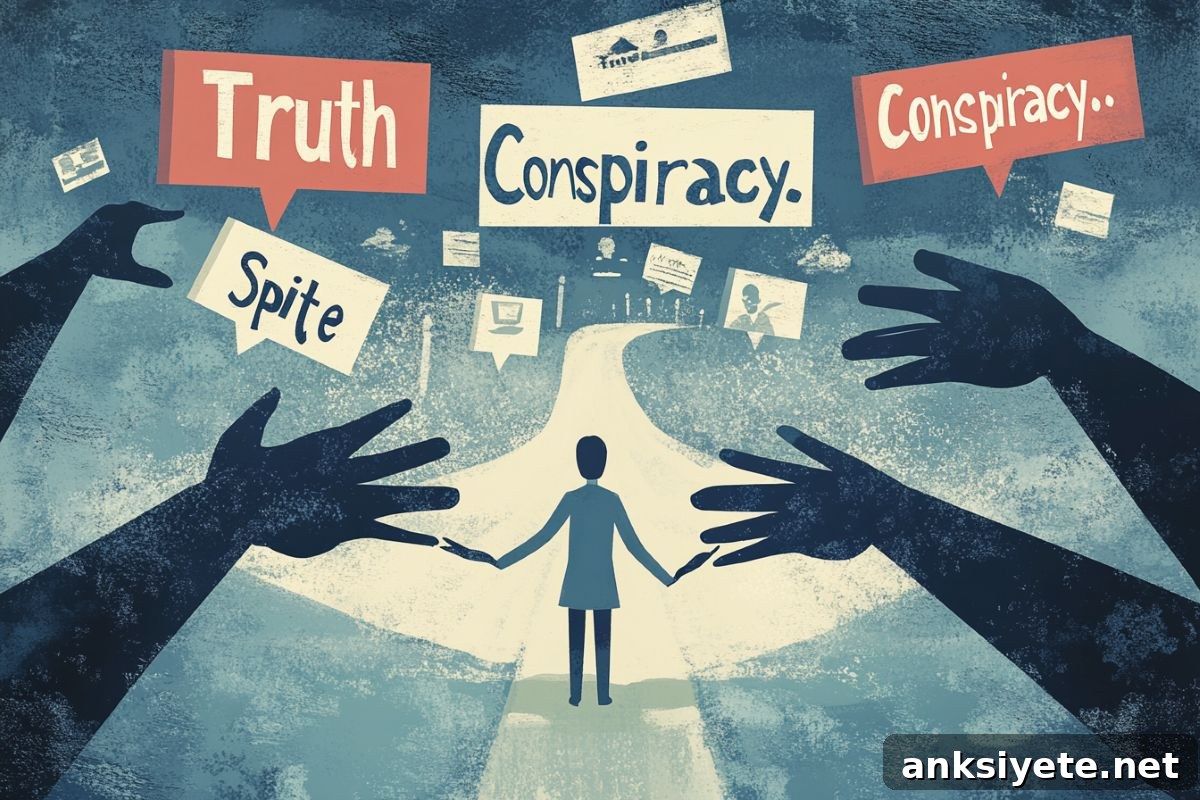
Why do people believe conspiracy theories? New research points to spite as an influential psychological mechanism.
Conspiracy theories—alternative explanations for important events that reject well-supported accounts in favour of secret, often implausible plots—have become more visible in recent years, particularly during crises. A new series of studies by psychologists at the University of Staffordshire and the University of Birmingham, published in the Journal of Social Issues, offers evidence that spitefulness is an important psychological driver behind such beliefs.
Lead researcher Dr David Gordon (University of Staffordshire) explains that “spiteful psychological motives tend to emerge when people feel at a competitive disadvantage, often when we feel uncertain, threatened or undervalued.” From this perspective, spite can be understood as a desire to “level the playing field” by undermining others, a motivation that conspiracy theories can satisfy by encouraging rejection of experts and mainstream explanations.
Across three studies involving roughly 1,000 participants in total, the researchers investigated how spite interacts with three established motivations for conspiracy thinking: epistemic motives (the need to understand the world), existential motives (the need for safety and security), and social motives (the need for social significance and esteem). The combined findings indicate that higher spite levels made participants more likely to endorse conspiracy beliefs, and that spite helped explain (mediated) the relationship between the three motivational drivers and conspiratorial thinking.
Dr Megan Birney (University of Birmingham), a co-author, emphasizes that the research does not portray conspiracy belief as a conscious, spiteful choice. Rather, “feelings of disadvantage in those three areas can provoke a common psychological—spiteful—response that makes individuals more receptive to believing conspiracy theories.” In other words, felt insecurity, uncertainty, or social marginalization can trigger spite, which in turn increases openness to misinformation and science denial.
Among the motivational factors studied, the strongest link involved uncertainty about the world. The authors suggest that clear, accessible science communication and improved media literacy around complex topics could help reduce the uncertainty that feeds spiteful responses and, by extension, conspiracy belief. However, they also stress that communication efforts alone are unlikely to be sufficient.
The broader implication is that initiatives to counter conspiracy theories should combine accurate, empathetic communication with policies that reduce social and economic precarity. If conspiracy belief can function as a reaction to real or perceived injustice and insecurity, then long-term reduction in misinformation and science denial may require action on underlying issues such as financial insecurity, social exclusion, and inequality.
About this conspiracy theory and psychology research news
Author: Amy Platts
Source: Staffordshire University
Contact: Amy Platts – Staffordshire University
Image: The image is credited to Neuroscience News
Original Research: Open access.
“Spite and Science-Denial: Exploring the Role of Spitefulness in Conspiracy Ideation and COVID-19 Conspiracy Beliefs” by David Gordon et al., Journal of Social Issues.
Abstract
Spite and Science-Denial: Exploring the Role of Spitefulness in Conspiracy Ideation and COVID-19 Conspiracy Beliefs
Science denialism underlies many conspiracy beliefs. The authors propose that these beliefs can be viewed as manifestations of a broader social process: spite. In three pre-registered studies, they tested whether known predictors of conspiracy belief—epistemic, existential, and social motives—act as cues of competitive disadvantage that trigger a common “spiteful” psychological response, increasing openness to conspiracy explanations.
Study 1 (N = 301; UK representative Prolific sample) found that spite mediated the links between realistic threat and in‑group narcissism (social motives), political powerlessness (existential motive), and intolerance of uncertainty (epistemic motive) with general conspiracy belief and COVID‑19 conspiracies. Study 2 (N = 405; UK representative Prolific sample) replicated this pattern. In Study 3 (N = 405; UK representative Prolific sample), participants who completed a spite-inducing task reported higher spite, which indirectly led to stronger conspiracy beliefs. Collectively, these results provide initial evidence that spite may help explain why people engage with and endorse false information. The paper discusses implications for research and public policy.