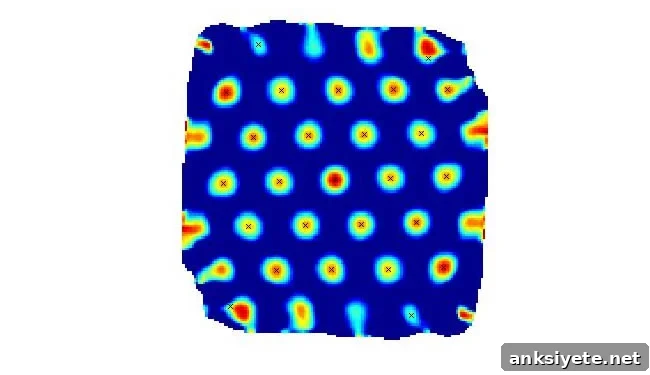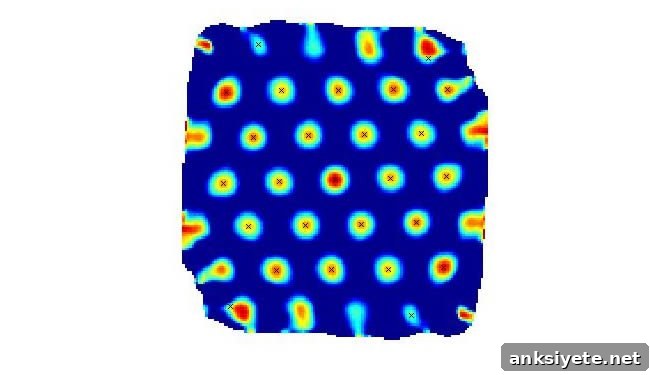
Grid cells, a specialized type of neuron that helps the brain form internal maps for spatial navigation, have been identified in two additional brain regions of the rat: the presubiculum and the parasubiculum. Until recently, most research on grid cells focused on the medial entorhinal cortex, where these cells were originally characterized. The new findings expand our understanding of the neural circuitry that supports spatial mapping and suggest that multiple connected areas contribute to the brain’s ability to represent location and navigate the environment.
Better understanding of mapmaking in the brain
Researchers at the Norwegian University of Science and Technology (NTNU), working at the Kavli Institute for Systems Neuroscience, report that grid cells appear intermingled with head direction cells and border cells in the presubiculum and parasubiculum. This observation, published in the August issue of Nature Neuroscience, highlights that the neural network responsible for creating internal maps extends beyond the medial entorhinal cortex and includes upstream regions that provide important inputs to that area.
Grid cells are known for producing a striking hexagonal firing pattern that provides geometric coordinates for locations in an environment. In combination with place cells, which signal specific locations, head direction cells, which encode orientation like an internal compass, and border cells, which respond to environmental boundaries, grid cells contribute to a multi-scale, multi-component spatial mapping system. Together these cell types allow animals to form stable internal representations of space, recognize landmarks, and plan routes.
The discovery of grid cells in the presubiculum and parasubiculum is significant because these regions are major sources of input to the medial entorhinal cortex. Although the presubiculum and parasubiculum are distinct from the medial entorhinal cortex anatomically, they share functional connections and certain response properties. Finding grid cells in these upstream areas suggests that the circuit mechanisms that generate grid-like signals may be distributed across a broader network than previously appreciated. This distributed architecture could influence how grid patterns emerge, how stable they remain across environments, and how they interact with other spatial cell types.
Identifying grid cells in these additional regions opens new avenues for research into the origins of the grid signal and the computations that produce it. Scientists studying neural models of spatial coding will now consider how inputs from the presubiculum and parasubiculum shape activity in the medial entorhinal cortex and how these regions may work together to maintain coherent maps across different spatial scales. The presence of grid cells in multiple connected regions also raises questions about how grid patterns are coordinated across brain structures during learning, memory consolidation, and navigation.
Practically, this finding encourages researchers to broaden experimental focus when investigating the cellular and circuit-level foundations of spatial representation. Recording and manipulating activity in the presubiculum and parasubiculum, alongside medial entorhinal cortex and hippocampus, can yield a more complete picture of how mapmaking emerges from interacting networks of neurons. Such studies could clarify the relative roles of each region in generating grid patterns, integrating sensory and self-motion information, and anchoring internal maps to environmental cues.
Beyond basic neuroscience, a deeper understanding of the distributed network responsible for spatial mapping may inform computational models used in robotics and artificial navigation systems, where biologically inspired strategies for localization and path planning are valuable. Moreover, since spatial memory and navigation can be affected in neurological conditions, clarifying how multiple brain regions support map creation could ultimately help guide approaches to diagnosis or intervention.
Contact: Charlotte Boccara
Source: Norwegian University of Science and Technology