
Weak Connection Between Brain Hemispheres Redirects Language to the Wrong Side and Lowers Verbal IQ, Researchers Say
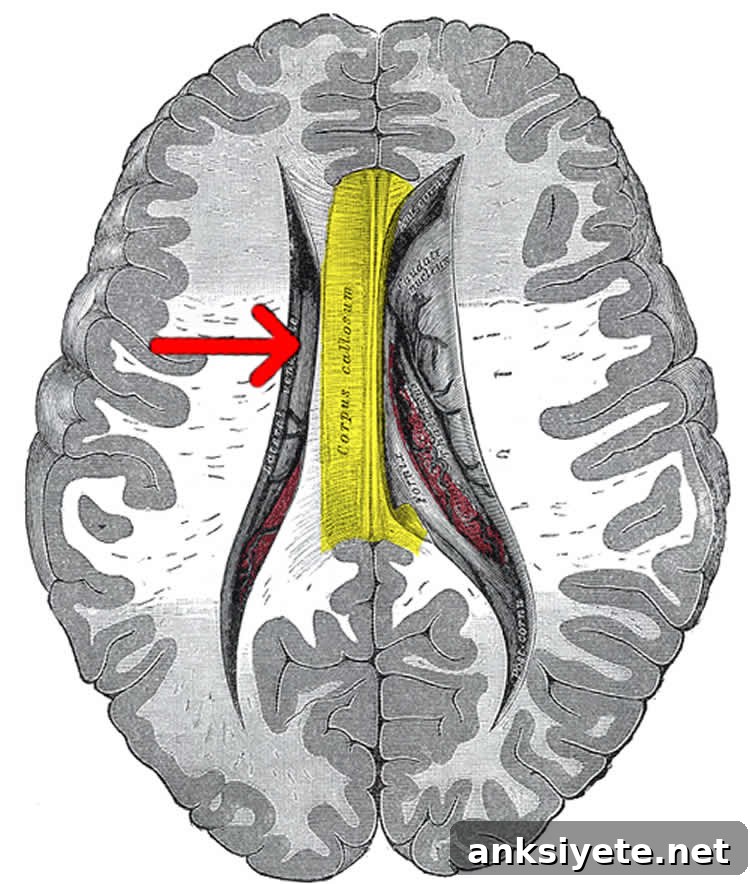
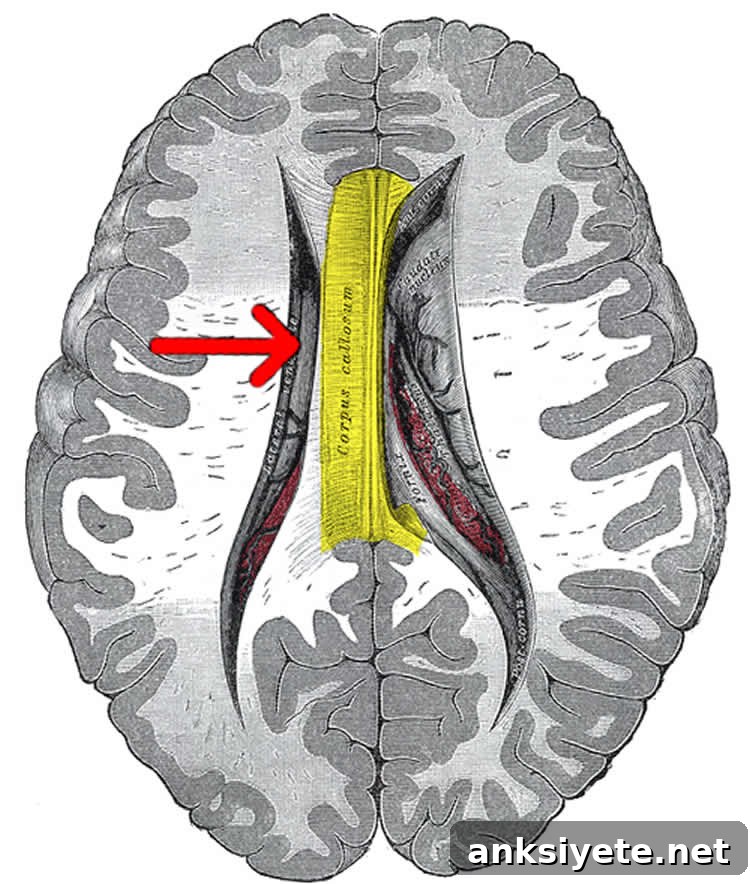
New research from the University of California, San Francisco (UCSF) shows that proper communication between the left and right hemispheres of the brain is essential for the development of advanced language skills. In most people, language processing is predominantly located in the left hemisphere. The UCSF team found that when the major bridge between the hemispheres—the corpus callosum—is missing or underdeveloped, language is more likely to be processed in the right hemisphere, and this shift is associated with lower performance on verbal tasks.
Study Overview and Methods
The study, published in the Journal of Neuroscience (April 20, 2016), is the largest investigation to date of individuals born without a normal corpus callosum. Lead investigators included neurologist Elliott Sherr, MD, PhD, and neuroscientist Srikantan Nagarajan, PhD. They focused on agenesis of the corpus callosum (AgCC), a congenital condition in which the callosal fibers that normally connect the two hemispheres are absent or only partially formed.
To determine how the absence of this hemisphere-connecting structure affects where language is localized, researchers used magnetoencephalography (MEG) to record high-resolution brain activity during language tasks. Participants performed verb generation and picture-naming tests while the team measured the tiny magnetic fields produced by coordinated neuronal activity. MEG’s subsecond temporal resolution allowed the researchers to observe the timing and localization of language-related cortical responses.
Participants
The study compared three groups: 21 neurotypical control subjects, 13 participants born with complete agenesis of the corpus callosum, and 12 participants born with partial agenesis. This cohort allowed the investigators to examine how the degree of callosal development correlates with language lateralization and verbal ability.
Key Findings
Neurotypical control subjects largely showed the expected left-hemisphere dominance for language. In contrast, individuals with complete agenesis were significantly more likely to activate right-hemisphere regions during linguistic tasks. Those with partial agenesis exhibited intermediate patterns, with more bilateral activity than controls but less rightward dominance than the complete agenesis group.
Importantly, the study found a clear relationship between language lateralization and verbal intelligence: greater left-hemisphere dominance correlated with higher verbal IQ scores. Participants whose language processing was shifted toward the right hemisphere tended to perform worse on standardized verbal measures. These results suggest that the corpus callosum plays a role in establishing or reinforcing left-hemisphere specialization for language during development, and that disruption of this mechanism can have measurable effects on verbal functioning.
Clinical Context and Implications
Agenesis of the corpus callosum is relatively rare, affecting an estimated one in 3,000 to one in 4,000 newborns. The corpus callosum normally forms between the 10th and 14th weeks of gestation and can be detected on routine prenatal ultrasound. Children with AgCC commonly show delays in language acquisition and may display intellectual disability or autism-like social and cognitive features, although outcomes vary widely and many individuals eventually learn to speak.
Dr. Sherr, who has treated and studied children with AgCC for more than a decade, notes that even higher-functioning individuals with this condition often experience language delays. Genetic studies led by UCSF investigators have linked some cases of AgCC to mutations in single genes, suggesting diverse developmental pathways can produce the condition.
From a therapeutic perspective, some clinicians are exploring ways to modify cross-hemispheric signaling in brain-injured patients, such as after stroke, but it remains unclear whether brain stimulation approaches could replicate the developmental role of the corpus callosum and promote normal language lateralization in young children.
Technical Notes on MEG and Timing
MEG detects magnetic fields generated by synchronous electrical activity in large populations of neurons, using superconducting sensors cooled in liquid helium inside shielded rooms. Because MEG can resolve changes in brain localization on the order of one tenth of a second, it is well suited to observe the rapid dynamics of language processing. The intention to speak typically unfolds over several hundred milliseconds before speech is produced, a timescale effectively captured by MEG.
The authors also observed a relationship between handedness and language localization consistent with prior work: right-handed individuals are overwhelmingly left-dominant for language, while a minority of left-handed people show right-hemisphere or more bilateral language organization. Some left-handers with rightward language localization are developmentally typical, but in other cases right-side language dominance has been associated with developmental difficulties.
Funding: The study received funding from the UCSF Program in Breakthrough Biomedical Research, the National Institutes of Health, and the National Science Foundation.
Source: Nicholas Weiler, UCSF
Image Source: Public domain image.
Original research citation: “The Contribution of the Corpus Callosum to Language Lateralization” by Leighton B.N. Hinkley, Elysa J. Marco, Ethan G. Brown, Polina Bukshpun, Jacquelyn Gold, Susanna Hill, Anne M. Findlay, Rita J. Jeremy, Mari L. Wakahiro, A. James Barkovich, Pratik Mukherjee, Elliott H. Sherr, and Srikantan S. Nagarajan. Journal of Neuroscience. Published online April 20, 2016. DOI: 10.1523/JNEUROSCI.3850-14.2016
Abstract Summary
The study tested whether the corpus callosum contributes to hemispheric specialization for language. Using magnetoencephalographic imaging during verb generation and picture-naming tasks, researchers compared 25 participants with agenesis of the corpus callosum (complete or partial) to 21 neurotypical controls. Controls showed strong left-hemisphere language activation. Participants with partial or complete agenesis displayed more bilateral or right-hemisphere activations, with complete agenesis showing the strongest rightward bias. In the AgCC group, greater left-hemisphere laterality correlated with higher verbal IQ. These results support the idea that the corpus callosum helps establish language lateralization and that its absence is linked to reduced verbal performance.