
Summary: An experiment investigating how the brain interprets artificial touch delivered through a finger neuroprosthesis has produced new insights and a promising method for assessing brain health.
Source: Lund University.
Swedish and Italian researchers collaborated to study how the brain decodes a virtual sense of touch created by a finger prosthesis with artificial sensation. Unexpectedly, their work produced a precise new tool for measuring neural network function and overall brain health.
“We could measure the cooperation between neural networks with very high precision and detail. We can also observe how the whole network reorganizes when new inputs arrive,” says neuroscience researcher Henrik Jörntell from Lund University.
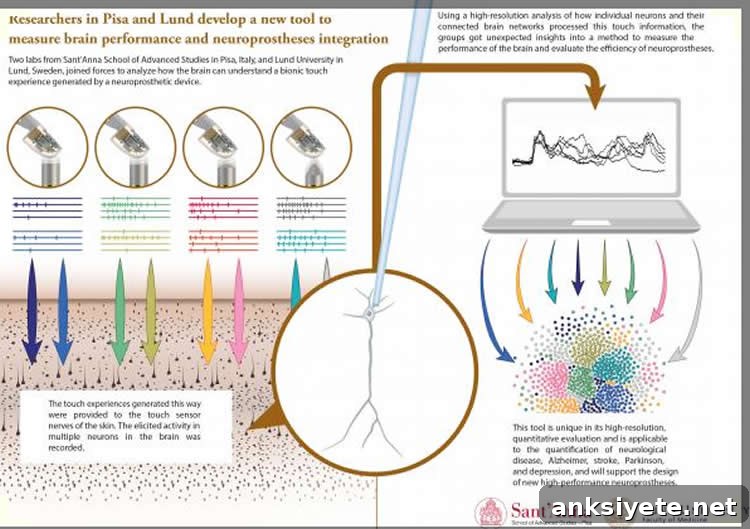
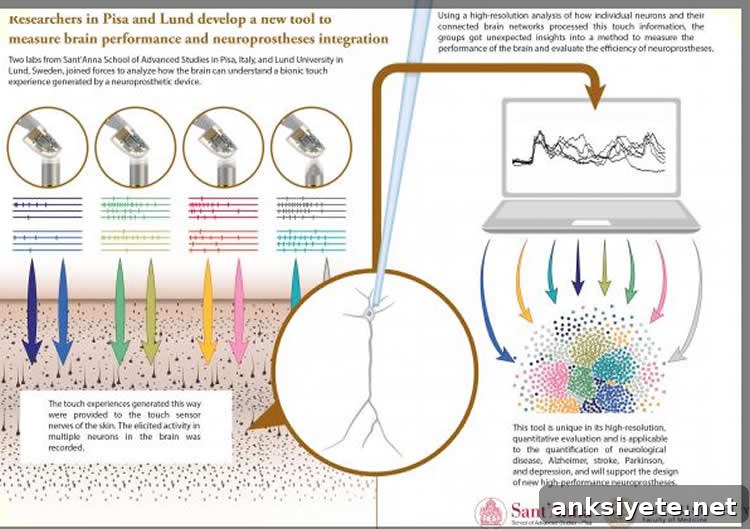
The Pisa–Lund team used a bionic fingertip—like those being developed for robotic upper-limb neuroprostheses—to generate controlled artificial touch patterns. Those tactile patterns were delivered as electrical spike sequences to the cutaneous sensory nerves of an anesthetized rat’s paw, effectively replaying tactile information to the brain. With high-resolution recordings and advanced analysis methods developed by neurocomputational scientist Alberto Mazzoni and physicist Anton Spanne, the researchers examined how individual neocortical neurons and their interconnected networks encoded those inputs.
The results revealed that single neurons carry far more information than previously appreciated and that neighboring neurons can combine complementary responses to produce very rich representations of tactile stimuli. This heterogeneity and complementarity among neurons enable a small population to support high decoding capacity for complex sensory inputs.
“This knowledge will inform a new generation of sensitive robotic hands capable of conveying fine tactile details to amputees,” says lead bioroboticist Calogero Oddo. Robotic systems with human-like tactile richness may also improve performance in surgical robotics, rescue operations, service tasks and industrial applications.
Brain function depends on large, complex neural networks. In neurological disorders such as Alzheimer’s disease, stroke and Parkinson’s disease, the organization and function of those networks change, but it has been difficult to precisely measure what is altered and to evaluate potential treatments. The method developed by the Swedish and Italian teams offers a way to probe network function objectively and reproducibly, which could be a major advance for studying disease models and therapy effects.
In the experiments, the prosthetic fingertip explored different objects to produce distinct spatiotemporal electrical patterns. These spike patterns were delivered repeatedly to sensory afferents in the rat’s second digit via a matrix of stimulation electrodes. Simultaneous low-noise intra- and extracellular recordings from neocortical neurons allowed the team to capture neural responses at very high resolution, because the artificial inputs could be replayed with exact reproducibility.
“With real-world touch it’s impossible to recreate identical conditions each time. Shifting the stimulus by only a few micrometres across the skin can change neural patterns entirely,” explains Henrik Jörntell. The artificial stimulation approach avoids that variability and makes it possible to assess how reliably networks encode touch information.
For researchers developing advanced prostheses, this method is a valuable tool for mapping and comparing the sensations a device can evoke. For neuroscientists, it provides a way to study how neurons cooperate within a healthy brain and in animal models of neurological disease. Because even localized damage can disrupt global network organization, the brain’s responses to controlled sensory inputs can serve as sensitive indicators of overall brain health.
“The technique is unique in its resolution, its reproducibility, and its capacity to measure brain activity objectively and precisely,” says Henrik Jörntell.
Funding: The research was performed by teams from SSSA (led by Calogero Oddo and Silvestro Micera) and Lund University (led by Henrik Jörntell). Projects and funding sources included the Italian Ministry of Foreign Affairs and International Cooperation, the Swedish Research Council via the Italy–Sweden SensBrain bilateral project, the EU FET NEBIAS project, the EU FP7 NANOBIOTOUCH project, the national PRIN/HandBot project, Hjärnfonden and the Swedish Research Council.
Source: Henrik Jörntell, Lund University.
Image credit: Matthew Walker and Bryce Mander.
Original research: “Artificial spatiotemporal touch inputs reveal complementary decoding in neocortical neurons” by Calogero M. Oddo, Alberto Mazzoni, Anton Spanne, Jonas M. D. Enander, Hannes Mogensen, Fredrik Bengtsson, Domenico Camboni, Silvestro Micera & Henrik Jörntell, published in Scientific Reports (April 4, 2017).
Abstract
Artificial spatiotemporal touch inputs reveal complementary decoding in neocortical neurons
Research on touch perception has been limited by the difficulty of producing invariant patterns of skin receptor activation. To generate reproducible spatiotemporal activation of sensory afferents, the team used an artificial fingertip equipped with an array of neuromorphic sensors. That fingertip converted real-world haptic stimuli into spike patterns, which were delivered to the skin afferents of the rat’s second digit through a stimulation electrode array. Combined with low-noise intra- and extracellular recordings from neocortical neurons in vivo, this approach enabled a previously unattainable, high-resolution analysis of tactile information representation in cortical circuits. Results demonstrate high information content in single neurons and reveal novel tactile coding features, including heterogeneous and complementary spatiotemporal input selectivity among neighboring neurons. Such heterogeneity and complementarity can support very high decoding capacity within a limited population of neurons. The findings also point to a neuroprosthetic approach capable of communicating with the brain at high resolution and suggest a potential method for evaluating the state or degree of neurological disease in animal models.
“Artificial spatiotemporal touch inputs reveal complementary decoding in neocortical neurons” by Calogero M. Oddo et al., Scientific Reports. Published online April 4, 2017.