
Summary: A new study finds a mismatch between neuronal activity and blood flow in the brains of newborn mice, offering insight into how the developing brain supplies itself with energy.
Source: Columbia University
Researchers identify a developmental mismatch between neuronal firing and blood flow in newborn mouse brains, revealing how the maturing brain establishes its blood supply and energy balance.
Scientists at Columbia University report that bursts of neuronal activity in young mice do not produce the immediate increases in blood flow seen in adult brains. This surprising discovery challenges long-held assumptions about neurovascular coupling from birth and has implications for interpreting functional magnetic resonance imaging (fMRI) in infants, understanding neonatal brain metabolism, and improving newborn care.
The findings were published in the Journal of Neuroscience.
“In adults, neural activity reliably triggers a localized increase in blood flow,” said Elizabeth Hillman, PhD, senior author of the study and principal investigator at Columbia’s Mortimer B. Zuckerman Mind Brain Behavior Institute. “Our data show that this neurovascular relationship is not present at birth but rather develops over the first days and weeks of life. This developmental process appears to be a critical element of healthy brain maturation and may be relevant to early childhood brain disorders.”
Motivated by earlier fMRI studies that reported atypical hemodynamic responses in human infants, the Columbia team set out to determine whether differences in fMRI signals reflected altered neural activity or a different relationship between neural activity and blood flow during development.
Mariel Kozberg, MD, PhD, first author on the study, explained: “We needed to know whether the infant brain simply behaves differently at the level of neurons, or whether the coupling between neurons and the local vasculature is immature. To answer that, we developed imaging techniques that could record neuronal signals and blood flow at the same time in mice across developmental stages.”
Using a novel, simultaneous imaging approach, the researchers stimulated each animal’s hind paw and compared neural responses and vascular responses across ages from newborn to adult. The team used wide-field calcium imaging to map neuronal activity across both cortical hemispheres while also measuring blood vessel dilation and oxygen dynamics.
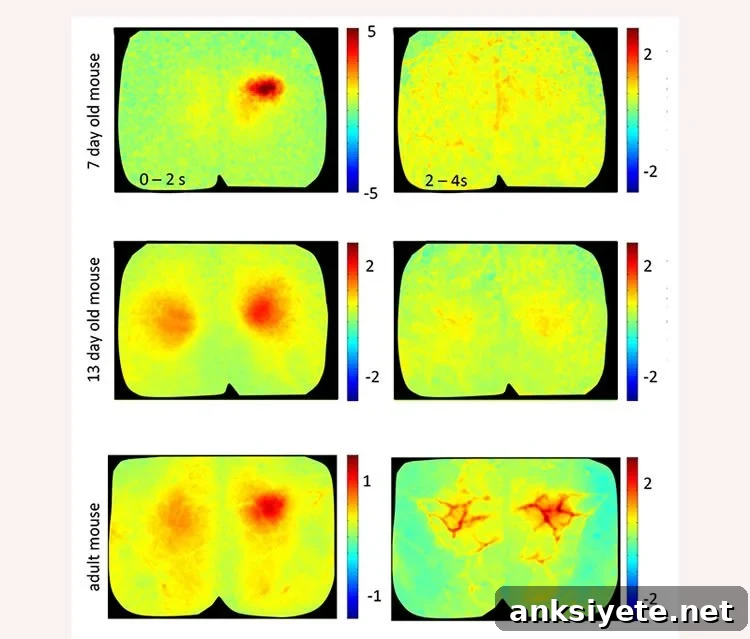
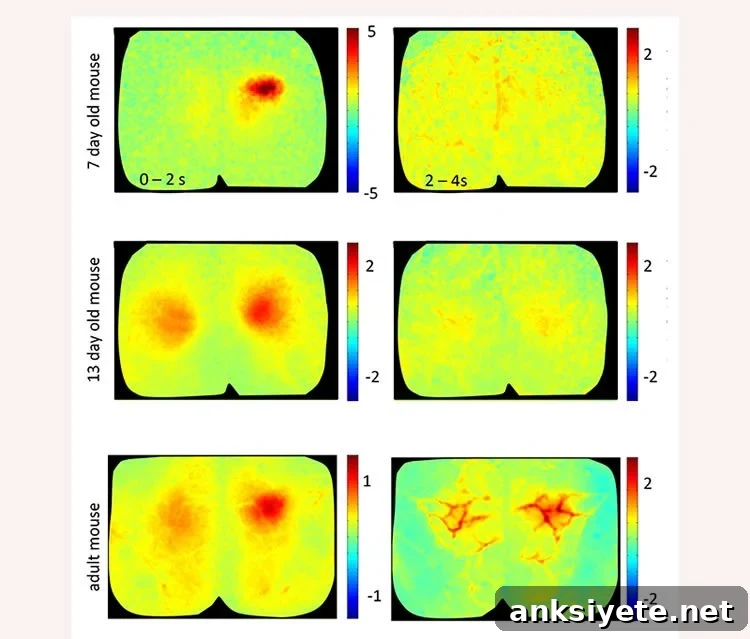
Early in development, hind-paw stimulation produced strong neuronal responses localized to a single cortical area. As the mice matured, the neuronal response expanded and became bilateral; by about 10 days of age, stimulation of the right paw first activated the left cortex and then propagated to the right, reflecting the formation of interhemispheric connections and the emergence of distributed neural networks.
“We were essentially watching neural networks form in real time,” Dr. Hillman said. “The progression from local, unilateral responses to widespread bilateral activity tracked the establishment of connectivity throughout the cortex.”
But crucially, the blood-vessel response followed a different timeline. In the youngest mice, robust neuronal activation did not produce the rapid, localized increases in blood flow that are typical in adults. Instead, functional hyperemia — the process by which active neurons receive an increase in blood supply — developed gradually as cortical connectivity matured. Only in adulthood did neuronal activation consistently evoke the expected blood-flow increase.
To probe the metabolic consequences of this mismatch, the researchers used flavoprotein fluorescence imaging to measure oxidative metabolism and local oxygen usage. They found that, in the youngest animals, neuronal activity consumed oxygen but was not followed by fresh blood delivery, producing transient local drops in oxygen — hypoxias — in response to stimulation.
“Newborns must manage dramatic changes in oxygen availability at birth,” noted Dr. Hillman. “The immature vasculature and its delayed coupling to neuronal activity may reflect an adaptive state that prepares the brain to tolerate fluctuating oxygen levels during early life.”
The authors suggest that these brief, activity-driven hypoxias could play a beneficial role: oxygen deprivation is a known stimulus for angiogenesis, so localized oxygen drops during neuronal activity might help guide blood vessels to grow where they are most needed, shaping the developing neurovascular network.
Looking ahead, the team plans to investigate whether similar neurovascular developmental signatures exist in humans. Dr. Hillman is collaborating with colleagues in Columbia’s Department of Psychiatry to reanalyze existing fMRI scans from newborns and children to search for comparable patterns. If confirmed in humans, these developmental markers could improve interpretation of infant fMRI and help detect or monitor early disruptions in brain development.
The researchers are also exploring how oxygen therapy and other medical interventions could affect blood-vessel growth in preterm infants. Excessive oxygen exposure is already linked to abnormal vascular growth in the eye (retinopathy of prematurity); the authors hypothesize that similarly altered oxygen levels might disrupt blood-vessel development in the brain.
“By better understanding the unique metabolic state of the developing brain, we hope to improve clinical strategies for premature or at-risk infants while also advancing knowledge of normal and abnormal brain maturation,” Dr. Hillman said.
Funding: Supported by the National Institutes of Health, the National Science Foundation, the Human Frontier Science Program, and the Kavli Foundation. The authors report no financial or other conflicts of interest.
Source: Anne D. Holden – Columbia University
Image credit: Hillman lab / Zuckerman Institute
Original research: Abstract for “Rapid postnatal expansion of neural networks occurs in an environment of altered neurovascular and neurometabolic coupling” by Mariel G. Kozberg et al., Journal of Neuroscience. Published online June 22, 2016. DOI: 10.1523/JNEUROSCI.2363-15.2016
Abstract
Rapid postnatal expansion of neural networks occurs in an environment of altered neurovascular and neurometabolic coupling
In adults, increased neural activity is coupled to local blood flow increases. Yet many prior studies, including fMRI in human infants, have reported altered or inverted hemodynamic responses in neonates. Here, the authors show that localized neural activity in early postnatal mice does not evoke the blood-flow increases seen in adults, and they trace how neural, vascular, and metabolic responses change with developmental age. Wide-field calcium imaging reveals that neural responses to somatosensory stimulation progress from localized, unilateral maps to bilateral patterns as interhemispheric connectivity forms. Simultaneous hemodynamic imaging demonstrates that functional hyperemia is absent during early postnatal stages and emerges gradually as connectivity strengthens. Measurements of oxidative metabolism via flavoprotein fluorescence indicate that early neural activity depletes local oxygen below baseline, a state confirmed by hemoglobin oxygenation dynamics for both stimulus-evoked and resting activity. This unmet metabolic demand during neural network development raises questions about mechanisms of neurovascular maturation and their roles in normal and disordered brain development, and it has important implications for interpreting fMRI in developing brains.
Significance: The study reveals that the maturation of neuronal connectivity is paralleled by the emergence of mechanisms that link neural activity to local blood flow. In the developing mouse brain, robust neural responses can occur without concurrent blood-flow increases, producing localized oxygen depletion. This altered metabolic environment may influence vascular growth and neural circuit formation, carrying implications for developmental disorders and for the interpretation of functional brain imaging in infants.