
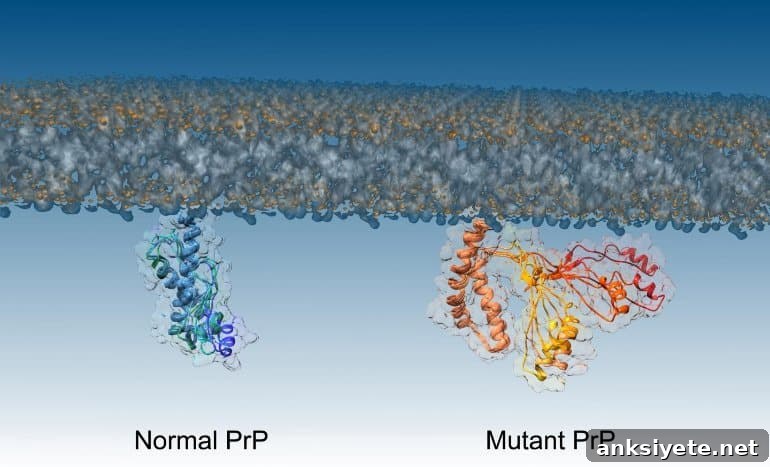
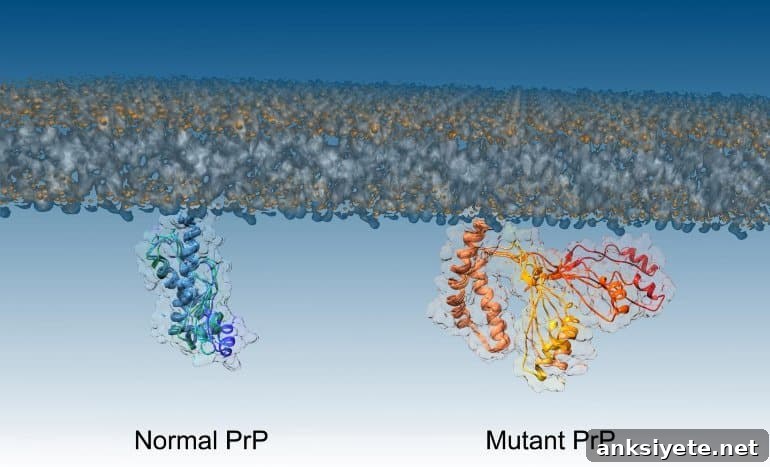
Summary: New research identifies the short-lived molecular step that converts healthy prion proteins into their disease-causing form, with implications for treating Creutzfeldt-Jakob disease, Kuru and other prion disorders.
Source: Imperial College London
Researchers have, for the first time, isolated the fleeting intermediate that drives normal prion proteins to misfold into their pathogenic form—an advance that opens a path toward targeted therapies for prion diseases such as CJD and Kuru.
A team from Imperial College London in collaboration with the University of Zurich combined high-resolution experimental methods and computational analysis to characterise the transient structural change that precedes prion aggregation. Their study, supported by Alzheimer’s Research UK, appears today in the Proceedings of the National Academy of Sciences (PNAS).
Prion diseases are fatal neurodegenerative disorders caused when the normal cellular prion protein (PrP) misfolds into an abnormal conformation that accumulates in the brain, damages neurons and ultimately leads to severe neurological decline. These illnesses—including Kuru, bovine spongiform encephalopathy (mad cow disease) and its human counterpart Creutzfeldt-Jakob disease (CJD), as well as inherited forms such as fatal familial insomnia—often incubate for years before progressing rapidly and fatally.
Although researchers have previously described both the healthy and pathogenic structures of prion proteins, the intermediate state that triggers the conversion remained elusive because it is extremely short-lived and difficult to observe directly.
To capture this elusive stage, the team studied a mutant version of the prion protein found in people with inherited prion disease. This mutant form transitions more readily to the pathogenic conformation, making the intermediate step easier to detect and analyse without altering the fundamental mechanism under study.
Isolating sufficient quantities of prion fragments for structural study posed a major technical challenge. Lead author Dr Máximo Sanz-Hernández pursued this problem over several years, developing methods at Imperial that enabled the purification and preparation required for detailed analysis.
The researchers employed nuclear magnetic resonance (NMR) spectroscopy together with intensive computational modelling to determine the structure and dynamics of the intermediate. This combined biophysical and in silico approach allowed them to map the precise molecular rearrangements that initiate misfolding and aggregation.
Armed with a model of the intermediate conformation, the team partnered with colleagues at the University of Zurich to generate antibodies that specifically recognise and bind the misfolding mechanism. In a proof-of-concept experiment conducted in vitro, these antibodies blocked the transition from the normal to the pathogenic form, demonstrating that the mechanism is druggable.
The current antibody molecules used in the lab are too large to cross the blood-brain barrier efficiently, so they are not immediate therapeutic candidates. However, the demonstration that the intermediate can be targeted establishes a clear molecular goal for drug discovery: design smaller, brain-penetrant compounds or engineered biologics that disrupt the critical steps of prion conversion.
Professor Alfonso De Simone of Imperial’s Department of Life Sciences, the lead investigator, said understanding this intermediate is a key milestone: it identifies the structural features a therapeutic agent must recognise in order to prevent pathological misfolding. Dr Sanz-Hernández added that the intermediate stage had been “almost ghost-like” because of its transient nature, and that obtaining a structural picture will enable more precise intervention strategies.
Dr Rosa Sancho, Head of Research at Alzheimer’s Research UK, emphasised the technical difficulty and importance of studying small, unstable protein fragments: “This is early-stage research examining short protein fragments that are highly unstable and notoriously difficult to study. Funding sophisticated biophysical and computational work like this is vital to understand how fragments contribute to disease and to identify ways to reduce their impact in human neurodegeneration.”
With the mechanism now defined, the researchers hope pharmaceutical teams can screen existing libraries of small molecules and biologics to find candidates that disrupt the conversion process. Any promising compounds would then require extensive laboratory validation to confirm efficacy, safety and the ability to reach the brain in therapeutic concentrations.
Identifying a concrete structural target for prion misfolding accelerates the search for treatments by focusing efforts on molecules with the necessary properties to stabilise the normal protein or block the pathogenic transition. Although clinical therapies remain a future goal, this discovery supplies a clear roadmap for drug discovery and further mechanistic studies of protein misfolding in neurodegenerative disease.
About this neurology research news
Source: Imperial College London
Contact: Hayley Dunning – Imperial College London
Image: The image is credited to Imperial College London
Original Research: The findings will appear in PNAS (Proceedings of the National Academy of Sciences)