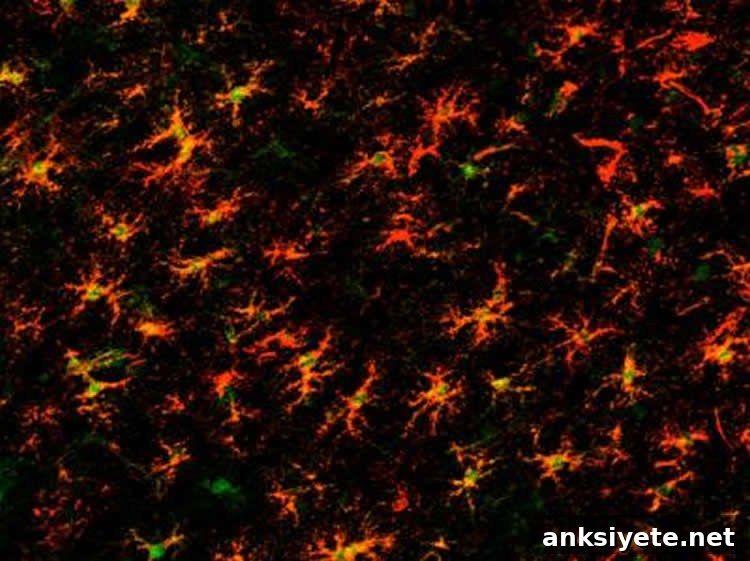
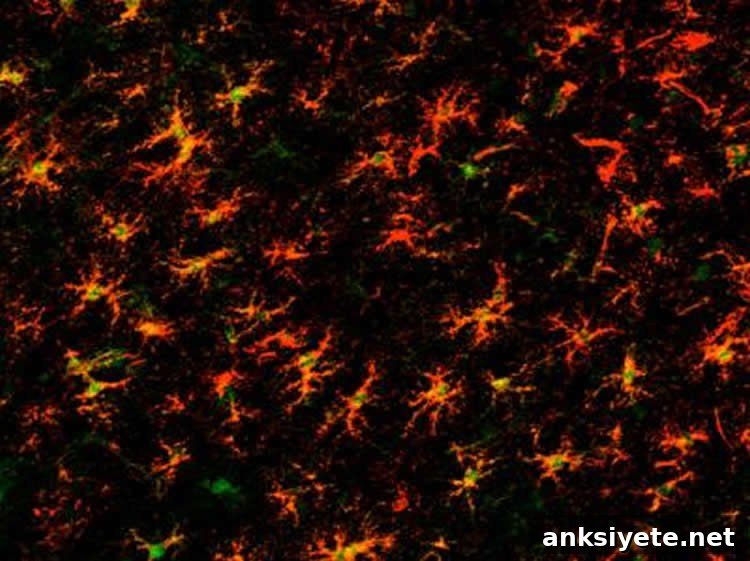
Summary: New research suggests that astrocytes — the brain’s star-shaped support cells — reactivate developmental programs during normal aging, which may drive loss of neuronal connections and contribute to cognitive decline. Targeting aged astrocytes could offer a way to prevent or reverse some age-related declines.
Source: Salk Institute.
Researchers at the Salk Institute report that genes normally active during early brain development to eliminate excess neuronal connections are reactivated in aging astrocytes. Published in Cell Reports on January 2, 2018, the study indicates that aged astrocytes may promote synapse loss and that modulating astrocyte function could be a promising therapeutic strategy to counteract healthy brain aging.
“Much of the work exploring how non-neuronal cells affect neuronal function has focused on astrocytes in developing brains,” says Nicola Allen, assistant professor in Salk’s Molecular Neurobiology Laboratory. “We wanted to know why neurons in otherwise healthy aging brains no longer communicate as effectively as they once did.”
Astrocytes, named for their star-like shape, comprise roughly one-third to one-half of brain cells and play vital roles in supporting neuronal health and function. Allen’s earlier work identified astrocyte-secreted proteins that promote the formation of active synapses — the connections that allow neurons to communicate. While synapse formation and pruning are dynamic during development and largely stable in adulthood, aging is associated with progressive synapse loss and reduced neuronal communication. Allen and graduate student Matthew Boisvert asked whether aging-related changes in astrocytes might underlie these alterations to synaptic connectivity.
To address this, the team compared gene expression in astrocytes from adult and aged mice, creating a region-specific profile of astrocyte activity. Boisvert examined four-month-old mice, considered adult, and two-year-old mice, representing advanced age in mice. They applied a molecular approach known as ribo-tag to capture which messenger RNAs (mRNAs) were actively being translated by astrocyte ribosomes. By isolating ribosomes from astrocytes and sequencing the mRNAs they carry, the researchers obtained a snapshot of genes being expressed as proteins in those cells.
The analysis covered astrocytes from four distinct brain regions: two cortical areas, the hypothalamus, and the cerebellum. Overall, many defining astrocyte features and core gene expression patterns remained stable with age. However, a striking and unexpected change emerged: aged astrocytes showed reactivation of gene programs that, during development, drive the elimination of synapses.
“Our results suggest that a genetic program normally active during development is re-engaged in aged astrocytes and that this program promotes neuronal disconnection,” Allen explains.
The changes were most pronounced in brain regions already known to show marked functional decline with age — the cerebellum and the hypothalamus. These regions are critical for coordination and metabolic regulation, respectively, which may help explain age-related declines in motor coordination and metabolism.
Boisvert adds, “The regional specificity we observed may help account for why certain brain functions decline more than others with age.”
The research team has made the astrocyte transcriptome data publicly available as a resource for other scientists studying aging and neurodegeneration. Their future work will compare the aging astrocyte profile with astrocytes from disease models to determine whether early, pre-pathological astrocyte changes facilitate progression to disease states.
Other contributors to this work include Galina Erickson and Maxim Shokhirev of the Salk Institute.
Funding: This research was supported by the Ellison Medical Foundation, the Chapman Foundation, the National Institutes of Health – National Institute of Neurological Disorders and Stroke, the Hearst Foundation, the Pew Foundation, the Dana Foundation, the Whitehall Foundation and the Helmsley Charitable Trust.
Source: Salk Institute
Publisher: Organized by NeuroscienceNews.com.
Image Credit: Salk Institute.
Original Research: “The Aging Astrocyte Transcriptome from Multiple Regions of the Mouse Brain” by Matthew M. Boisvert, Galina A. Erikson, Maxim N. Shokhirev, and Nicola J. Allen, published in Cell Reports (published online January 2, 2018). DOI: 10.1016/j.celrep.2017.12.039.
Salk Institute (2018, January 12). What Happens When Your Brain’s Support Cells Aren’t So Supportive? NeuroscienceNews.
Abstract
The Aging Astrocyte Transcriptome from Multiple Regions of the Mouse Brain
Highlights
- Provides astrocyte transcriptomes from multiple regions of adult and aged mouse brain
- Shows that astrocytes have region-dependent aging responses and become moderately reactive with age
- Aged astrocytes upregulate genes involved in synapse elimination and downregulate cholesterol synthesis pathways
- Most astrocyte-enriched genes are expressed differently between brain regions
Summary
Aging is accompanied by cognitive decline that correlates with reduced synapse number and function and altered brain metabolism. Astrocytes regulate synapse formation and neuronal function throughout life, but whether astrocyte properties change with aging and contribute to neuronal dysfunction was previously unclear. To address this, the authors generated RNA-seq transcriptomes of astrocytes from multiple brain regions in adult and aged mice, producing a comprehensive dataset available to the research community. The study identifies genes commonly altered by aging across regions as well as region-specific changes. Aging astrocytes maintain many homeostatic and neurotransmission-supporting genes, yet they upregulate synapse-elimination pathways and adopt some features of reactive astrocytes. Regional heterogeneity in synapse-regulating gene expression was observed between different cortical areas. Overall, aging-related alterations in astrocytes create an environment that favors synapse removal and potential neuronal damage, which may contribute to cognitive decline in normal aging.
Reference: “The Aging Astrocyte Transcriptome from Multiple Regions of the Mouse Brain” by Matthew M. Boisvert, Galina A. Erikson, Maxim N. Shokhirev, and Nicola J. Allen, Cell Reports, published online January 2, 2018. DOI: 10.1016/j.celrep.2017.12.039.