
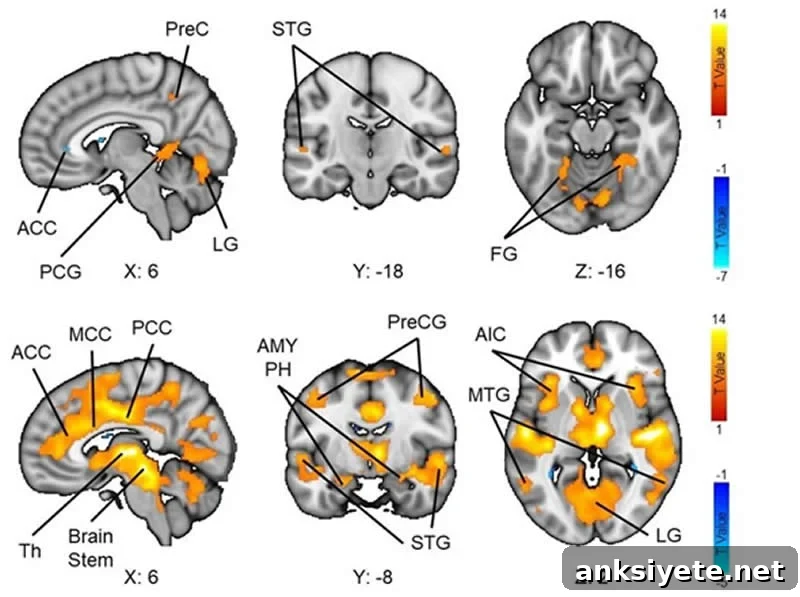
Summary: Neuroimaging shows that brain regions responsible for visual and auditory processing become more active as anxiety builds slowly during horror films. After sudden, shocking moments, activity increases in areas associated with emotion, threat assessment, and decision-making.
Source: University of Turku
Finnish researchers map how the brain responds while watching horror movies. A study from the University of Turku identifies the most influential horror films of the last century and describes how they modulate neural activity.
People are drawn to experiences that scare them—whether skydiving, riding roller coasters, or watching true-crime shows—so long as the danger remains safely distant. Horror films tap into the same attraction. While most movies present threats to characters’ wellbeing, horror raises the stakes by introducing threats that often feel supernatural or impossible to reason with, creating intense, visceral reactions.
The research team at the University of Turku set out to understand why audiences seek this kind of entertainment. They first compiled a list of the 100 most notable and fear-inducing horror films of the past 100 years and examined how those films affected viewers’ emotions and brain activity.
Unseen Threats Are the Most Terrifying
The study found that watching horror is common: 72% of respondents reported viewing at least one horror movie every six months. Beyond fear and anxiety, the main appeal is excitement. Horror films are also a social pastime—many people prefer viewing them with others rather than alone.
Participants ranked psychological horror and films based on real events as the scariest. Importantly, threats that are unseen or implied provoked stronger fear than threats that are plainly visible. This reflects two distinct kinds of fear: a creeping, anticipatory dread when something feels off, and an immediate, reflexive startle response to a sudden monster or jump-scare.
“This distinction mirrors two different fear experiences: the slow-building sense of dread when something feels wrong, and the instant jump caused by a sudden appearance,” explains Professor Lauri Nummenmaa of the Turku PET Centre, who led the study.
MRI Reveals How the Brain Reacts to Different Forms of Fear
To examine how the brain handles fear in a dynamic and natural context, researchers scanned participants with functional magnetic resonance imaging (fMRI) while they watched feature-length horror films. The aim was to capture brain activity across different time scales of fear: sustained anticipation versus acute shock.
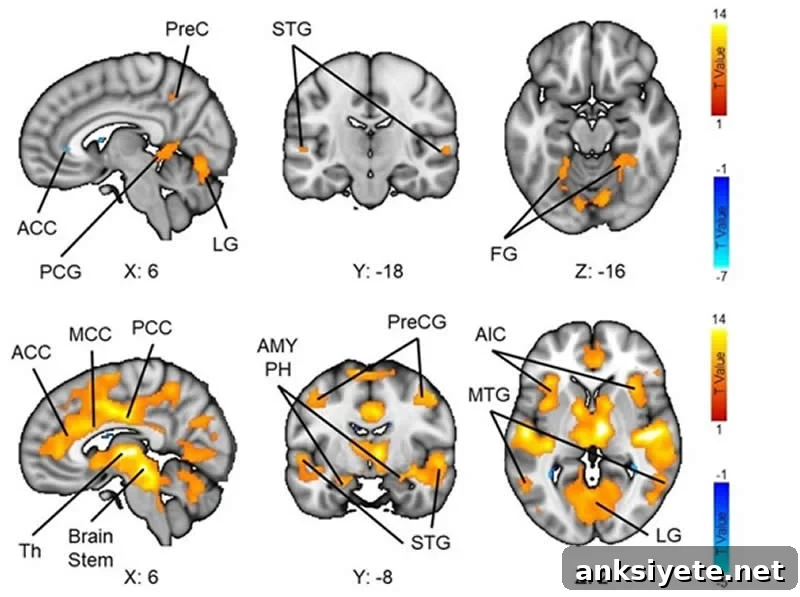
When anxiety rises gradually, sensory regions—areas involved in visual and auditory perception—show increased activity. This heightened sensory processing likely supports vigilance and the search for subtle cues that might signal danger. In contrast, sudden shocks or jump-scares trigger stronger responses in regions tied to emotion processing, threat evaluation, and rapid decision-making, preparing the viewer for immediate action.
The study also found ongoing interaction between sensory areas and higher-order response networks throughout the films. Sensory regions appear to prime networks involved in threat assessment and behavioral responses as the likelihood of a scary event grows, indicating continuous anticipation and preparation for action.
“Our brains continuously predict and prepare for threats, and horror films skillfully exploit this mechanism to amplify excitement,” says researcher Matthew Hudson.
The research team continues to gather audience responses through an active survey. Participation information is available from the study organizers.
Funding: This research was supported by NIA grant R01AG053155.
Source:
University of Turku
Media Contacts:
Lauri Nummenmaa – University of Turku
Image Source:
The image is credited to Lauri Nummenmaa.
Original Research: Open access
“Dissociable neural systems for unconditioned acute and sustained fear”. Lauri Nummenmaa, et al. Neurolmage. DOI: 10.1016/j.neuroimage.2020.116522.
Abstract (summary)
The study examined how sustained anticipatory fear and acute reactive fear are processed in the human brain. Using naturalistic fMRI, 37 participants watched feature-length horror films while their hemodynamic activity was recorded. Researchers applied time-varying intersubject correlation measures to assess how reliably brain activity synchronized across viewers, and used phase-based connectivity analyses to track dynamic functional interactions. Participants also provided continuous ratings of perceived fear, allowing the team to relate neural synchronization and connectivity to emotional intensity.
Results indicate that sustained fear primarily amplifies sensory processing, increasing synchronization in cortical regions that process visual and auditory cues. Acute fear, by contrast, engages subcortical and limbic structures such as brainstem regions, the thalamus, amygdala, and cingulate cortices, which support rapid threat responses. Sustained fear heightened intersubject correlation in areas involved in acute fear and strengthened functional connectivity across these networks. Findings were replicated in an independent sample using a different film, demonstrating a robust distinction between neural pathways for gradual anticipation and sudden defensive reactions. Overall, the data reveal a dynamic interplay between cortical networks that anticipate threat and subcortical systems that execute immediate responses, with interaction patterns changing according to perceived threat proximity and the demands of threat appraisal and decision-making.