
Researchers stimulate the brain to produce GM1 ganglioside, a protective molecule reduced in the brains of Parkinson’s patients.
Current treatments for Parkinson’s disease can relieve symptoms but do not reliably slow the disease’s progression. In 2013, the lipid molecule GM1 ganglioside showed promise for both symptom relief and potential slowing of disease progression, but practical obstacles have limited its clinical deployment. GM1 is difficult to manufacture, challenging to deliver across the blood–brain barrier, and commercial supply has relied on extraction from animal brain tissue. Researchers at Thomas Jefferson University have now demonstrated an alternative strategy: stimulating the brain to convert its own ganglioside molecules into GM1. Their findings, reported in PLOS ONE, show that increasing endogenous GM1 production can be neuroprotective in a mouse model of Parkinson’s disease.
“GM1 ganglioside has shown real potential in Parkinson’s patients,” says lead author Jay Schneider, Ph.D., Professor in the Department of Pathology, Anatomy and Cell Biology at the Sidney Kimmel Medical College at Thomas Jefferson University. “Because manufacturing and delivering GM1 systemically are problematic, we investigated whether it is possible to encourage the brain to generate more of its own GM1.”
GM1 ganglioside is naturally produced by neurons, but levels are substantially lower in individuals with Parkinson’s disease and other neurodegenerative disorders. Earlier clinical and preclinical work suggested that administration of GM1 can improve symptoms and slow progression. However, most prior GM1 used in studies was derived from bovine brain tissue, raising manufacturing constraints and potential safety concerns. GM1 is also not readily synthesized at scale. Faced with these limitations, Dr. Schneider and colleagues explored a different approach: enzymatically converting existing brain gangliosides into GM1.
Through literature review, the investigators identified a sialidase enzyme capable of converting polysialogangliosides—such as GT1b, GD1a, and GD1b—into GM1. They tested this approach in a well-established mouse model of Parkinson’s disease. The team delivered Vibrio cholerae sialidase (VCS) directly into the brain by continuous infusion using an osmotic minipump placed in the dorsal third ventricle. After beginning the sialidase infusion, the mice were treated with the neurotoxin MPTP to induce Parkinsonian pathology, and outcomes were evaluated two weeks after the final toxin exposure.
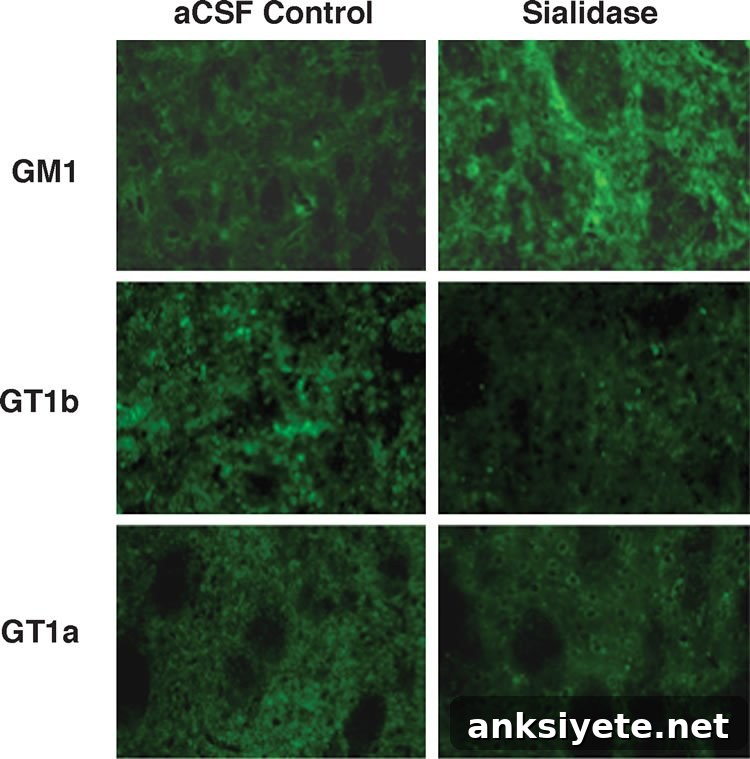
The infusion of VCS produced the expected biochemical shift: a significant increase in GM1 levels accompanied by reductions in the precursor gangliosides. Importantly, mice treated with sialidase showed partial neuroprotection following MPTP exposure. The sialidase-treated animals displayed greater sparing of striatal dopamine content and increased survival of dopaminergic neurons in the substantia nigra compared with control animals. The degree of neuron preservation in sialidase-treated mice was similar to that observed in mice given systemic GM1 in prior experiments.
“Seeing that enzymatic conversion could achieve neuroprotection in the mouse model was very encouraging,” Dr. Schneider says. Because long-term enzyme delivery to the brain via implanted pumps is not ideal for clinical application, the team is exploring gene therapy approaches to raise GM1 levels more sustainably and safely. These gene-based strategies aim to enable neurons to express enzymes that increase GM1 biosynthesis or convert existing gangliosides into GM1, potentially avoiding repeated infusions or reliance on animal-derived products.
Raising GM1 ganglioside levels in the brain could have therapeutic relevance beyond Parkinson’s disease. Reduced GM1 has been implicated in other neurodegenerative conditions such as Huntington’s disease and Alzheimer’s disease, and approaches that restore neuronal GM1 may offer wider neuroprotective benefits. Dr. Schneider and collaborators are pursuing novel gene-therapy approaches to boost neuronal GM1 content and plan to evaluate their neuroprotective potential in additional preclinical studies. Provisional patents related to these technologies have been filed.
Funding: This research was supported by the Michael J. Fox Foundation. The authors report no conflicts of interest.
Source: Thomas Jefferson University
Image credit: Schneider et al./PLOS ONE
Abstract
Intraventricular Sialidase Administration Enhances GM1 Ganglioside Expression and is Partially Neuroprotective in a Mouse Model of Parkinson’s Disease
Background
Preclinical and clinical studies have demonstrated that systemic administration of GM1 ganglioside can exert neuroprotective and neurorestorative effects in Parkinson’s disease models and in some patients. Clinical development of GM1 has been limited by its animal origin, issues with large-scale production, and limited penetration of the blood–brain barrier after systemic dosing.
Objective
To evaluate an alternative to systemic administration of brain-derived GM1: increasing brain GM1 levels via enzymatic conversion of polysialogangliosides into GM1 and to determine whether this enzymatic approach provides neuroprotection in a mouse Parkinson’s disease model.
Methods
Sialidase from Vibrio cholerae (VCS) was used to convert GD1a, GD1b and GT1b gangliosides to GM1. VCS was delivered by osmotic minipump into the dorsal third ventricle of mice over four weeks. After one week of infusion, mice received MPTP injections (20 mg/kg, subcutaneously, twice daily, four hours apart, for five consecutive days) and were analyzed two weeks after the final injection.
Results
VCS infusion produced the intended changes in ganglioside composition, including a significant increase in GM1 levels. Sialidase-treated animals showed significant sparing of striatal dopamine and preservation of substantia nigra dopamine neurons after MPTP treatment, with levels of sparing comparable to those achieved by systemic GM1 administration in prior studies.
Conclusion
Enzymatic conversion of polysialogangliosides to GM1 represents a promising strategy to increase brain GM1 levels and to provide partial neuroprotection to the nigrostriatal dopaminergic system in Parkinson’s disease models.